
India’s SFDR Breakthrough: How a Missile That ‘Breathes’ Air Changes the Aerial Combat Game
India’s SFDR Breakthrough: How a Missile That ‘Breathes’ Air Changes the Aerial Combat Game
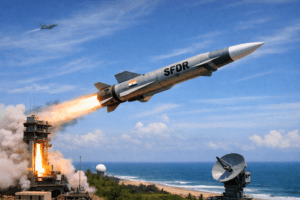
On February 3, 2026, India’s Defence Research and Development Organisation (DRDO) marked a seminal moment in its defense technology history. At precisely 10:45 AM from the Integrated Test Range (ITR) in Chandipur, Odisha, a missile system roared to life, demonstrating the flawless performance of India’s indigenous Solid Fuel Ducted Ramjet (SFDR) technology. With this success, India has officially joined an elite group of nations—including the United States, Russia, France, and China—that possess this advanced air-breathing propulsion system.
This achievement is far more than a successful test; it represents a fundamental shift in the capabilities of India’s air power. SFDR is the core technology that will power a new generation of long-range air-to-air missiles (BVRAAMs), granting Indian fighter pilots a decisive tactical edge by allowing them to engage enemy aircraft from vastly greater distances with missiles that remain fast and agile until the moment of impact.
The Core Principle: Why “Breathing” Air Is a Game-Changer
To grasp the significance of SFDR, one must first understand the limitation of conventional missiles. A standard rocket-powered missile, like many in service today, carries both fuel and a chemical oxidizer. Once ignited, it burns fiercely and accelerates rapidly, but it then coasts to its target after its motor burns out. In the critical final phase of flight, it slows down, losing energy and maneuverability, which makes it easier for a skilled pilot to evade.
The SFDR turns this concept on its head. It is an air-breathing propulsion system. Think of it as a jet engine for a missile. Instead of carrying a heavy oxidizer, it ingeniously uses the missile’s own high-speed forward motion to scoop up and compress atmospheric oxygen from the surrounding air. This oxygen is then mixed with a solid fuel grain (often boron-based for high energy) burning inside a duct, creating continuous thrust.
This fundamental difference creates a stark tactical advantage, as summarized below:
| Feature | Conventional Rocket-Powered Missile | SFDR-Powered Missile |
| Propulsion Cycle | Boost-coast: Short, violent burn, then unpowered glide. | Sustained burn: Continuous thrust throughout mid and terminal flight. |
| Oxidizer | Carries heavy onboard oxidizer (e.g., ammonium perchlorate). | Uses atmospheric oxygen; no need for onboard oxidizer. |
| Weight & Range | Heavier due to oxidizer; limits fuel/payload capacity. | Lighter, can carry more fuel or a larger warhead, extending range significantly. |
| Terminal Phase | Loses speed and energy; less maneuverable. | Maintains high speed (Mach 2-3.8) and energy; highly agile and harder to evade. |
| Pilot’s Advantage | Must get relatively closer to target; post-launch energy loss. | Can engage from safer, beyond-visual ranges with high kill probability. |
Decoding the Test: A Symphony of Indigenous Engineering
The recent demonstration was a validation of this complex symphony of engineering. The test followed a meticulously choreographed sequence:
- The Nozzle-Less Booster Kick: The system was first propelled by a unique ground-based, nozzle-less booster. This component is critical as it must accelerate the vehicle to around Mach 2, the minimum speed required for the ramjet effect to start working efficiently.
- The Ramjet Takes a Breath: Once at the required speed, the SFDR motor ignited. Air intakes on the missile’s body captured the supersonic airflow, compressed it, and channeled it into the combustion duct.
- Precision Control in a Supersonic Furnace: Here, the fuel flow controller played its vital role. Regulating the combustion of solid fuel in a supersonic airflow is one of the technology’s greatest challenges. The controller, using indigenously developed advanced materials, managed this process to ensure stable, sustained thrust.
- Verification and Validation: The entire flight profile, achieving speeds over Mach 3, was tracked by an array of instruments along the Bay of Bengal coast. The captured data confirmed that all subsystems performed in “textbook precision”.
The development has been a journey of persistent iteration. DRDO began this project in 2013, with the first partial test in 2018, followed by progressive successes in 2019, 2021, and a pivotal test in December 2024 that saw an SFDR-propelled missile successfully knock out an aerial target. The February 2026 test stands as the definitive demonstration of a mature, ready-to-integrate technology.
Strategic Imperative: More Than a Technological Trophy
For India, mastering SFDR is a strategic imperative with multi-layered benefits:
- A Transformative Tactical Edge: The primary application is in next-generation Beyond Visual Range Air-to-Air Missiles (BVRAAMs). An SFDR-powered missile like the projected Astra Mark-3 (Gandiva) could engage hostile aircraft at ranges estimated between 150 km to over 300 km. A pilot can launch from a safe distance, confident that the missile will not only reach that distance but will do so while retaining the speed and energy to chase down a maneuvering target. This dramatically expands the “no-escape zone” for adversaries.
- The Pillar of Self-Reliance (Aatmanirbhar Bharat): Before this, only a handful of global defense giants held the keys to this technology. By developing SFDR indigenously through a consortium of DRDO labs like the Defence Research and Development Laboratory (DRDL) and Research Centre Imarat (RCI) in Hyderabad, India has broken a critical technological dependency. This means future missile systems can be developed, produced, and upgraded domestically, without geopolitical strings or supply chain vulnerabilities.
- Versatility for Integrated Defense: While initially for air-to-air combat, the SFDR technology is inherently adaptable. Experts note it can be the heart of future long-range surface-to-air missile (SAM) systems, enhancing India’s air defense network against everything from enemy aircraft to cruise missiles. This flexibility ensures the massive R&D investment pays dividends across multiple domains of warfare.
- A Statement on the Global Stage: Entering this exclusive club is a powerful statement of India’s advanced engineering and systems integration capabilities. It places the country in a position of strength in the high-stakes arena of aerial combat technology, a domain where technological superiority often dictates strategic outcomes.
Beyond SFDR: The Horizon of Hypersonic Ambition
The mastery of ramjet technology is not an end point, but a crucial stepping stone. The natural progression in propulsion is toward **scramjets (Supersonic Combustion Ramjets)**—engines capable of operating at hypersonic speeds (Mach 5 and above). While a ramjet slows incoming air to subsonic speeds for combustion, a scramjet combusts fuel in a supersonic airflow, an immensely more complex challenge.
The SFDR program has given Indian scientists and engineers invaluable, hands-on experience in managing the physics of high-speed air intake, thermal management, and stable combustion at extreme velocities—all foundational knowledge for the hypersonic leap. The global race for hypersonic weapons is intensifying, with major powers investing heavily. India’s proven success with SFDR provides a credible foundation from which to approach this next frontier, ensuring it is not left behind in a critical future technology.
Conclusion: The Dawn of a New Era in Indian Air Power
The successful SFDR demonstration is a quiet revolution. There were no explosive geopolitical pronouncements, just the serene flight of a missile off the Odisha coast, meticulously tracked by scientists. Yet, its implications are profound. In the near future, when Indian Air Force Sukhoi Su-30MKIs or Rafales are armed with SFDR-powered missiles, the tactical calculus in the region will shift.
It grants the pilot the power of the first look, first shot, and first kill from unprecedented ranges. It embodies India’s shift from a buyer to a builder of the world’s most sophisticated weapon systems. Most importantly, it signals that the nation’s defense technological imagination is now focused firmly on the horizon, mastering the art of making missiles that breathe fire from the air itself.
You must be logged in to post a comment.