
India’s Russian Oil Shift: A Temporary Pause or a Strategic Realignment?
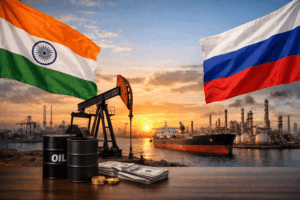
India’s Russian Oil Shift: A Temporary Pause or a Strategic Realignment?
For over two years, India’s oil import strategy has been a masterclass in pragmatic geopolitics. Since the onset of the Ukraine conflict in February 2022, the world’s third-largest crude importer deftly pivoted from its traditional Middle Eastern suppliers to become the largest buyer of discounted Russian oil. At its peak, Russian crude constituted nearly 40% of India’s imports—a staggering leap from less than 1%. However, recent data from analytics firm Kpler reveals a startling reversal: imports are projected to plunge to 1.2 million barrels per day (bpd) in December 2025, down sharply from 1.84 million bpd in November and marking the lowest monthly volume since December 2022.
This sudden dip has sent ripples through global energy markets, prompting a critical question: Is this the beginning of a fundamental realignment in India’s energy security blueprint, or merely a tactical pause in the face of short-term turbulence?
Decoding the December Drop: Sanctions and Supply Chain Snafus
Analysts point to a confluence of immediate, external pressures as the primary drivers behind the decline, rather than a voluntary shift in Indian policy.
- The US Sanctions Hammer: The most significant catalyst was the enforcement of fresh US sanctions on November 21, 2025, targeting Russian energy giants Rosneft and Lukoil, along with their majority-owned subsidiaries. For Indian refiners, this introduced substantial compliance risks. Entities like Reliance Industries (RIL), which has significant international exposure, and public sector undertakings like Hindustan Petroleum, quickly moved to temporarily halt imports from these sanctioned entities to protect their global financial operations and avoid secondary sanctions.
- The Ripple Effect of EU Measures: Concurrently, the European Union’s evolving sanctions regime on Russian-linked product flows complicated shipping, insurance, and payment logistics. The intricate web of “shadow fleets” and intermediary traders that had facilitated the Russia-India trade came under strain, disrupting established supply chains.
- The Refinery Retreat: The impact is refinery-specific. Major buyers like RIL and the Mangalore Refinery and Petrochemicals Ltd. (MRPL) significantly scaled back purchases. The notable exception is Nayara Energy, partly owned by Rosneft, which continues its reliance on Russian feedstock. This selective retreat underscores that the pullback is a risk-management exercise, not a blanket embargo.
The Structural Foundation: Why a Full Breakup is Unlikely
Beneath this temporary decline lies a robust structural logic that suggests a likely recovery, albeit potentially at reconfigured levels.
- The Irresistible Economics of Discounts: The foundational pillar of the India-Russia oil trade remains price. Even with recent narrowing, Urals crude typically trades at a significant discount to Brent. For a price-sensitive market like India, which spends colossal amounts on energy imports, these discounts are a vital tool for managing the current account deficit, inflation, and subsidizing domestic fuel prices. The economic imperative is simply too strong to ignore permanently.
- Diversification as a Strategic Goal, Not a Reaction: India’s energy policy has long been anchored in the principle of diversification to enhance security and bargaining power. The Russian import spree was itself a successful diversification away from Middle Eastern dominance. The current pause may accelerate efforts to bring in more barrels from sources like the US, Africa, and Latin America, but the goal is to expand the portfolio, not to replace one primary supplier with another. Russia has cemented itself as a key, permanent member of this diversified basket.
- The “New Intermediary” Adaptation: The global oil trade is notoriously adaptable. As Sumit Ritolia, Lead Research Analyst at Kpler, notes, the expectation is for imports to “recover gradually from January as new intermediaries step in and supply chains re-establish.” The market is already working to create new non-sanctioned entities and payment mechanisms (like continued use of UAE dirhams or other currencies) to circumvent the hurdles. This rerouting may add minor costs, but it is unlikely to derail the trade entirely.
The Broader Canvas: Geopolitics and the Domestic AI Revolution
This oil import narrative is unfolding alongside a transformative domestic announcement that signals India’s future economic priorities. Reliance Industries Chairman Mukesh Ambani’s unveiling of a draft “AI Manifesto” is profoundly symbolic. His call to transform Reliance into an “AI-native deep-tech company” and drive a “tenfold improvement in productivity” highlights a strategic pivot from brute-force commodity processing to knowledge and technology-led growth.
This parallel development offers an insightful lens: India’s long-term strategy is to leverage its current economic advantages—like cheap energy imports—to fuel its ascent into a higher-value, technology-driven economy. Affordable energy today funds the investments for the AI-powered tomorrow.
The Road Ahead: A More Nuanced, Compliant Partnership
Looking forward, the India-Russia oil trade is likely to evolve into a more nuanced, mature, and compliance-focused relationship.
- A Gradual Rebound: Expect imports to recover from the December lows through early 2026, but they may stabilize at a level below the 2023-2024 peaks, perhaps around 30-35% of India’s import mix, as diversification efforts bear fruit.
- The Refinery Divide: The gap between refiners with large international ambitions (like RIL) and those with a purely domestic focus will widen. The former will operate with extreme caution regarding sanctions, while the latter may continue more aggressive buying if compliant routes are established.
- The Geopolitical Tightrope: India will continue its delicate balancing act. It will maintain its strategic autonomy, defending its right to secure affordable energy for its 1.4 billion citizens, while publicly and privately urging for a peaceful resolution in Ukraine. Its actions will remain a testament to “strategic pragmatism.”
Conclusion: A Tactical Retrenchment, Not a Strategic Retreat
The sharp decline in December 2025 is a clear indicator of the global oil market’s sensitivity to geopolitical shocks and regulatory actions. However, labeling it as the end of the India-Russia energy partnership would be a misreading of the deep economic and strategic currents at play.
This episode is best understood as a tactical retrenchment. It demonstrates India’s acute sensitivity to compliance risk in an increasingly complex sanctions environment. Yet, the underlying drivers—economic necessity, energy security through diversification, and a dynamic, adaptable global commodity market—remain firmly intact. The dance between New Delhi and Moscow, mediated by traders in Dubai and shaped by edicts from Washington and Brussels, will continue. It will just involve more intricate steps, with India expertly navigating the rhythm of sanctions to the enduring beat of its own national interest. The pipeline may have momentarily tightened, but it is far from being shut off.
You must be logged in to post a comment.