
India’s Rural Lifeline at a Crossroads: Can the World’s Largest Jobs Scheme Survive Its Own “Overhaul”?
India’s Rural Lifeline at a Crossroads: Can the World’s Largest Jobs Scheme Survive Its Own “Overhaul”?
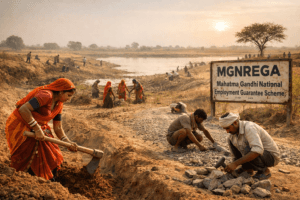
For nearly two decades, it has been a quiet revolution woven into the fabric of rural India. A woman in Rajasthan, her sari tucked securely, digs a water-conservation trench. Men in Bihar repair a rural road under the harsh sun. In Karnataka, a community revives a desiccated lake. These scenes, enacted by millions, are powered by the Mahatma Gandhi National Rural Employment Guarantee Act (MGNREGA)—once hailed as a global beacon for poverty alleviation. Today, this groundbreaking social programme finds itself at a precarious juncture, its future reshaped by a new law that supporters call modernisation and critics decry as a fundamental dilution of a hard-won legal right.
The Bedrock of Rural Resilience
To understand the stakes, one must first appreciate what MGNREGA achieved. Born in 2005 as the NREGS, it was radical in its simplicity and guarantee: every rural household could legally demand 100 days of unskilled manual labour at minimum wage. In a nation where nearly half the population depends on an agrarian sector contributing just 16% to GDP, it was more than a scheme; it was a social security lifeline.
Its brilliance lay in its design. By tying wages to work, it preserved dignity while building rural infrastructure. Its self-targeting mechanism—manual labour attracts those in genuine need—and its provisions for timely payment and unemployment allowances embedded accountability. The results were transformative. Studies, including an influential one by economists Muralidharan, Niehaus, and Sukhtankar, quantified its impact: a 14% boost in household earnings, a 26% reduction in poverty. It empowered women, who comprise over half its workforce, and uplifted Scheduled Castes and Tribes, granting them economic agency and slightly shifting the power balance in villages. During crises, like the demonetisation shock or the catastrophic COVID-19 pandemic migration, it acted as a vital automatic stabiliser, absorbing desperate workers flooding back to villages.
The Rebranding and the Radical Restructuring
Last week’s legislation, the Gramin Rozgar aur Mazdoor Guarantee (GRAM G) Act, does more than just drop Mahatma Gandhi’s name—a move laden with political symbolism. It enacts structural changes that alter the scheme’s very financial and philosophical core.
On the surface, there are expansions: the guarantee increases from 100 to 125 days per household. Yet, as development economist Jean Drèze sharply notes, this is a “red herring.” Data from advocacy group LibTech India reveals that in 2023-24, only 7% of households received the full 100 days. The constraint was never the legal ceiling but the availability of funds and work. Raising an unattained limit, critics argue, is cosmetic.
The seismic shift is in the funding model. The original scheme operated on a 90:10 cost share between the central government (covering all wages and most materials) and the states. GRAM G flips this to a 60:40 split for most states. While the central government retains supreme control over notification and allocation, the financial onus on states balloons. Simultaneously, states remain legally liable to provide work or pay unemployment allowances.
The government frames this as empowering states and enhancing efficiency. Federal Agriculture Minister Shivraj Singh Chouhan states the new law “stands firmly in favour of the poor.” The official narrative is one of weeding out corruption, leveraging technology, and creating more productive assets.
The Central Contradiction: Centralised Control vs. Decentralised Burden
The critics’ fear is a paradox: hyper-centralisation of decision-making with a decentralisation of financial burden. This, they warn, creates a perfect storm to cripple the guarantee.
- The Fiscal Stranglehold: Wealthier states may cope, but poorer, high-demand states—precisely where the scheme is most needed—could be financially throttled. A state facing a drought or economic shock may see demand spike but lack the resources to co-fund the 40%, leading to artificial suppression of work or delayed wages, violating the law’s core promise.
- The Discretionary Danger: A clause allowing the centre to decide “where and when” the scheme applies transforms a universal right into a discretionary handout. This, warns Drèze, reduces an “employment guarantee to a discretionary scheme.”
- The Accountability Vacuum: If a state fails to provide work, who is accountable? The state pleads lack of central funds; the centre points to state administration. The citizen’s legal recourse becomes mired in a blame game.
This concern prompted an unprecedented open letter from over 70 international scholars, led by UN Special Rapporteur Olivier De Schutter, urging the Indian government to reconsider, warning that diluting MGNREGA “would be a historic error.”
A Mirror to India’s Deeper Economic Malady
The fierce debate over GRAM G holds up a mirror to India’s most persistent economic challenge: the chronic failure to generate quality, non-farm jobs. MGNREGA’s enduring relevance is a symptom of this deeper malaise.
As economist Nitin Pai argues, the scheme is a “steroid” treating a serious illness. It cushions distress but does little to raise long-term agricultural productivity or spur industrial employment. The government’s own Economic Survey 2023-24 questions the scheme’s targeting, noting that richer states like Tamil Nadu and Kerala draw disproportionate funds, suggesting demand is often driven by administrative capacity rather than poverty alone.
Yet, this critique misses a crucial point. In an economy where recent rises in labour force participation—especially among women—are driven by “distress rather than growth,” as a paper by Ghatak, Jha, and Singh finds, MGNREGA provides a vital floor. It offers a wage higher than exploitative market rates for landless labour, gently pushing up private wages and allowing families to survive lean seasons without falling into debt bondage or desperate migration.
The Path Ahead: Preservation or Erosion?
The revamped scheme now walks a tightrope. Its success or failure will hinge on implementation:
- Will the centre provide timely, adequate allocations to states based on realistic demand, not political expediency?
- Will states ramp up administrative capability and treat their 40% share as a priority investment, not a burden?
- Can transparency be enhanced so that fund flows and work demand are publicly trackable, preventing misuse?
The world watches. For years, MGNREGA has been a case study in development economics—a model of rights-based social policy that inspired similar efforts globally. Its potential undermining is not merely a domestic policy shift; it signals a retreat from a powerful idea: that the state has a legal obligation to guarantee its most vulnerable citizens a basic right to work.
The final verdict will be written in the fields and villages. If a woman in Odisha or a landless worker in Uttar Pradesh can still demand—and reliably receive—work within 15 days, the spirit of the guarantee survives. If they face closed gates, opaque excuses, or endless payment delays, then a cornerstone of rural India’s resilience will have been fundamentally eroded, not by repeal, but by restructuring. The GRAM G Act has not killed the world’s largest jobs guarantee scheme, but it has placed its beating heart under unprecedented strain. The coming months will reveal whether it can still sustain the lives of hundreds of millions.
You must be logged in to post a comment.