
India’s Rural Digital Awakening: How Technology is Reshaping Villages Beyond Infrastructure
India’s rural digital transformation is reshaping villages far beyond basic connectivity, driven by massive infrastructure expansion under the Digital India Program that has brought internet access to over 95% of villages and pushed rural internet users past urban numbers. Technology is increasingly enabling economic empowerment through precision agriculture, digital payments, e-commerce, telemedicine, and online education, while also redefining aspirations by reducing the need for migration and creating local opportunities, especially for rural youth and women.
However, a deep “unseen divide” persists, as low digital literacy, shared device usage, limited productive use of the internet, and rising cybersecurity risks prevent many rural users from fully benefiting from connectivity. Bridging this gap now requires moving beyond infrastructure to deep digital literacy, vernacular and rural-first technologies, stronger economic linkages, and scalable smart village models, ensuring rural Indians shift from passive digital consumption to active participation and creation in the digital economy.
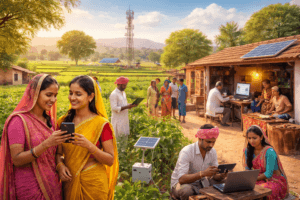
India’s Rural Digital Awakening: How Technology is Reshaping Villages Beyond Infrastructure
Across India’s vast rural landscape, a quiet revolution is unfolding, one mobile data connection at a time. From 134 million users in 2017, rural internet adoption has swelled to an estimated 488 million today, officially surpassing urban user numbers. This isn’t just about connectivity statistics; it represents a profound socio-economic shift where technology is moving from being a luxury to the very “backbone of opportunity,” as described by Gaurav Chopra of IAMAI. However, beneath this narrative of explosive growth lies a more complex story of aspiration, adaptation, and a persistent divide that defines the true challenge and potential of a digitally empowered rural India.
The Infrastructure Leap: From Digital Darkness to Connected Villages
The foundation of this transformation is an unprecedented push in digital infrastructure, a core pillar of the national Digital India Program (DIP). Government data reveals a staggering expansion: total internet subscribers in India grew from 251.59 million in March 2014 to 954.40 million in March 2024, a compound annual growth rate of over 14%. The most telling statistic is that as of April 2024, approximately 95.15% of India’s over 644,000 villages have access to internet with 3G/4G mobile connectivity.
This connectivity boom has been fueled by both public investment and private enterprise. Flagship projects like BharatNet aim to provide high-speed broadband to all Gram Panchayats (village councils), with over 2.13 lakh already made service-ready. Telecom giants like Airtel, Jio, and Vodafone Idea are now intensely focused on rural expansion, deploying thousands of new sites and exploring technologies like Fixed Wireless Access (FWA) and satellite services to reach the most remote areas. The economic incentive is clear: rural data consumption is soaring, and with it, the average revenue potential per user.
Beyond Connectivity: How Rural India is Using the Internet
Access is only the first step. The true measure of transformation lies in usage. Rural users now spend nearly 1.5 hours daily online, matching their urban counterparts. But crucially, this time is increasingly devoted to productive and life-enhancing activities:
- Economic Empowerment: Digital tools are creating new livelihoods. Farmers use IoT sensors and AI-powered platforms like Smart Kheti for precision agriculture, accessing real-time data on soil health, weather, and optimal harvest times, which can help reduce water usage by up to 50%. E-commerce and digital payment systems like UPI are enabling rural artisans and shopkeepers to access wider markets and go cashless.
- Social Inclusion and Services: Perhaps the most unexpected finding from recent research is that female respondents in rural areas are adopting digital technology at a higher rate, actively challenging the perception of gender disparities in tech access. Technology is also revolutionizing access to healthcare through telemedicine and e-health cards, and to education via digital classrooms and remote learning setups.
- Redefining Aspiration: Technology is directly addressing the issue of “aspirational migration.” As IAMAI’s Chopra notes, “When aspirations can be met locally, the pressure to migrate reduces”. Platforms for digital education, skill development, and local entrepreneurship are allowing rural youth to envision a prosperous future within their communities.
The Unseen Divide: When Access Does Not Equal Empowerment
Despite the impressive numbers, a significant gap persists between mere internet access and meaningful, empowering digital inclusion. This is India’s “unseen divide.”
A critical barrier is digital literacy. While 95% of villages may have connectivity, government data indicates that only about 25% of rural India is digitally literate, compared to 61% in urban areas. A household is considered digitally literate if at least one member can use a computer and the internet. This gap is starkest among casual agricultural laborers, with only 13% being digitally literate.
The story of migrant workers illustrates this divide vividly. Many, like Avadhesh from Bihar, use smartphones primarily for WhatsApp calls and entertainment but hesitate to use digital payments or banking, preferring cash transactions due to fear and lack of understanding. This limits their financial inclusion and leaves them vulnerable. As Umi Daniel of Aide et Action International observes, receiving wages in accounts and using digital tools for financial management “has not happened yet” for most migrant workers.
| Metric | Urban India | Rural India | Note |
| Internet Penetration (2024) | High (Specific figure not in results) | 442-488 million users (surpassing urban) | Rural user base now larger. |
| Digital Literacy | 61% | 25% | A major barrier to empowerment. |
| Primary Use Case | Diverse (education, finance, etc.) | Entertainment & Communication lead | Productive use is growing but lags. |
| Device Ownership | High personal ownership | Significant shared device usage (24% in 2024) | Affects privacy & consistent access. |
Furthermore, new users face acute cybersecurity risks. Lacking awareness, they are prime targets for phishing scams, fraudulent loan apps, and QR-code frauds. There are instances where predators have set up fake WhatsApp accounts in the names of vegetable sellers by tricking them into revealing OTPs. As cybersecurity expert Gautam Mengle notes, the biggest risk is that many “may not even be aware that they are being targeted”.
Bridging the Gap: From Pilots to Platforms
Recognizing that infrastructure alone is insufficient, a multi-stakeholder approach is emerging to convert access into empowerment.
- Collaborative Platforms: Initiatives like the EARTH Summit, organized by IAMAI and NABARD, are creating crucial junctions where farmers, tech developers, policymakers, and financiers converge. These forums aim to ground innovation in real-world needs and scale successful pilots into nationwide platforms.
- Localized Solutions: Success hinges on vernacular and voice-based technology. The popularity of voice assistants using local languages to access weather, market prices, and government schemes is a testament to this. NGOs like the Digital Empowerment Foundation (DEF) work directly with communities to provide contextual digital literacy.
- The Smart Village Model: Pioneering projects, like the NiralOS-powered smart village in Satnavri, Maharashtra, showcase an integrated future. This model converges precision agriculture, telemedicine, digital education, and smart water management on a single, sustainable platform, offering a replicable blueprint for holistic development.
The Road Ahead: From Consumption to Creation
The next phase of India’s rural digital journey must focus on moving users from being passive consumers of content to active creators in the digital economy. This requires:
- Prioritizing Deep Digital Literacy: Programs must go beyond basic “how-to” and encompass financial digital literacy, cybersecurity awareness, and skills for online entrepreneurship.
- Developing Rural-First Technologies: Solutions must be designed for low-bandwidth environments, affordable devices, and local languages. The shift from kiosk-based models to mobile-first “super apps,” as suggested by MIT Sloan’s India Lab for STL’s rural initiative, is a step in this direction.
- Ensuring Economic Linkages: Technology must demonstrably improve incomes. This means better integration of farmers with digital marketplaces, easier access to credit through digital trails, and creating platforms for rural freelancers.
As Shaji K.V., Chairman of NABARD, envisions, the goal is to build a future “where rural innovation drives sustainable global growth”. The wires and towers have been laid. The task now is to ensure that every villager can harness their power, not just to watch the world, but to actively reshape their own. The story of rural India is no longer just one of migration and scarcity; it is increasingly being rewritten as one of innovation, inclusion, and homegrown opportunity, powered by the profound and equitable reach of technology.
You must be logged in to post a comment.