
India’s Rise as Rice King: A Historic Shift Built on More Land, But With a Critical Yield Gap to Close
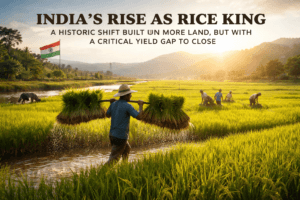
India’s Rise as Rice King: A Historic Shift Built on More Land, But With a Critical Yield Gap to Close
India has achieved a monumental shift in global agriculture. According to the latest report from the United States Department of Agriculture (USDA), India’s rice production for 2025-26 has reached a record 152 million metric tonnes, surpassing China’s estimated 146 million tonnes. This ends China’s long-held dominance and crowns India as the world’s new top rice producer.
However, this historic achievement is a tale of two different agricultural strategies. While China’s rise was powered by intensifying yields, India’s recent surge has been significantly driven by expanding the land under cultivation. This fundamental difference underscores both the scale of India’s accomplishment and the significant challenges it must overcome to secure this position for the long term.
From Food Scarcity to Global Leader: The Green Revolution Legacy
India’s path to becoming the “rice king” is rooted in a transformative period of its history. At independence, the nation produced a mere 20.58 million metric tonnes of rice annually. By the 1960s, it was grappling with severe food grain shortages, relying on traditional, low-yielding varieties.
The turning point came with international collaboration, most notably from Taiwan. The introduction of the dwarf rice variety Taichung Native-1 (TN1) provided a solution to a critical problem: traditional Indian rice stalks would collapse (“lodge”) under the weight of increased grain when fertiliser was applied. These sturdy, short-stemmed varieties could support higher yields. This was soon followed by the “Miracle Rice” IR-8 from the International Rice Research Institute, which triggered a rapid production surge.
Indian scientists quickly built on this foundation. By cross-breeding these varieties with local strains, they developed homegrown successes like the ‘Jaya’ variety, cementing the gains of the Green Revolution and setting the country on its current trajectory.
Table 1: The Production Surge – India vs. China
| Metric | India (2025/26 Estimate) | China (2025/26 Estimate) | Notes |
| Total Production | 152 million metric tonnes | 146 million metric tonnes | First time India surpasses China. |
| Global Share | Over 28% | N/A | Underscoring massive scale. |
| Key Driver | Expansion of harvested area | Intensification of yield per hectare | Core strategic difference. |
The Modern Engine: Area Expansion and Economic Might
Today, India’s production lead is not primarily due to matching China’s legendary efficiency, but rather by cultivating more land, more often. A 2024 scientific study provides crucial insight: from 2001 to 2021, India’s total harvested area for staple crops soared by 49.32%, largely due to a dramatic increase in double-cropping. In contrast, yield capacity per unit of land grew by only 4.35% over the same two decades.
This expansion is a powerful economic engine. Rice is a cornerstone of Indian exports, accounting for 24% of the country’s record agricultural export earnings of ₹450,840 crore in 2024-25. Basmati rice alone has carved out a premium global market, with exports crossing ₹50,000 crore and varieties like Pusa Basmati-1121 setting records for grain length.
The government and industry are aggressively pursuing new markets. India is targeting 21 countries for potential exports, with a focus on value-added products like fortified rice kernels destined for Latin America and Southeast Asia. This export prowess also translates into geopolitical influence, with rice serving as a key tool of foreign policy for engaging with 172 countries.
The Looming Challenge: The Yield Gap and Water Stress
Despite the celebratory headlines, analysts agree that India’s new status is tempered by a persistent and serious challenge: productivity. India’s average yield, while projected to rise to 4,390 kg per hectare in 2025-26, remains significantly below the global average and less than two-thirds of China’s estimated 7,100 kg per hectare.
Table 2: The Yield Gap – A Long-Term Trend
| Year | India’s Average Yield (kg/hectare) | Key Driver of Change |
| 1950-51 | 668 | Traditional varieties. |
| 1975-76 | 1,235 | Post-Green Revolution adoption of dwarf varieties. |
| 2021-22 | 2,809 | Continued area expansion. |
| 2025-26 (Est.) | 4,390 | Further area increase; incremental yield gains. |
| China’s Current Yield | ~7,100 | Intensive farming, advanced agronomy. |
This yield gap is more than a statistical footnote; it is directly linked to environmental sustainability. Rice cultivation is notoriously water-intensive, with traditional transplanted paddy fields consuming about 2,500 liters of water to produce one kilogram of rice. In parts of India, the water table is falling by as much as 4 cm per year due to agricultural pressure.
Bridging this gap requires a second revolution in farming practices. Promising technologies like Direct Seeded Rice (DSR), which seeds directly into fields rather than transplanting seedlings into flooded paddies, can reduce water use, cut labor, lower greenhouse gas emissions, and even improve yields. However, adoption faces hurdles due to lack of access to quality seeds, herbicides, and farmer awareness.
Reshaping the Global Market: Implications of India’s Surplus
India’s record harvest is not just a domestic story; it is reshaping global trade dynamics. As the world’s largest exporter with a 45% market share, India’s massive supply is applying significant downward pressure on international rice prices.
Traders report that buyers from Africa to Asia are poised to shift their purchases to more competitive Indian origins. A major South African buyer noted that if Indian rice becomes $15/tonne cheaper, procurement would “immediately” shift from Thailand. This price advantage, coupled with a depreciating rupee, is forcing rival exporters in Thailand, Vietnam, and Pakistan to recalibrate their strategies for early 2026.
The global market’s direction now hinges on decisions in New Delhi. Buyers are waiting to see if the Indian government will adjust its Open Market Sale Scheme (OMSS) pricing after domestic procurement ends in January. Any signal of lower official prices could trigger a wave of global demand swinging toward India, setting the tone for the year.
Conclusion: A Precipitous Crown
India’s ascent to the top of global rice production is a historic achievement born from decades of effort, strategic area expansion, and a thriving export machine. It bolsters food security, national income, and diplomatic influence.
Yet, the crown rests on a precarious base. The nation’s continued leadership and the sustainability of its agricultural sector depend on transitioning from a model of land expansion to one of yield intensification. Closing the gap with China’s productivity, while managing acute water stress through sustainable practices like DSR, is the definitive challenge ahead.
The world now looks to India not only as its leading rice supplier but also to see if it can leverage its newfound scale to pioneer a more productive and sustainable future for staple crop farming. The “rice king” has claimed its throne, but the true test of its reign has just begun.
You must be logged in to post a comment.