
India’s Rare Earth Paradox: Why 7% Reserves Yield Less Than 1% Production
India holds significant rare earth reserves—around 7% of the global total, ranking third worldwide—yet produces less than 1% of global output, creating a sharp paradox between resource wealth and supply chain vulnerability. As the country’s demand surges for electric vehicles, renewable energy, electronics, and defense technologies, it remains heavily dependent on imported processed rare earths, mainly from China. To address this, recent policy measures include the development of dedicated rare earth corridors across Odisha, Kerala, Andhra Pradesh, and Tamil Nadu, a ₹7,280 crore scheme to manufacture sintered permanent magnets, and strategic international alignments such as joining the U.S.-led Pax Silica initiative and the Minerals Security Partnership. Despite these steps, challenges persist in refining technology, environmental management, skill development, and cost competitiveness. Ultimately, securing integrated rare earth value chains is not a peripheral concern but central to India’s long-term economic resilience and geopolitical positioning.
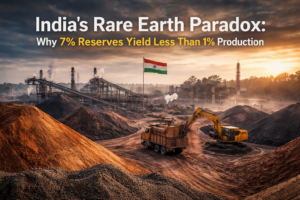
India’s Rare Earth Paradox: Why 7% Reserves Yield Less Than 1% Production
For decades, India’s economic story has been written in the language of software, services, and human capital. From Bengaluru’s tech hubs to Mumbai’s financial districts, the nation’s rise has felt almost weightless—driven by code, not coal; by algorithms, not alloys. But a quiet shift is underway. As the world pivots to electric vehicles, AI-driven data centers, and advanced defense systems, the foundations of power are becoming physical again. And here, India finds itself standing on a geological goldmine—yet unable to mine its own future.
The paradox is stark. India holds an estimated 13.15 million tonnes of monazite reserves, containing nearly 7.23 million tonnes of rare earth oxides (REOs). That’s roughly 7% of global reserves, ranking the country third in the world behind only China and Vietnam. Yet, when it comes to actual production of processed rare earths—the refined, usable materials that power semiconductors, wind turbines, and missile guidance systems—India accounts for less than 1% of global output.
This isn’t a story of scarcity. It’s a story of strategic inertia, technological bottlenecks, and a belated awakening to a new kind of resource war.
The Hidden Cost of Your Smartphone and EV
Rare earth elements (REEs) are not necessarily “rare” in the earth’s crust. They are, however, notoriously difficult to extract and purify. The 17 metallic elements that make up this group—from neodymium (vital for powerful magnets) to praseodymium (used in aircraft engines) and dysprosium (essential for heat-resistant EV motors)—don’t come out of the ground ready to use. They are locked in complex mineral matrices, requiring hundreds of steps of solvent extraction, ion exchange, and electro-winning to separate them into high-purity oxides and metals.
That’s where the real leverage lies. And today, that leverage belongs almost entirely to one nation. China controls over 85% of global rare earth refining capacity. It didn’t achieve this by accident. Starting in the 1980s, Beijing systematically invested in separation technology, tolerated environmental shortcuts, and built an integrated supply chain that now leaves the rest of the world scrambling.
For India, this concentration creates a silent but dangerous asymmetry. Every lithium-ion battery in a new electric bus, every permanent magnet in a wind turbine, every vibration motor in a smartphone—all of them trace their material lineage back, indirectly or directly, to processing lines in Inner Mongolia or Jiangxi. India may assemble the final product, but it does so on a foundation of imported vulnerability.
From “Mining” to “Value Chain”—A Necessary Mental Shift
For years, Indian policy treated critical minerals as just another extractive industry. The focus was on leasing mining blocks, collecting royalties, and moving on. But the 2026 Union Budget signaled a rupture with that past. The proposal to develop dedicated “rare earth corridors” across Odisha, Kerala, Andhra Pradesh, and Tamil Nadu is more than infrastructure spending. It is an admission that extraction alone is useless without co-located refining, metallurgy, and manufacturing.
Consider the logic of these corridors. Odisha has bauxite and monazite; Kerala’s coastal sands are rich in heavy minerals; Tamil Nadu houses automotive and electronics manufacturing hubs; Andhra Pradesh offers port access for exports. By clustering the entire chain—from mine to magnet—within a single geography, the government hopes to solve the chronic problem of fragmentation that has killed previous efforts.
But corridors alone don’t create chemistry. The real bottleneck has always been technology. Rare earth separation is a notoriously proprietary domain. Chinese firms have perfected low-cost, high-volume separation using decades of state-backed R&D. Western firms like Australia’s Lynas have clawed their way up the learning curve. India’s state-owned Indian Rare Earths Limited (IREL) has operated at a small scale, but lacks the advanced solvent extraction circuits and calcination capacity to produce the high-purity (99.99%+) oxides that global supply chains demand.
That is why the Modi government’s December 2025 approval of the ₹7,280 crore Scheme to Promote Manufacturing of Sintered Rare Earth Permanent Magnets is so significant. Permanent magnets—specifically neodymium-iron-boron (NdFeB) magnets—are the workhorses of the clean energy economy. An EV motor uses about 1-2 kg of these magnets. A direct-drive wind turbine uses over 600 kg. Without domestic magnet manufacturing, India will always remain a price-taker, not a price-maker.
The Geopolitical Pivot: From Non-Alignment to Material Alignment
One of the most revealing developments in India’s strategy came at the AI Impact Summit 2026 in New Delhi, when India joined the U.S.-led Pax Silica initiative. The name itself is telling—silica, the base of semiconductors and advanced computing, is the new oil. Pax Silica aims to build secure, resilient supply chains for silicon and the critical minerals that underpin AI, 5G, and autonomous systems.
Joining this initiative is a deliberate move away from the comfortable ambiguity of non-alignment. It signals that India recognizes a hard truth: in a world of technology decoupling, you must choose a supply chain. The Minerals Security Partnership (MSP)—which includes the US, Australia, Japan, and European partners—offers something India cannot build alone: capital pooling, technology sharing, and crucially, an alternative to total dependence on a single dominant processor.
Through Khanij Bidesh India Limited (KABIL), India is also hunting overseas. Lithium in Argentina, cobalt in Australia, rare earths in Mongolia—these aren’t just mining projects; they are insurance policies against a future blockade. The strategy is straightforward: diversify sources of ore, but more importantly, diversify processing partnerships. Lithium mined in Chile is useless if it must still be refined in China.
The Uncomfortable Questions India Must Answer
Yet for all the policy ambition, three uncomfortable questions remain unanswered.
First, what about the environment? Rare earth processing is notoriously dirty. The separation process uses large quantities of hydrochloric acid, sodium hydroxide, and ammonia, producing radioactive byproducts (thorium and uranium) and acidic wastewater. India’s environmental enforcement has historically been uneven. If the new rare earth corridors cut corners in the name of speed, they will face fierce resistance from local communities and environmental tribunals. Kerala’s coast, for instance, has already seen protests over monazite mining. The government must demonstrate that “Atmanirbhar” (self-reliant) does not mean “environmentally reckless.”
Second, who will build the skills? This is not coal mining. Rare earth refining requires metallurgists, chemical engineers, and materials scientists who understand solvent extraction and pyrometallurgy. India produces millions of graduates, but very few with specialized knowledge in hydrometallurgy. Unless IITs and NITs launch dedicated programs in critical minerals processing, the corridors will be filled with imported talent—or worse, idle equipment.
Third, can India compete on cost? Chinese rare earths are cheap not just because of economies of scale, but because of subsidized energy, relaxed pollution norms, and a domestic market that absorbs lower-grade output. Indian industry will face higher power costs, stricter compliance, and the challenge of building a customer base from scratch. Without a production-linked incentive (PLI) scheme tailored to magnets and refined oxides, Indian processors may find themselves undercut before they even start.
A Window That Won’t Stay Open Forever
The global race for critical minerals is not a marathon; it is a sprint with no finish line. The United States has the Defense Production Act to fund rare earth projects. The European Union has the Critical Raw Materials Act targeting 10% domestic mining, 40% domestic refining, and 15% recycling by 2030. Australia has 21 critical minerals projects in development. Japan has stockpiled rare earths for decades.
India’s window is open—but not indefinitely. The 13.15 million tonnes of monazite in its soil are not a guarantee of prosperity; they are a challenge to its engineering, its governance, and its strategic patience. The corridors, the scheme, the international partnerships—all of these are necessary, but none is sufficient by itself.
What India needs now is what it has often struggled to produce: continuity. Not just of policy, but of purpose. Rare earth plants take five to seven years to design, build, and commission. Magnet factories need another three years to reach commercial scale. The geopolitical landscape will shift three times over in that period. Governments will change. Commodity prices will crash and spike. And through it all, the bureaucrats, scientists, and industrialists working on this problem will need to keep going.
Because the alternative is stark. Without secure access to processed rare earths, India’s ambitions for electric mobility, semiconductor fabs, and indigenous defense production will remain perpetually dependent on supply chains it does not control. In the 20th century, nations fought wars over oil. In the 21st, they will negotiate, partner, and compete over rare earths. India has the resource. Now it must build the resolve.
The paradox is not a dead end. It is a starting line. But only if the country chooses to run.
You must be logged in to post a comment.