
India’s Protein Revolution: How Listed Food Companies Are Finally Confronting Supply Chain Vulnerabilities
According to the APB100 report by Asia Research and Engagement (ARE), India’s listed food companies have significantly accelerated their management of protein supply chain risks, with the average performance score more than doubling from 7% in 2023 to 16% in 2025, and 11 out of 13 assessed firms showing year-on-year improvement—progress that places India broadly in line with the Asia-wide average but distinguishes it by its rapid pace of change. The strongest gains have been made in foundational areas like traceability, sourcing policies, and labor standards, indicating that companies are beginning to establish essential supply chain governance. However, the report highlights persistent and significant gaps in critical areas such as climate action—where most companies lack Scope 3 emissions disclosure or transition planning—and animal welfare, which remains largely undeveloped with few companies adopting higher-welfare standards. Experts emphasize that while India’s early progress on governance is encouraging, the critical challenge now is converting this momentum into measurable, outcome-based action across sourcing, climate resilience, and welfare, positioning the country as a potential reference point for managing protein transition in emerging markets.
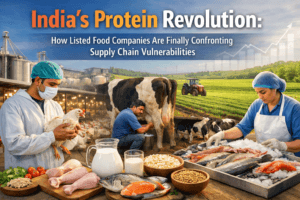
India’s Protein Revolution: How Listed Food Companies Are Finally Confronting Supply Chain Vulnerabilities
Beyond the Headlines: What the APB100 Report Reveals About India’s Evolving Food Industry
On the outskirts of Bengaluru, a mid-sized poultry processor recently made an uncharacteristic decision. They began mapping exactly where every chicken in their supply chain came from—not just the district, but the specific farm, the hatch date, and even the feed source. Three years ago, such meticulous tracking would have been dismissed as unnecessary paperwork. Today, it’s becoming table stakes for staying competitive in India’s rapidly transforming protein industry.
This quiet revolution in supply chain transparency is playing out across the country, and it’s finally showing up in the data. The Asian Protein Buyers 100 (APB100) report, released this week by Asia Research and Engagement (ARE), offers the most comprehensive look yet at how India’s largest listed food companies are grappling with the complex web of risks embedded in meat, dairy, poultry, and seafood sourcing.
The headline numbers tell an encouraging story: Indian companies more than doubled their average performance scores, jumping from approximately 7 percent in 2023 to 16 percent in 2025. Eleven of the thirteen companies assessed improved year-on-year. For a market often characterized as lagging in corporate sustainability metrics, this acceleration deserves attention.
But beneath these top-line figures lies a more nuanced reality—one that reveals both genuine progress and stubborn blind spots that could leave companies exposed to climate shocks, regulatory shifts, and changing consumer expectations.
The Indian Exception: Why This Market Is Moving Faster
What makes India’s performance particularly noteworthy isn’t where it stands today—the 16 percent average still leaves enormous room for improvement—but rather the velocity of change. Among the 100 companies assessed across twelve Asian markets, Indian firms showed one of the steepest improvement curves.
“We’re seeing a fundamental shift in how Indian food companies approach risk,” explains Rituj Sahu, ARE Director for Protein Transition in India. “Three years ago, conversations about sustainable sourcing were largely confined to export-oriented businesses responding to international buyer demands. Now domestic-facing companies are waking up to these issues, driven by a combination of investor pressure, regulatory signals, and genuine concern about supply chain resilience.”
This acceleration didn’t happen in a vacuum. Several converging factors help explain why Indian food companies are suddenly prioritizing protein supply chain governance:
The pandemic hangover revealed just how fragile food supply chains can be. Companies that weathered COVID-19 disruptions now view supplier diversification and traceability not as sustainability luxuries but as operational necessities.
Investor scrutiny has intensified. The APB100 itself is investor-backed, reflecting growing demand from institutional shareholders for better visibility into portfolio companies’ exposure to environmental and social risks.
Regulatory signals from SEBI and other bodies have pushed even reluctant companies toward greater disclosure, creating the data infrastructure needed to manage risks that were previously invisible.
Domestic market evolution means Indian consumers—particularly in urban centers—are beginning to ask questions about where their food comes from, how it was produced, and whether it aligns with their values.
Yet as the report makes clear, this momentum has produced uneven results. To understand where India’s protein buyers stand today, we need to look beyond aggregate scores and examine the specific areas where progress is real—and where it remains elusive.
Traceability and Labor: The Low-Hanging Fruit
India’s strongest performance in the APB100 assessment came in three interconnected categories: traceability, sourcing practices, and labor standards. This isn’t accidental. These areas represent the most accessible entry points for companies beginning their sustainability journey.
Take traceability, for instance. Several Indian companies have begun implementing supplier codes of conduct that extend beyond first-tier vendors. Jubilant FoodWorks, which operates Domino’s Pizza in India, has made meaningful strides in mapping its dairy supply chain—no small feat in a country where milk often passes through multiple intermediaries before reaching processors.
Similarly, Tata Consumer Products has leveraged its group-wide sustainability frameworks to strengthen visibility into agricultural supply chains. The company’s heritage in tea gives it decades of experience managing grower relationships, experience now being applied to emerging protein categories.
Labor standards have also seen improvement, driven partly by growing awareness of the social risks embedded in food supply chains. India’s informal labor practices—widespread in agriculture and food processing—create significant exposure for companies that don’t actively monitor working conditions. The best-performing Indian firms have begun implementing due-diligence frameworks that, while still incomplete, represent genuine progress over the industry’s historical approach.
“Foundational governance is being put in place,” notes Sahu. “Supplier codes, sourcing policies, basic monitoring—these are the building blocks without which nothing else works. The fact that Indian companies are establishing these mechanisms suggests they’re preparing for more ambitious action down the road.”
But even in these relatively advanced areas, the report identifies persistent gaps. Disclosure remains largely process-oriented rather than outcome-based. Companies will report that they have a supplier code, but not how many suppliers have been audited against it. They’ll describe their sourcing policies, but not the percentage of supply covered. They’ll acknowledge labor risks, but without demonstrating remediation when problems are found.
The Climate Blind Spot
If traceability represents Indian companies’ relative strength, climate reveals their vulnerability. More than half of the thirteen assessed companies have yet to begin meaningful disclosure against climate-related indicators.
This matters because protein supply chains are extraordinarily emissions-intensive. Livestock production alone accounts for approximately 14.5 percent of global greenhouse gas emissions, according to FAO estimates. Dairy, poultry, and seafood each carry significant carbon footprints, much of it concentrated in Scope 3 emissions—the indirect emissions generated throughout the supply chain, far beyond a company’s direct operations.
For Indian food companies, Scope 3 emissions represent both a massive exposure and a measurement challenge. A restaurant chain’s carbon footprint isn’t primarily in its kitchens or delivery vehicles; it’s in the farms producing its chicken, the feed mills supplying those farms, the fertilizer applied to grow that feed, and the transport connecting each node.
“Very few Indian companies have begun quantifying their Scope 3 exposure,” explains a supply chain consultant who works with multiple listed food firms but requested anonymity to speak candidly. “And even fewer have set absolute emissions reduction targets. The ones that do typically talk about intensity-based goals—reducing emissions per unit of production—which sounds good but doesn’t actually reduce total emissions if production volume grows.”
The APB100 findings confirm this pattern. References to recognized disclosure frameworks like the Task Force on Climate-related Financial Disclosures remain limited. Transition planning—the work of fundamentally rethinking supply chains to align with a low-carbon future—is almost entirely absent.
This creates genuine risk. Climate shocks are already disrupting agricultural production globally, and India’s protein supply chains are hardly immune. Heat stress reduces dairy yields. Extreme weather disrupts feed grain availability. Water scarcity affects every stage of animal agriculture. Companies without clear visibility into their climate exposure are essentially flying blind.
Animal Welfare: The Missing Conversation
If climate represents a measurement gap, animal welfare represents an even more fundamental conversation that Indian food companies have largely avoided.
The APB100 assessment found that most Indian companies lack even basic animal welfare policies, let alone species-specific standards or measurable targets. References to higher-welfare practices like cage-free or tether-free systems are rare. Measurable progress disclosure is almost nonexistent.
This isn’t simply a matter of Indian companies lagging behind global peers—though they certainly do. It reflects deeper structural realities about how animal agriculture operates in India and what consumers expect from it.
“In India, animal welfare conversations have historically been framed through a cultural rather than an industrial lens,” explains Praveer Srivastava, Executive Director of the Plant Based Foods Industry Association. “We have strong traditions of respecting animals in certain contexts, but those traditions don’t easily translate into demands for higher-welfare industrial production. The two conversations have remained largely separate.”
Yet the gap also represents opportunity. As Indian consumers become more exposed to global food trends—through travel, media, and the expansion of international restaurant chains—expectations around animal welfare will inevitably evolve. Companies that have already begun developing welfare standards and measurement systems will be better positioned than those starting from scratch when that shift accelerates.
The APB100 findings suggest some early movers are emerging. A small minority of Indian companies now reference higher-welfare sourcing in their disclosures, even if measurable progress remains limited. These pioneers may find themselves with a competitive advantage as the conversation matures.
What Progress Actually Looks Like
Behind the aggregate scores and category breakdowns, the APB100 data reveals something more interesting: the specific ways Indian companies are beginning to operationalize responsible sourcing.
Consider antibiotic stewardship—an issue with profound public health implications that has received less attention in India than in Western markets. Several assessed companies have begun developing policies around responsible antibiotic use, acknowledging the role that intensive animal agriculture plays in driving antimicrobial resistance.
Or consider supplier engagement. The best-performing Indian companies aren’t simply issuing codes of conduct and hoping for compliance; they’re working directly with suppliers to build capacity for meeting higher standards. This approach acknowledges the reality of India’s fragmented protein supply chains, where thousands of smallholders operate with limited resources and technical support.
Dairy offers a particularly instructive example. Several Indian dairy processors have begun working with cooperative societies to improve animal health and productivity—interventions that simultaneously enhance welfare, reduce emissions intensity, and strengthen farmer livelihoods. These multi-benefit approaches may ultimately prove more sustainable than narrow compliance-focused programs.
“Protein transition isn’t just about risk management,” Sahu emphasizes. “It’s about building systems that can deliver nutrition sustainably for decades to come. Indian companies are beginning to understand that this requires engagement, not just enforcement.”
The Asia Context: India in Perspective
The APB100’s value lies partly in its comparative lens. By assessing companies across twelve Asian markets, it reveals both regional patterns and national idiosyncrasies.
India’s overall performance aligns broadly with the Asia-wide average—a notable achievement for a market with historically lower sustainability expectations. But the composition of that performance differs meaningfully from regional peers.
Japanese and Korean companies, for instance, tend to score higher on disclosure and technical reporting but have been slower to implement substantive supply chain interventions. Southeast Asian firms often show stronger community engagement but weaker formal governance structures. Indian companies sit somewhere in between, with foundational systems beginning to emerge alongside pockets of genuine innovation.
The report also highlights challenges that cut across national boundaries. “These gaps mirror challenges seen across Asia,” the authors note, “underscoring a persistent disconnect between awareness of protein-related risks and demonstrable execution.”
That disconnect—between what companies know they should do and what they actually accomplish—represents the central challenge for India’s protein buyers in the years ahead. Awareness is rising. Policies are being written. But meaningful execution requires investments, capabilities, and sustained attention that many companies have yet to mobilize.
Beyond Compliance: The Strategic Case
For companies inclined to view responsible sourcing as a compliance burden, the APB100 findings offer an alternative framing: risk management as competitive advantage.
India’s protein landscape is transforming rapidly. Urbanization, rising incomes, and changing dietary patterns are reshaping demand. Climate volatility is introducing new uncertainties. Regulatory expectations are evolving. Consumer awareness is growing. Companies that wait for these forces to fully materialize before adapting their supply chains will find themselves perpetually behind.
The early movers identified in the APB100 assessment aren’t just reducing their exposure to future risks; they’re building capabilities that will serve them regardless of how those risks materialize. Traceability systems improve quality control regardless of whether climate disclosure becomes mandatory. Supplier relationships built around capacity-building rather than pure price negotiation prove resilient through disruptions. Data infrastructure developed for sustainability reporting supports broader operational intelligence.
“India stands at an inflection point,” Srivastava observes. “Responsible protein sourcing is becoming central to climate resilience and long-term food-system stability. Diversifying protein sources—including scaling plant-based alternatives—is not just an environmental priority but a strategic imperative for industry readiness.”
The Road Ahead
The APB100 report offers a snapshot, not a final verdict. Indian food companies have made genuine progress in a short period, establishing foundational systems and beginning to address risks that went largely unacknowledged just a few years ago.
But the gaps are equally real. Climate remains a blind spot. Animal welfare is barely on the radar. Even in areas of relative strength, disclosure rarely translates into verified outcomes. The “persistent disconnect between awareness and execution” that the report identifies across Asia applies with particular force to India.
Closing that disconnect will require sustained effort from multiple stakeholders. Investors must continue demanding better disclosure and holding companies accountable for follow-through. Regulators need to create frameworks that reward genuine progress rather than box-ticking. Civil society organizations can help translate global best practices into locally relevant approaches. And consumers—ultimately the most powerful force for change—must begin asking harder questions about where their protein comes from and at what cost.
The thirteen Indian companies assessed in the APB100—from Devyani International to Nestlé India, from Parag Milk Foods to Hindustan Unilever—collectively shape protein supply chains reaching millions of consumers daily. Their progress over the past two years demonstrates that change is possible. The question now is whether they can sustain that momentum, moving from foundational disclosure to transformative action.
As one supply chain executive put it during a recent industry gathering: “We’ve learned to measure the risks. Now we have to learn to manage them.” That transition—from measurement to management, from awareness to execution—will define India’s protein landscape for years to come.
You must be logged in to post a comment.