
India’s Port Security Overhaul: CISF Takes Command of 250 Seaports
In a significant move to strengthen India’s coastal security, the Union Government has designated the Central Industrial Security Force (CISF) as the central security regulator for all of the country’s 250+ seaports, creating a unified security framework to replace the previously fragmented system where only 13 major ports had CISF protection and others relied on private or local police with inconsistent standards.
This new mandate appoints CISF as the Recognised Security Organisation (RSO) to implement a standardized, sovereign security architecture, which will be rolled out in phases, starting with 80 crucial Export-Import (EXIM) ports, and will involve CISF conducting security assessments, creating security plans, and managing core functions like access control and patrolling under a hybrid model that integrates state police and private security for non-core duties, thereby aiming to eliminate vulnerabilities, ensure compliance with global standards, and secure India’s critical maritime trade gateways against threats like terrorism and smuggling.
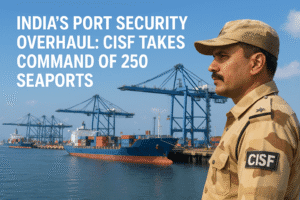
India’s Port Security Overhaul: CISF Takes Command of 250 Seaports
In a landmark reform of India’s maritime security infrastructure, the government has designated the Central Industrial Security Force (CISF) as the central security regulator for all of India’s 250+ seaports. This strategic move, formalized through an order from the Ministry of Ports, Shipping and Waterways on November 18, 2025, marks one of the most significant overhauls of India’s coastal protection in decades and represents a crucial step toward standardizing port security nationwide .
The Need for Change: Addressing Security Gaps
India’s extensive coastline stretches over 7,500 kilometers, hosting a network of major, minor, and private ports that handle approximately 95% of India’s EXIM cargo by volume and 70% by value . Despite this critical economic function, security arrangements have historically been fragmented and inconsistent across different port categories.
Prior to this reform, only 13 major ports benefited from CISF’s professional security cover . The remaining ports relied on a patchwork of private security agencies and local police forces, resulting in varying security standards and potential vulnerabilities . This discrepancy became increasingly concerning as security threats evolved, with ports remaining vulnerable to transnational threats including maritime terrorism, smuggling, and cyberattacks on port IT infrastructure .
The government’s decision didn’t emerge in a vacuum. It was the culmination of years of high-level security reviews chaired by the Prime Minister and Home Minister, where the vulnerability and security gaps across India’s 250+ seaports were repeatedly highlighted . The urgency for reform was further underscored by alarming statistics: between 2020 and 2024, drugs worth ₹11,311 crore were seized from seaports across the country in 19 major drug bust cases .
Understanding the New Security Framework
CISF as the Recognised Security Organisation
Under the new framework, CISF has been designated as the Recognised Security Organisation (RSO) for seaports under the International Ship and Port Facility Security (ISPS) Code . The ISPS Code is a comprehensive global security framework established after the 9/11 attacks to safeguard ships and port facilities from terrorism and other security threats .
As the RSO, CISF will function as the nodal regulatory authority for all security matters at Indian seaports . This designation transforms the force from merely providing security at select ports to becoming the central architect and overseer of port security nationwide. The force will now lead in three critical domains: providing consultancy for establishing security systems and gadgets, deploying hybrid security manpower, and training all stakeholders in the maritime sector .
Phased Implementation Strategy
The government has adopted a pragmatic, phased approach to implementation:
- Phase 1: Focus on 80 EXIM (Export-Import) ports that handle international trade through customs clearance, cargo movement, storage, and logistics . These ports form India’s critical trade gateways and handle the entirety of the country’s international maritime trade.
- Phase 2: Extend security regulation to the remaining ports as they become operational or are upgraded to handle EXIM cargo .
This phased rollout allows for systematic implementation and resource allocation, ensuring that the most critical trade facilities receive immediate attention.
Table: India’s Port Landscape and Security Coverage
| Port Category | Total Number | Active in Cargo | Previous Security | New Security Framework |
| Major Ports | 12-13 | All | CISF | CISF as RSO |
| Non-Major EXIM Ports | ~65-68 | All | Private/State Police | CISF as RSO |
| Other Minor Ports | ~200 | Limited | Private/State Police | CISF regulation when operational |
The Hybrid Security Model
A cornerstone of the new framework is the hybrid security model, which optimizes expertise and resources through clear role differentiation :
- CISF – Core Security Functions: The force will handle sovereign security responsibilities including access control, CCTV surveillance, perimeter security, seafront patrolling, quick reaction teams, and integrated operations center management . These functions address critical vulnerabilities and require professional, standardized execution.
- Other Agencies – Non-Core Duties: State police, State Industrial Security Forces, or private security agencies will continue to manage non-core responsibilities such as traffic management, gate control, and ancillary tasks .
This layered approach ensures that specialized security functions receive expert attention while maintaining cost-effectiveness through appropriate resource allocation.
Strategic Implementation Components
Security Assessments and Planning
As the new RSO, one of CISF’s primary responsibilities will be conducting fresh Port Facility Security Assessments (PFSAs) and preparing Port Facility Security Plans (PFSPs) for all EXIM ports . These assessments will identify vulnerabilities and develop comprehensive, standardized security protocols compliant with international standards, effectively eliminating the previous patchwork of security arrangements .
Training and Capacity Building
Recognizing that effective security depends on human capability, the framework introduces a mandatory training regime for all private security personnel deployed at EXIM ports . Modeled on the aviation security sector, where certification is required before deployment, this training will be conducted by CISF experts who have already developed specialized curricula .
The government plans to establish a dedicated Port Security Training Institute (PSTI) to institutionalize capacity-building, standardize certifications, and create a skilled security workforce specifically for the maritime ecosystem .
Manpower and Resource Implications
The scale of this new responsibility necessitates significant expansion of CISF’s maritime security capabilities. According to estimates, the force may require up to 80,000 additional personnel to properly secure all EXIM ports, with an initial requirement of approximately 10,000 personnel for the first phase of deployment . This expansion represents one of the most significant enhancements to India’s industrial security infrastructure in recent years.
The Bigger Picture: Alignment with National Maritime Strategy
This security overhaul dovetails with broader reforms in India’s maritime sector, particularly the passage of the Indian Ports Act, 2025, which replaced the colonial-era Indian Ports Act of 1908 . This modern legislation provides a comprehensive framework for port development, management, and security, establishing State Maritime Boards and granting statutory status to the Maritime State Development Council to coordinate between central and state authorities .
Together, these reforms support India’s strategic focus on port-led development and the Blue Economy – leveraging maritime resources for economic growth, employment generation, and enhanced regional connectivity . As India charts its course toward becoming a global maritime leader, secure and efficient ports are essential for realizing this vision.
Table: Key Elements of India’s Maritime Security Reform
| Reform Component | Previous System | New Framework | Strategic Impact |
| Security Regulation | Fragmented across agencies | CISF as unified RSO | Standardized protocols |
| Coverage | 13 major ports only | All 250+ seaports | Comprehensive protection |
| Training Standards | Variable quality | CISF-led certification | Professionalized workforce |
| Legal Foundation | Indian Ports Act, 1908 | Indian Ports Act, 2025 | Modernized governance |
Conclusion: Toward Secure and Efficient Maritime Gateways
The designation of CISF as the unified security regulator for India’s seaports represents a transformative shift in the country’s approach to maritime security. By replacing fragmented, inconsistent security arrangements with a standardized, professional framework, India addresses critical vulnerabilities while supporting its economic ambitions.
This reform goes beyond mere security enhancement – it represents a strategic investment in India’s trade infrastructure, global connectivity, and economic competitiveness. As the CISF begins implementing this new mandate through systematic security assessments, hybrid deployment models, and comprehensive training programs, India moves closer to creating the secure, efficient, and future-ready ports necessary to support its growing maritime footprint and broader economic aspirations.
The successful implementation of this security framework will ensure that India’s ports remain resilient against emerging threats while facilitating the smooth flow of trade that powers the nation’s economy – truly embodying the vision of secure ports powering a secure nation.
You must be logged in to post a comment.