
India’s New Waste Rules 2026: Why Segregation at Source Remains the Missing Link in Delhi’s Toxic Landfill Crisis
India’s ambitious 2026 Solid Waste Management Rules, which mandate four-way segregation, tighter bulk generator accountability, and a centralized tracking portal, represent a significant policy upgrade from the 2016 framework, but experts warn that two decades of implementation failures—symbolized by Delhi’s towering, fire-prone landfills like Ghazipur and Bhalaswa—continue to undermine progress, as the persistent lack of source segregation, weak enforcement by urban local bodies, and a deep trust deficit between residents and municipal systems mean that thousands of tonnes of mixed waste still reach dumpsites daily, generating methane, toxic emissions, and localised heat stress, while the rules’ continued endorsement of Waste-to-Energy plants raises additional concerns about air pollution and dioxin releases. Ultimately, without addressing fundamental issues of administrative capacity, political will, and the integration of informal workers and community trust, the new regulations risk joining their predecessors as well-intentioned documents that fail to transform ground realities.
India’s New Waste Rules 2026: Why Segregation at Source Remains the Missing Link in Delhi’s Toxic Landfill Crisis
Lofty Ambitions, Ground Realities: Can India Finally Fix Its Waste Problem?
On paper, India’s newest Solid Waste Management Rules—notified in January 2026 and taking effect April 1—represent the most ambitious overhaul of the country’s waste architecture in a decade. Four-way segregation. Tighter accountability for bulk generators. Higher landfill fees for mixed waste. A centralized digital portal promising end-to-end tracking. The framework reads like a policymaker’s dream.
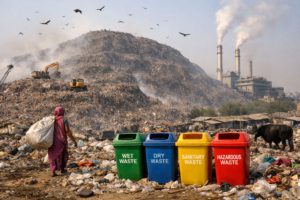
But standing at the edge of Ghazipur landfill on a warm March morning, with vultures circling above mountains of decomposing waste and the acrid smell of slow-burning garbage hanging in the air, the dream feels very distant indeed.
This 70-acre monstrosity in east Delhi, long since exceeding its permitted height, receives thousands of tonnes of waste daily—much of it unsegregated, most of it avoidable. It is not an exception. It is the rule. And it embodies the central paradox of Indian waste management: progressive rules, regressive realities.
The Four-Way Shift: Ambition Meets Apathy
The 2026 rules mandate that households and institutions now segregate waste into four streams: dry (recyclables), wet (biodegradable), sanitary (diapers, menstrual waste), and special care (medicines, paint cans, bulbs, mercury thermometers). This expands upon the 2016 framework’s three-way segregation system, which itself was never fully implemented in most cities.
“We’ve moved from ‘this is difficult’ to ‘this is more difficult’ without addressing why the first level of difficulty wasn’t overcome,” says Dr. Ruby Makhija, ophthalmologist-turned-environmentalist and founder of the Why Waste Wednesdays Foundation. Her organization has spent years attempting to scale zero-waste models across Delhi-NCR, with mixed success.
The logic behind four-way segregation is sound. Sanitary waste requires different treatment—ideally incineration or deep burial—and poses health risks when mixed with recyclables. Special care items contain hazardous materials that shouldn’t enter landfills or recycling streams. But logic and implementation have never been comfortable bedfellows in Indian urban governance.
“What happens in practice,” Makhija explains, “is that a resident who carefully maintains four separate bins watches as the collection vehicle empties them all together. That happens once. Maybe twice. By the third week, they’re back to throwing everything in one bag. Why would anyone invest effort in a system that visibly doesn’t work?”
This trust deficit sits at the heart of India’s waste crisis. The 2026 rules cannot legislate trust. They can only create conditions where trust might eventually rebuild—if, and only if, urban local bodies fundamentally change how they operate.
The Numbers That Haunt Delhi
Delhi generates approximately 600 grams of waste per person daily—leading all Indian cities in per-capita production. Of the total waste collected, the Central Pollution Control Board reports that 64% undergoes processing. The remaining 36%—4,241 tonnes every single day—travels to unsanitary landfills or open dumpsites.
These aren’t abstract statistics. They represent real mountains: Bhalaswa in the north, Ghazipur in the east, Okhla in the south. Each towers over surrounding communities, home to thousands of waste pickers and their families who survive amid toxic conditions. Each periodically catches fire, sending plumes of hazardous smoke into already-polluted air. Each silently generates methane—a greenhouse gas 80 times more potent than carbon dioxide over a 20-year period—contributing to both global warming and localised heat stress.
A study examining the Ghazipur landfill found that high-temperature zones within the waste mass are widening and approaching the surface—a phenomenon with implications for both spontaneous combustion and the health of nearby residents. When the Bhalaswa landfill experienced an accidental fire in 2022, PM2.5 concentrations in the vicinity increased by 45-55% within hours. PM10 rose 40-50%. Nitrogen oxides, carbon monoxide, and sulphur dioxide jumped between 25% and 100%.
“These aren’t distant environmental problems,” says Shrotik Bose, Research Associate at the Centre for Science and Environment’s Solid Waste Management and Circular Economy division. “They’re immediate public health crises. Yet the new rules contain remarkably few provisions directly addressing air pollution or heat stress from waste, despite the clear linkages.”
Bulk Generators: The 30% Solution
One of the 2026 rules’ most significant shifts involves what the government now calls Extended Bulk Waste Generator Responsibility (EBWGR). Bulk waste generators—defined as entities producing over 100 kilograms of waste daily, occupying more than 20,000 square meters, or consuming over 40,000 litres of water per day—must now either treat wet waste onsite or send it to authorized facilities, obtaining EBWGR certificates as proof of compliance.
This matters because bulk generators—hotels, hospitals, large residential complexes, commercial establishments—contribute approximately 30% of total solid waste. Getting this segment right could dramatically reduce pressure on municipal systems.
But definitions and ground realities diverge sharply. A large residential welfare association in south Delhi might technically qualify as a bulk generator, but its ability to implement onsite composting depends on space availability, resident cooperation, and maintenance budgets—all variable factors. A hotel chain might have resources for compliance but lack incentives if enforcement remains sporadic.
“The 2026 rules have certainly absorbed lessons from the past decade,” observes Lakshmi P., Head of Impact at Cleanhub, an environmental technology company focused on plastic waste collection. “There’s greater clarity about responsibility. But clarity without consequences is just documentation. The real test will be whether urban local bodies have the capacity—and political will—to enforce these provisions against powerful interests.”
The Landfill Tax That Isn’t
The new rules prescribe higher landfill user fees for local bodies that continue sending unsegregated waste to sanitary landfills. On paper, this creates a financial disincentive against business-as-usual. In practice, it assumes that urban local bodies operate within budget constraints that make them responsive to such penalties—and that the fees will actually be collected.
Neither assumption is secure.
Municipal corporations across India face chronic revenue shortfalls, with property tax collection far below potential and user charges for services rarely enforced. In Delhi, where multiple municipal bodies govern different zones, coordination failures compound financial weaknesses. When penalties exist but aren’t collected—or are collected but don’t influence behavior—they become noise rather than signals.
“If a municipal commissioner knows the landfill fee increase exists but also knows the state government will waive it or the central government will provide grants to cover it, nothing changes,” says Bharati Chaturvedi, founder and director of the Chintan Environmental Research and Action Group. “We’ve seen this pattern repeatedly. Rules get notified. Implementation lags. Exceptions get made. Eventually, everyone forgets the rules existed.”
Chaturvedi’s organization has worked on circular economy and waste issues for decades, witnessing multiple policy cycles. “Indore succeeded where others failed because the state government treated waste management as a political priority. Officials went door-to-door. Non-profits were treated as partners, not dispensable actors. That political will is what’s missing in Delhi and most other cities.”
The Portal Promise
A centralised online portal under development aims to track all stages of solid waste management—generation, collection, transportation, processing at Material Recovery Facilities, disposal. The vision: complete visibility, data-driven decision-making, accountability through transparency.
The reality: portals are only as good as the data entered, and data entry depends on thousands of field-level workers and supervisors across dozens of urban local bodies, many operating with outdated equipment, inadequate training, and minimal digital literacy.
“Rewriting old agreements with waste processing facilities, registering them on the portal, managing compliance at that scale—these are enormous administrative challenges,” Bose notes. “The portal could eventually transform how waste systems function, but getting there requires months or years of groundwork that hasn’t yet begun.”
There’s also the question of what happens to the data once collected. Will it inform policy? Drive enforcement? Remain accessible to researchers and civil society? Previous transparency initiatives in Indian governance have produced impressive dashboards with limited impact on ground-level outcomes. The waste portal risks similar irrelevance unless connected to actual decision-making processes.
Waste-to-Energy: The Controversy Continues
Perhaps the most contentious aspect of the 2026 rules is their continued endorsement of Waste-to-Energy plants as a permissible processing pathway—despite overwhelming evidence of their environmental and health impacts in Indian conditions.
An inspection by the Central Pollution Control Board, conducted in response to National Green Tribunal directions, found the Okhla Waste-to-Energy incinerator releasing dioxins and furans at levels nearly 900% above permissible limits. These compounds rank among the most toxic carcinogens known to science, with no safe exposure threshold.
“In India, waste only has meaningful calorific value after proper segregation,” Lakshmi explains. “But once you’ve segregated properly, the recycling industry can absorb most materials. The truly non-recyclable fraction is actually quite small—maybe 5-10% by weight. Extended Producer Responsibility and better product design should further reduce non-recyclable plastics over time. So waste-to-energy, recycling, and EPR end up competing for the same waste stream.”
This competition creates perverse incentives. Waste-to-energy plants require long-term contracts and consistent feedstock to achieve economic viability—typically 15-20 years of operation. Once built, they create institutional pressure to keep receiving waste, often mixed waste with low calorific value, undermining segregation efforts. Operating at relatively low temperatures compared to advanced international facilities, Indian WtE plants struggle to break down toxins effectively, releasing them into surrounding communities.
“Technology alone cannot fix this,” Makhija insists. “No matter how advanced or expensive the machinery, it will fail without source segregation. Nearly 70% of effective waste management depends on what happens in households, yet we treat public engagement as an afterthought rather than an investment priority.”
The new rules do require WtE and cement plants to increase their Refuse Derived Fuel sources from 5% to 15% over six years—potentially creating market pull for processed waste. But RDF itself requires segregation and processing, bringing the challenge back to source.
A Crisis on Fire
The consequences of continued failure are not theoretical. On a sweltering April afternoon in 2022, when the Bhalaswa landfill spontaneously ignited, residents of nearby Sultanpuri and Begumpur experienced something close to environmental collapse.
“People couldn’t breathe,” recalls a local activist who requested anonymity. “Schools closed. Hospitals saw lines of patients with burning eyes and breathing difficulties. The government said it was temporary. But for families living there, temporary meant weeks of suffering, and the fear that it would happen again—because everyone knows it will.”
It did. Similar fires have occurred at Ghazipur and Okhla, though none captured international attention like the 2022 Bhalaswa blaze. Each time, authorities promise improved monitoring and preventive measures. Each time, the underlying conditions—unsegregated waste accumulation, methane generation, inadequate landfill management—remain unchanged.
The 2026 rules mandate mapping and assessment of legacy waste dumpsites, with time-bound biomining and bioremediation requirements. These microorganism-based technologies can extract metals and break down contaminants, potentially reclaiming land and reducing environmental hazards. But biomining operations require sustained investment, technical expertise, and disposal pathways for recovered materials—none of which materialize automatically from regulatory notifications.
The Health of Those Who Handle Our Waste
Amid policy discussions about segregation streams and compliance mechanisms, one constituency remains consistently overlooked: the informal waste workers who form the backbone of India’s recycling economy.
Approximately 1.5 million waste pickers operate across Indian cities, according to estimates, collecting, sorting, and selling recyclable materials with minimal protection or recognition. They work barefoot on toxic landfills, live in settlements adjacent to waste dumps, and bear the health consequences of a system that excludes them from formal planning.
“When we talk about four-way segregation and improved processing, we rarely ask what happens to the people currently doing this work,” Chaturvedi observes. “Formalization isn’t just about registering workers—it’s about ensuring safe conditions, fair compensation, and dignity. The 2026 rules don’t address this adequately.”
Women constitute a significant majority of the waste-picking workforce, facing additional vulnerabilities including harassment, lack of sanitation facilities at worksites, and exclusion from decision-making structures. Their children often accompany them to landfills, beginning lives of hazardous work before reaching adolescence.
“The rules talk about responsibility, tracking, and technology,” Makhija says. “But until we recognize that waste management is fundamentally about people—the people generating waste, the people handling it, the people living near disposal sites—we’re designing systems that will fail the most vulnerable.”
The Trust Deficit
Perhaps the deepest insight from decades of Indian waste management experience concerns trust—or rather, its absence. When residents don’t trust that segregated waste will remain segregated, they stop segregating. When urban local bodies don’t trust that residents will pay user charges, they don’t invest in service quality. When informal workers don’t trust that formalization will benefit rather than displace them, they resist registration efforts. When policymakers don’t trust implementers to enforce rules, they add more rules rather than strengthening enforcement capacity.
“Trust is built through consistent, visible action over time,” Lakshmi explains. “A resident who sees the same collector arriving at the same time, with a vehicle that clearly has separate compartments, who actually checks whether segregation is happening—that resident might start believing the system works. But that requires investment in training, supervision, and accountability that most municipalities haven’t made.”
Indore’s widely-cited success demonstrates what’s possible when these investments occur. The city achieved near-universal segregation through sustained door-to-door engagement, clear communication, and visible consequences for non-compliance. But Indore’s population (approximately 2 million) and administrative capacity differ dramatically from Delhi’s (over 20 million across multiple municipal jurisdictions).
“Delhi isn’t Indore,” Chaturvedi says bluntly. “The scale is different, the politics are different, the institutional fragmentation is different. We need solutions that recognize these differences rather than importing models that worked elsewhere without adaptation.”
What the New Rules Change—And What They Don’t
The 2026 Solid Waste Management Rules represent genuine progress in several dimensions. Four-way segregation, if implemented, would improve both recycling quality and hazardous waste management. Extended Bulk Waste Generator Responsibility creates accountability for major waste producers. Higher landfill fees could shift incentives. The portal could enable transparency.
But the rules cannot:
- Create the administrative capacity urban local bodies lack
- Generate the political will necessary for enforcement against powerful interests
- Bridge the trust deficit between residents and municipal systems
- Protect informal workers without complementary social protection measures
- Address the air pollution and health impacts of existing landfills
“Rules are necessary but insufficient,” Bose concludes. “What we need is a fundamental shift in how urban local bodies approach waste—from seeing it as a technical problem requiring technological fixes, to understanding it as a social and behavioral challenge requiring sustained engagement with communities.”
The Road Ahead
As April 1 approaches, municipalities across India scramble to prepare for the new rules’ implementation. Training programs for collectors. Information campaigns for residents. Upgrades to processing facilities. Portal registration for bulk generators. The activity suggests momentum.
But those who’ve watched previous policy cycles know that initial activity often masks deeper continuity. The 2016 rules generated similar flurries of preparation, yet a decade later, Delhi’s landfills continue growing, its waste fires continue burning, its residents continue breathing contaminated air.
“What gives me hope,” Makhija says slowly, “is that awareness is finally building. More people understand that waste doesn’t disappear when it leaves their doorstep. It returns through the air they breathe, the water they drink, the food grown in contaminated soil. That understanding creates pressure for change that didn’t exist twenty years ago.”
Whether that pressure translates into sustained action—whether the 2026 rules join their predecessors in the archive of good intentions poorly implemented, or actually shift ground-level realities—depends on factors beyond any single policy document.
It depends on urban local bodies treating waste management as a core function requiring adequate resources, not a peripheral activity to be outsourced and forgotten. It depends on residents accepting that segregation isn’t optional, and paying for services they receive. It depends on political leaders prioritizing long-term environmental health over short-term convenience. It depends on recognizing that the people handling waste deserve safety, dignity, and voice.
The new rules provide a framework. They cannot provide the will. That must come from somewhere else—from citizens who demand accountability, from officials who deliver on commitments, from leaders who treat waste as what it is: not someone else’s problem, but a shared responsibility with consequences for everyone.
At Ghazipur landfill, the mountains remain. The vultures still circle. The fires still smolder beneath the surface. Whether the 2026 rules will change any of this—whether India’s latest attempt at waste management reform will succeed where previous efforts failed—remains an open question, awaiting answers that only time and sustained effort can provide.
You must be logged in to post a comment.