
India’s New e-B-4 Visa: Unlocking Manufacturing Growth by Welcoming Global Expertise
India has launched a streamlined e-B-4 visa process, a digital system on the National Single Window System (NSWS), to significantly expedite the entry of foreign engineers and technical experts needed for manufacturing activities like machine installation and training. This reform replaces a cumbersome, multi-layered approval process by allowing Indian firms to digitally generate sponsorship letters, eliminating the need for ministry recommendations and enabling faster visa grants through auto-authentication with government databases.
The move directly addresses critical delays faced by domestic manufacturers, especially those relying on foreign expertise for imported equipment, and is designed to accelerate project execution, support Production-Linked Incentive (PLI) schemes, and improve India’s overall ease of doing business by ensuring vital human expertise can reach factory floors without bureaucratic hindrance.
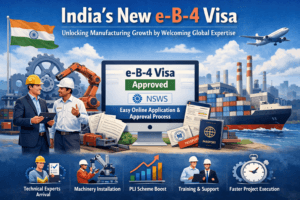
India’s New e-B-4 Visa: Unlocking Manufacturing Growth by Welcoming Global Expertise
India’s manufacturing ambitions have long been hampered by a critical, yet often overlooked, bottleneck: the timely arrival of foreign technical experts. For companies importing specialized machinery from Germany, Japan, or China, a machine sitting idle on a factory floor for weeks, waiting for a specialist’s visa, represents a direct hit to productivity and profitability. In a decisive move to eliminate this friction, the Indian government has launched a simplified e-Production Investment Business Visa (e-B-4 Visa), a reform that promises to accelerate project execution and strengthen India’s position as a global manufacturing hub.
From Bureaucratic Hurdle to Strategic Enabler
The genesis of the new e-B-4 visa lies in persistent complaints from the industry. Domestic manufacturers, particularly those capitalizing on government Production-Linked Incentive (PLI) schemes, repeatedly flagged severe delays in securing visas for foreign engineers and technicians. These experts are essential for the installation, commissioning, and maintenance of high-tech imported equipment. Without them, billion-dollar investments in new production lines risked stalling before they even began.
Recognizing this as a major impediment to the “ease of doing business,” the Ministry of Home Affairs issued a pivotal circular in August 2025. This circular reclassified key activities. Previously, foreign nationals coming to install equipment under a supply contract or those receiving fees from an Indian company needed an employment visa—a category with more stringent requirements and longer processing times. The reform shifted these activities to the business visa regime and created a dedicated new sub-category: the B-4, or Production Investment Visa.
The bureaucratic process was described as “cumbersome and lengthy,” involving multiple layers of approvals and recommendations from various line ministries. The new system, operationalized by the Department for Promotion of Industry and Internal Trade (DPIIT), aims to replace this complexity with digital efficiency and transparency.
Inside the New Digital Gateway: How the e-B-4 System Works
The core of the reform is a digital module launched on November 29, 2025, on the **National Single Window System (NSWS)**—a government platform designed to unify business compliance processes.
Here’s a breakdown of the streamlined journey for a company and a foreign expert:
- For the Indian Company: Instead of navigating paper-based applications across ministries, an authorized company representative logs into the NSWS. They fill a simplified online form to generate a digital sponsorship letter for the invited professional. Crucially, the system auto-populates company data by authenticating against existing government databases like the Ministry of Corporate Affairs (MCA) and the GST Network (GSTN). This eliminates the need for separate documentation and, most importantly, removes the requirement for a recommendation from the relevant line ministry. The company instantly receives a unique sponsorship letter ID.
- For the Foreign Expert: The professional uses this unique ID when applying for the e-B-4 visa on the official Indian e-visa portal (indianvisaonline.gov.in). The integration between the NSWS and the visa portal via an API allows for instant verification of the sponsorship. The visa, valid for a period ranging from one to six months, is then issued electronically.
The scope of permitted activities under this visa is precisely tailored to manufacturing needs, covering:
- Installation, commissioning, and quality checks of equipment.
- Essential maintenance and production support.
- IT and ERP system ramp-up.
- Training of Indian workforce.
- Supply chain development and vendor empanelment.
- Plant design and visits by senior management for investment oversight.
Table: A Comparison of the Old Process vs. The New e-B-4 System
| Feature | Old Process | New e-B-4 Visa Process |
| Visa Category | Often required an Employment Visa for technical work. | Dedicated Business Visa sub-category (B-4) for production investment. |
| Sponsorship Letter | Manual, paper-based process. | Digital generation via the NSWS portal; 129+ already issued. |
| Key Requirement | Recommendation from the concerned Line Ministry was often mandatory. | Line Ministry recommendation eliminated; auto-authentication via MCA/GSTN. |
| Processing Time | Described as “cumbersome and lengthy,” involving multiple approvals. | Designed for significant reduction; “time taken to grant visas will be significantly shorter now”. |
| Eligibility | Could be ambiguous, leading to delays. | Clear scope for PLI and non-PLI beneficiary firms. |
Strategic Implications: More Than Just a Faster Visa
The introduction of the e-B-4 visa is not an isolated administrative tweak but a strategic intervention with wide-ranging implications.
- Supercharging PLI Schemes: The multi-billion-dollar PLI schemes across 14 sectors, from electronics to drones, are predicated on rapid capacity building. By ensuring that specialized global expertise is just a click away, the government is effectively de-risking these investments and enabling faster scale-up to meet production targets.
- Addressing the China Dependency: Reports specifically mention that Indian firms had faced difficulties securing visas for Chinese professionals, whose expertise is critical for machinery imported from China. By creating a transparent, rules-based channel, the reform mitigates a key operational risk for many manufacturers while maintaining necessary oversight. It pragmatically separates essential technical collaboration from broader geopolitical considerations.
- Elevating India’s Business Ecosystem: This move sends a powerful signal to global investors and supply chains. It demonstrates that India is proactively listening to industry and using digital governance to solve ground-level problems. It directly addresses a key metric in global indices for “ease of doing business,” making the country a more attractive destination for complex, technology-intensive manufacturing.
Real-World Impact and the Road Ahead
The early uptake is promising, with 129 sponsorship letters already generated within weeks of the module’s launch. For a mid-sized auto parts manufacturer awaiting a German engineer to commission a new robotic line, this reform translates directly into saved costs, met export deadlines, and realized revenue.
However, the success of this policy will hinge on its consistent implementation. Key challenges to monitor include:
- Consular Discretion: While the central policy is clear, its uniform application across all Indian embassies and consulates worldwide will be critical.
- Clarity on Long-Term Engagements: The visa’s one-to-six month validity is perfect for project-based work, but may need complementary solutions for roles requiring recurring short-term visits.
- System Reliability: The digital process’s efficiency depends on the seamless uptime and integration of the NSWS, MCA, and GSTN databases.
It is also important to distinguish this from similarly named programs elsewhere. For instance, India’s B-4 Visa is a non-immigrant business visa for temporary work. It should not be confused with the United States’ EB-4 visa, which is an immigrant visa category for “special immigrants” like religious workers or certain government employees seeking permanent residence.
Conclusion: A Welcome Step in India’s Industrial Journey
India’s new e-B-4 visa is a masterclass in targeted regulatory reform. By identifying a specific, persistent pain point for its manufacturing sector and deploying a digital solution to address it, the government has shown a practical commitment to industrial growth. This policy goes beyond mere facilitation—it acts as a force multiplier for domestic and foreign investment in Indian production.
In the competitive race to attract global capital and technology, infrastructure and incentives are crucial, but so is operational smoothness. By ensuring that the human expertise required to bring factories to life can enter the country predictably and efficiently, India has removed a significant barrier. This reform, while technical in nature, is a foundational step towards realizing the vision of a truly globally integrated and resilient ‘Make in India’ economy.
You must be logged in to post a comment.