
India’s Minority Rights at a Crossroads: An Analysis of Legal Shifts and Social Realities Under BJP Governance
India’s constitutional framework, established to protect religious minorities through equality guarantees and cultural safeguards, has faced significant strain under the BJP-led government since 2014, with critics documenting a systematic shift toward majoritarian governance. While the administration emphasizes inclusive development and reforms like banning triple talaq, its tenure has been marked by discriminatory laws such as the Citizenship Amendment Act (which excludes Muslims), a surge in anti-minority hate speech and violence often met with inadequate state response, and political marginalization evidenced by the absence of Muslim ministers in the 2024 cabinet.
This contrast between constitutional secular ideals and on-the-ground realities, including the use of “bulldozer justice” and anti-conversion laws, has heightened insecurity among Muslim, Christian, and other minority communities, positioning the protection of minority rights as a central test for India’s democratic integrity.
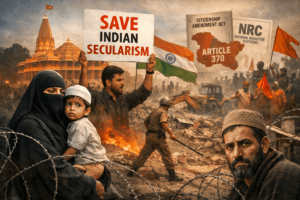
India’s Minority Rights at a Crossroads: An Analysis of Legal Shifts and Social Realities Under BJP Governance
The Evolution of a Secular Compact
India’s constitutional architects envisioned a secular, pluralistic republic where the rights of minorities were not merely protected but celebrated as integral to the nation’s fabric. With a legal framework built on Articles 14-15 (guaranteeing equality), Articles 25-28 (ensuring freedom of religion), and the crucial Articles 29-30 (protecting minority cultures and educational institutions), the founding document sought to balance majority rule with minority safeguards. For decades, this intricate balance defined the world’s largest democracy. However, since the Bharatiya Janata Party (BJP) came to power in 2014 and secured a third term in 2024, a series of legislative actions, political rhetoric, and social changes have prompted a fundamental re-examination of this compact. This analysis explores the widening gap between constitutional ideals and on-the-ground realities for India’s religious minorities, with a particular focus on Muslims, who constitute approximately 14% of the population.
The Legal and Institutional Landscape: A Shift in Framework
The current government has pursued a dual-track approach: enacting laws that are formally justified as promoting equality or national integration, while critics argue they institutionalize religious discrimination.
Table: Key Policy Initiatives and Their Critiques
| Policy/Law | Official Justification | Critiques & Documented Impacts |
| Citizenship Amendment Act (CAA), implemented 2024 | Provides refuge to persecuted non-Muslim minorities from three neighbouring countries. | Explicitly religious criteria for citizenship; excludes Muslims, Rohingya, Sri Lankan Tamils, Ahmadiyyas. Called a “bigoted law” by Amnesty International. |
| Ban on Instant Triple Talaq, 2019 | Empowers Muslim women by banning an archaic, unequal form of divorce. | Praised by some Muslim women; but viewed by critics as selective intervention in Muslim personal law aligned with majoritarian politics. |
| Abrogation of Article 370, 2019 | Integrates Jammu & Kashmir with the rest of India, fosters development, and applies national laws uniformly. | Imposed via communication blackout and mass arrests; accused of dismantling autonomy without local consent, risking demographic change. |
| “Anti-Conversion” & “Cow Protection” Laws | Protects religious faith and safeguards animal revered by many Hindus. | Used to target interfaith marriages and legitimate cattle trade; enable vigilante violence against Muslims and Christians. |
The CAA represents a landmark shift. By creating a religious test for fast-tracked citizenship—available to Hindus, Sikhs, Buddhists, Jains, Parsis, and Christians from Afghanistan, Bangladesh, and Pakistan, but explicitly excluding Muslims—it marks the first time religion has been overtly used as a criterion for Indian citizenship. When paired with proposals for a nationwide National Register of Citizens (NRC), it creates a scenario where Muslims unable to prove citizenship could be rendered stateless with no fast-track naturalization path, while non-Muslims in the same position could seek protection under the CAA. This has induced profound anxiety within Muslim communities.
Similarly, the revocation of Jammu and Kashmir’s special status in August 2019 was executed under a severe security and communication clampdown, with the detention of local political leaders and months-long internet shutdowns. While upheld by the Supreme Court in 2023 and framed as enabling integration, the move is viewed by many Kashmiri Muslims as a unilateral disempowerment that strips their region of its distinct constitutional identity and could alter its demographic character.
The Social and Political Atmosphere: Rhetoric, Violence, and Marginalization
Beyond legislation, a pervasive climate of hostility has been documented. Hate speech against minorities, particularly Muslims, saw a 74% surge in 2024, with about 80% of documented incidents occurring in BJP-ruled states. Research indicates that 90% of religion-based hate crimes between 2009 and 2019 occurred after the BJP took power in 2014.
A disturbing pattern involves state complicity or inadequate response to violence. Authorities have been repeatedly accused of failing to curb attacks by Hindu nationalist groups and, in some cases, punishing the victims. The practice of “bulldozer justice”—the unlawful demolition of Muslim homes, businesses, and places of worship, often as collective punishment after communal clashes—continued despite a Supreme Court ruling in November 2024 declaring such actions illegal without due process.
Political marginalization has also deepened. For the first time in India’s history, the union cabinet formed in 2024 included no Muslim ministers. Muslim representation in the Lok Sabha fell to just 24 seats (4.4%) in the 2024 elections, significantly below their population share. Current controversies, like the Special Intensive Revision (SIR) of electoral rolls, are viewed by the opposition as tools to disenfranchise poor and minority voters, with critics alleging it functions as a covert citizenship survey targeting Muslims.
Table: Documented Social Impacts on Minority Communities
| Community | Primary Concerns | Notable Incidents (2024) |
| Muslims | Lynchings over cattle, “bulldozer justice,” hate speech, disenfranchisement fears, discriminatory laws. | 11 Muslim homes razed in Madhya Pradesh over beef allegations; killing of a Muslim migrant worker in Haryana for alleged beef consumption. |
| Christians | Mob attacks over “conversion” allegations, especially in tribal areas; use of anti-conversion laws. | Attack on a pastor in Chhattisgarh; mob assault on a prayer congregation in Madhya Pradesh. |
| Dalits & Adivasis | Systemic caste violence, economic exclusion, and targeting in conflict zones. | Dalit boy forced to drink urine in UP; escalated counterinsurgency operations in Chhattisgarh. |
| Residents of J&K | Loss of autonomy, prolonged detention of leaders, communication restrictions, and heightened security measures. | Continued internet shutdowns; arrests of activists like climate campaigner Sonam Wangchuk. |
A Battle of Narratives: “Inclusive Development” Versus Majoritarian Nationalism
The government’s narrative counters these criticisms by emphasizing a doctrine of “inclusive development” that benefits all citizens without distinction. It points to welfare schemes in housing, sanitation, and financial inclusion that reach minority communities and frames actions like the triple talaq ban as progressive, gender-justice reforms. The CAA is defended as a humanitarian gesture for persecuted non-Muslim neighbours, and the integration of Kashmir is presented as a necessary step for prosperity and national unity.
However, international human rights organizations, foreign governments, and India’s own political opposition describe a different reality. The European Parliament has raised concerns about “violence, increasing nationalistic rhetoric and divisive policies”. The UN Human Rights Committee has questioned India about discrimination against minorities. In a significant rebuke, India’s National Human Rights Commission lost its UN accreditation in 2024 over independence concerns.
This divergence reflects a deeper ideological project: the transformation of India from a secular state into a “Hindu Rashtra” (Hindu nation). Policies are evaluated through this lens. The construction of the Ram Temple in Ayodhya under official patronage, the legal changes in Kashmir, and the citizenship law are seen not as isolated acts but as interconnected steps in this political and cultural project, which inherently places religious minorities in a precarious, second-class position.
Looking Ahead: The Resilience of Institutions and Society
The trajectory of minority rights in India is at a critical juncture. While constitutional safeguards remain on paper, their enforcement has become selective and politically mediated. The independence of institutions like the judiciary, the election commission, and the human rights commission is under unprecedented strain.
Yet, resistance persists. Opposition parties, civil society activists, journalists, and ordinary citizens continue to challenge discriminatory policies in courts and in the public sphere. The Supreme Court’s intervention on demolitions and its call for a “truth and reconciliation commission” in Kashmir, however limited, show the constitution’s enduring potential.
Ultimately, the status of India’s minorities will determine the character of Indian democracy itself. As the world watches, the fundamental question remains whether the country can uphold its founding pledge of equality for all, or if majoritarian impulses will redefine the world’s largest democracy in ways that will resonate for generations. The evidence from the ground, as documented by myriad sources, suggests a democracy under severe stress, struggling to reconcile its pluralistic soul with a rising majoritarian identity.
You must be logged in to post a comment.