
India’s March Weather Paradox: A Nation in Two Seasons Today
On March 13, 2026, India finds itself in a dramatic weather divide as a weak western disturbance brings a final touch of winter to the Himalayan regions with snowfall in places like Jammu & Kashmir, while the rest of the country, particularly western and central India, swelters under an intense early heatwave, with Delhi NCR experiencing a staggering 37°C (8-9 degrees above normal) and Ahmedabad bracing for a scorching 39°C. This meteorological paradox creates vastly different lived experiences across the nation, from the cold, cautious travel in the north to the heat-stressed commutes and health risks in the plains, serving as a stark reminder of India’s climatic diversity and the growing reality of adapting to seasonal extremes.
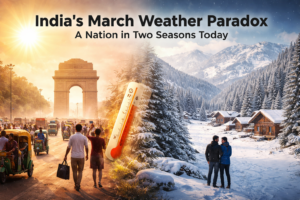
India’s March Weather Paradox: A Nation in Two Seasons Today
As the Ides of March arrive, India finds itself caught in a meteorological tug-of-war. On one side, an unrelenting early heat is gripping the western and central plains; on the other, a touch of winter lingers in the Himalayan highs. Here’s how the day unfolds for a billion people on March 13, 2026.
There is a moment in the Indian calendar when the weather becomes a national obsession. It’s not quite summer, but winter is a fading memory. That moment is now. Today, March 13, 2026, India is not experiencing one season, but two. According to the India Meteorological Department (IMD), the subcontinent is a land of stark contrasts, where conversations in one state are about finding the nearest air conditioner, while in another, they’re about digging out woolen socks for a surprise spring snowfall.
This isn’t just a data point; it’s the lived reality of 1.4 billion people. From the concrete jungles of the National Capital Region (NCR) to the serene, snow-laden valleys of Kashmir, the weather is dictating routines, health, and even moods. Let’s move beyond the statistics and look at what the forecast actually means for the people on the ground.
The Great Divide: Where Winter Refuses to Leave and Summer Arrives Early
The defining feature of today’s weather is the presence of a weak western disturbance over northern India. Think of it as a tired traveler arriving from the Mediterranean, still carrying a little moisture but lacking the energy to cause widespread disruption. However, its interaction with the warm landmass below is creating a fascinating weather cocktail.
Up in the Western Himalayan Region, which includes Jammu & Kashmir, Himachal Pradesh, and Uttarakhand, this disturbance is a final, wistful sigh of winter. For the higher altitudes—think Gulmarg, Sonamarg, or the upper reaches of Manali—this means a fresh dusting of snow.
The Human Element: For a hotel owner in Pahalgam, this forecast is a business opportunity. “This late snow is a gift,” he might tell you. “Tourists who thought the season was over are extending their stays. It makes the valley look like a bride again.” However, for the local shepherd or the truck driver navigating the precarious Srinagar-Leh highway, it’s a reminder of nature’s authority. The IMD’s prediction of “light rain and snowfall” translates to real-world caution: chains for tires, extra blankets, and a slower pace of life. For the lower valleys, like the plains of Jammu, it means grey skies and a pleasant nip in the air that feels more like January than March.
Meanwhile, 1,500 kilometers to the southwest, the story couldn’t be more different.
The Heat is On: Delhi NCR and the Great Indian Toaster
The most alarming forecast of the day belongs to the national capital. Delhi NCR is staring down the barrel of a 37°C day. To put that in perspective, the normal maximum for this time of year hovers around 28-29°C. An 8-9 degree anomaly isn’t just “above average”; it’s a climatic exclamation mark.
Life at 37°C in March:
- The Commuter’s Plight: For the office worker waiting for a bus at the ITO crossing or the auto-rickshaw driver stuck in traffic at Rajiv Chowk, 37°C feels like being inside a tandoor. The “light winds” mentioned in the forecast offer about as much relief as a handheld fan in a blast furnace.
- The Power Grid: As the temperature spikes, so does the demand for electricity. ACs and coolers, which usually get a thorough servicing in April, are being switched on today. The Delhi power distribution companies are on high alert, knowing that an early spike in demand can strain the city’s infrastructure.
- Health Advisory: For the city’s vast population of outdoor workers—construction laborers, street vendors, and delivery agents—today is a day of heightened risk. The IMD’s mention of “heat stress” is not a euphemism. It means starting work earlier, taking longer breaks in the shade, and consuming significantly more water to avoid dehydration.
The dry, punishing heat isn’t confined to Delhi. It stretches across the plains, with Ahmedabad potentially becoming the nation’s hotspot at a scorching 39°C. In Gujarat, this is officially “heatwave conditions.” For farmers tending to their wheat and mustard crops, the rising mercury is a double-edged sword. While it aids in the ripening of the grain, an unrelenting heatwave can cause the grains to shrivel, impacting yield.
Coastal Contrasts: The Humid Grip of Mumbai, Chennai, and Bengaluru
Travel to the coasts, and the heat takes on a different character—it’s sticky and persistent.
Mumbai remains relatively “cool” on paper, with temperatures hovering between 27°C and 30°C. But in the Maximum City, the real story is the humidity. The “sea breezes” mentioned are the city’s lifeblood. By late afternoon, as the land heats up, the cool air from the Arabian Sea rushes in, offering a daily ritual of relief for millions crammed into local trains and chawls. Today, that sea breeze is the most anticipated event of the evening.
Down south, Chennai is bracing for a warm and humid day at 33-34°C. The phrase “feels warmer than the actual temperature” is a masterclass in understatement for Chennaiites. The high moisture content in the air means sweat doesn’t evaporate, leaving residents feeling perpetually sticky. It’s a day for electrolyte drinks and staying indoors during the peak afternoon hours.
And then there is Bengaluru. Once famed for its perpetual spring, the city now grapples with a changing climate. A forecast of “partly cloudy” with highs of 33°C might seem pleasant, but for those who remember the Bangalore of the 90s, it’s a stark reminder of how much the city has warmed. The “air-conditioned” tag for the city is no longer a joke about its IT parks, but a reality for its weather.
The Air We Breathe: AQI and the Start of the Pollution Season
As temperatures rise, so does another concern: air quality. While Delhi’s AQI of 165 (Moderate) is a far cry from the “Severe” episodes of November, it carries a different kind of risk.
In winter, pollution is trapped by cold, heavy air (temperature inversion). In summer, it’s a different beast. The heat stirs up dust and ground-level ozone, a dangerous pollutant formed when sunlight reacts with vehicle exhaust. A “Moderate” AQI of 165 might not trigger alarms, but for the 30% of Delhi’s population with some form of respiratory sensitivity, it means a slight scratch in the throat and a conscious decision to wear a mask.
The table showing Varanasi at 178 (Moderate) and Mumbai at 85 (Satisfactory) tells a story of urban development and geography. Coastal cities benefit from sea breezes that flush out pollutants, while inland cities, especially those in river valleys or with less wind, tend to accumulate particulate matter.
A Traveler’s Advisory: Navigating India’s March Extremes
If you are traveling today, the IMD’s report is your essential guide.
- Heading to the Hills (J&K, HP, Uttarakhand): Pack for winter. That 0°C to 7°C range in Srinagar means cold mornings and evenings. If you’re driving to higher altitudes like Sonmarg or Auli, check road conditions. Fresh snowfall, while beautiful, can lead to temporary road closures. Carry chains for your vehicle.
- Exploring the Plains (Delhi, Rajasthan, UP, Gujarat): Hydrate or die-drate. Carry water bottles, wear light cotton clothes, and use sunscreen. The sun is deceptively strong. A day out at the Taj Mahal in Agra or the palaces of Jaipur will be exhausting if you aren’t prepared for the 35-38°C heat.
- Visiting the Coasts (Mumbai, Chennai, Kolkata): Lightweight, breathable fabrics are your best friend. Linen and cotton will keep you more comfortable than synthetics. Be prepared for sudden sweat and seek out air-conditioned spaces during the midday lull.
The Science Bit: Why is This Happening?
Meteorologically, this is a classic pre-summer setup. The weak western disturbance grazing the north is the only thing preventing a complete heatwave. As it moves away, the stage will be set for a more intense build-up of heat.
The IMD’s mention of another western disturbance around mid-March is crucial. If that system is stronger, it could bring much-needed thunderstorms and rain to the northern plains, providing a “dust storm” relief from the heat. If it’s weak, the heat will continue to build.
Conclusion: Adapting to the New Normal
The weather of March 13, 2026, is more than just a collection of numbers in a table. It is a snapshot of a country in transition. It’s the sight of snowflakes on a Kashmiri pine, the shimmering heat waves on a Delhi road, the salty breeze on a Mumbai evening, and the stubborn humidity of Chennai.
It highlights the incredible diversity of the Indian subcontinent, but it also serves as a gentle reminder of our changing climate. The early heatwave conditions in Gujarat and the 8-degree anomaly in Delhi are not just anomalies; they are part of a trend that demands awareness and adaptation.
So, as you go about your day on March 13, take a moment to look up at the sky. Whether you’re pulling a shawl tighter in the north or wiping sweat from your brow in the west, you are participating in the grand, chaotic, and ever-fascinating drama of the Indian weather. Stay safe, stay hydrated, and stay tuned for the next chapter in this seasonal story.
You must be logged in to post a comment.