
India’s Long, Hot Summer: Why 2026 Could Be a Season of Extremes and How to Survive It
The India Meteorological Department (IMD) has issued a stark warning for the summer of 2026, forecasting above-normal temperatures and a significant increase in heatwave days across large parts of the country from March to May, following a historically dry and warm February that saw the third-lowest rainfall in over a century. While a brief reprieve with near-normal temperatures and possible rain is expected in March, particularly in the northwest, the months of April and May are poised to be extreme due to the transition from a weak La Niña to an El Niño pattern, which typically intensifies heat. This prolonged heatwave season poses severe risks to public health, particularly for vulnerable populations, and will place immense stress on water resources and power grids, prompting the IMD to urge state authorities to prepare cooling shelters and health surveillance systems while also advising individuals to adopt proactive measures like disciplined hydration and adjusting daily routines to cope with the escalating threat.
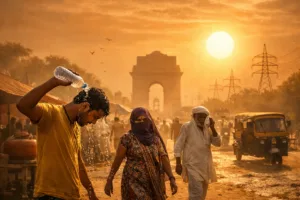
India’s Long, Hot Summer: Why 2026 Could Be a Season of Extremes and How to Survive It
The official warning came on a Saturday morning, buried in the meteorological jargon of probability percentages and spatial anomaly maps. But for the 1.4 billion people of India, the message from the India Meteorological Department (IMD) on February 28, 2026, was brutally simple: get ready for a scorcher.
After a February that felt more like a pre-summer dress rehearsal, the IMD has forecast a season of intense and prolonged heat. While a brief reprieve is expected in March, the outlook for April and May is daunting, with above-normal temperatures and an increased number of heatwave days predicted for large swathes of the country. This isn’t just another news cycle; it’s a public health advisory, an infrastructure stress test, and a call for a fundamental shift in how we prepare for the new normal of Indian summers.
The Calm Before the Scorch: Understanding the March Reprieve
The IMD’s forecast offers a sliver of hope: March might not be a washout. In fact, parts of northwest India, including the national capital region, Punjab, and Haryana, can expect near-normal maximum temperatures for the first half of the month. The culprit behind this brief cool-down is the possibility of active western disturbances—weather systems that bring rain and thunderstorms to northern plains.
IMD Director General M. Mohapatra pointed to this as a key factor. “We can say that maximum temperatures are likely to be normal in March over parts of northwest India before hot temperatures set in. We can also expect rainfall over northern plains and clouding in March,” he explained.
For residents of cities like Delhi, which sweltered through an unusually warm February, this news offers a moment to breathe. But it’s a deceptive calm. Think of it as the tense silence before the overture of a symphony of heat. This March is not a sign that summer is weak; it’s merely a late starter. The atmospheric and oceanic engines that drive India’s pre-monsoon heat are already revving up, and once they hit full throttle in April, the mercury is expected to soar.
The Anatomy of a Heatwave: More Than Just a Hot Day
To truly grasp the gravity of the forecast, it’s essential to understand what a heatwave actually means. It’s not just a day when you feel uncomfortably warm. The IMD has strict criteria: a heatwave is declared when the maximum temperature of a station reaches at least 40°C in the plains, 37°C in coastal areas, and 30°C in the hills. Alternatively, it can be declared when the departure from normal is 4.5 to 6.4 degrees Celsius. A “severe” heatwave is declared when the temperature soars 6.5 degrees or more above normal.
The IMD’s forecast for the March-to-May season predicts an “above-normal number of heatwave days” across a vast swathe of the country. This isn’t a localized phenomenon. The regions highlighted—east and east-central India (Bihar, Jharkhand, West Bengal, Odisha), many parts of the southeast Peninsula (Andhra Pradesh), and even some parts of the northwest and west-central India (including parts of Gujarat, Rajasthan, Punjab, Haryana, and Uttar Pradesh)—read like a roll call of India’s most populous and agriculturally vital states.
In some of these areas, the number of heatwave days could be 3 to 15 days above the normal. To put that in perspective, a region that typically experiences 5 heatwave days in a season could be staring at 20. This isn’t just a statistical anomaly; it’s a prolonged period of physiological stress.
The Global Weather Engine: El Niño’s Shadow Looms Large
Why is this happening? The answer lies thousands of kilometers away, in the cool waters of the equatorial Pacific Ocean. The world is currently in the grip of a weak La Niña, the cooler counterpart to the infamous El Niño. However, this La Niña is fading fast.
According to the IMD, global models and its own Monsoon Mission Climate Forecast System (MMCFS) indicate a transition to “ENSO-neutral” conditions very soon, followed by a shift to El Niño later in the year. For Indians, an El Niño year is often a harbinger of trouble. Historically, it is associated with weaker monsoons and, crucially, harsher summers.
El Niño conditions mean that the Pacific Ocean releases a tremendous amount of heat into the atmosphere, disrupting global weather patterns. This can lead to a weakening of the Indian summer monsoon and, in the pre-monsoon months, can contribute to the build-up of extreme heat over the Indian subcontinent. The stage is being set for a summer where the odds are stacked against us.
Adding to the complexity are the neutral conditions in the Indian Ocean Dipole (IOD). While a positive IOD can sometimes counterbalance the negative effects of El Niño, the neutral IOD forecast for the coming months offers no such buffer. The atmospheric forces that drive India’s climate are aligning in a way that favours extreme heat.
The February That Wasn’t: A Precursor to Summer’s Fury
If the forecast for March to May feels abstract, the data from February 2026 provides a tangible, recent memory of what an “above normal” temperature scenario looks like. The IMD data reveals a staggering 59.9% rain deficiency for the country from January 1 to February 28. For northwest India, the deficiency was a crippling 89.5%.
This wasn’t just a dry February; it was a historically dry one. The all-India rainfall of 4.2 mm was the third lowest since 1901 and the lowest since 2001. For northwest India, the 5.9 mm of rainfall was the third lowest in over a century.
When the winter rains fail, they take with them a crucial natural coolant. The lack of moisture in the soil and the absence of cloud cover allowed the sun to beat down relentlessly. The result? Northwest India experienced its third warmest February on record when considering mean temperatures. The average minimum temperature for the entire country was a full 0.94 degrees Celsius above normal. This wasn’t just about hot afternoons; it was about warm nights that offered little respite, preventing our bodies from recovering from the daytime heat.
This February was not an outlier; it was the opening act. It demonstrated the power of a dry, rainless weather system to amplify temperatures. The same dry conditions, if they persist into the summer, will only make the heatwaves more intense and more frequent.
A Crisis of Health, Water, and Power
The IMD’s forecast is a scientific document, but its implications are deeply human. As the report itself warns, “the increased likelihood of heatwave conditions may pose significant risks to public health, water resources, power demand, and essential services.”
The Human Toll: A heatwave is a silent killer. It doesn’t announce itself with the roar of a cyclone or the gush of a flood. Instead, it creeps in, placing immense stress on the human body. When the ambient temperature exceeds skin temperature (around 37°C), the body can no longer cool itself efficiently by radiating heat. It relies entirely on sweating. But in humid conditions, sweat doesn’t evaporate, leading to a rapid rise in core body temperature.
This can lead to heat exhaustion, characterized by dizziness, nausea, and fatigue, and can quickly escalate to heatstroke, a life-threatening medical emergency where the body’s temperature rises above 40°C, causing the brain and other vital organs to shut down. The most vulnerable—the elderly, children, outdoor workers like construction laborers and farmers, and those with pre-existing medical conditions—are on the front lines.
Infrastructure Under Siege: Our cities are not built for this new climate. As temperatures soar, so does the demand for electricity as millions switch on air conditioners and coolers. This surge in demand can overload power grids, leading to blackouts precisely when power is needed most. Water scarcity becomes acute, with reservoirs depleting rapidly and groundwater tables falling. The poor, who often lack access to reliable electricity and water, bear the brunt of this infrastructure failure.
Beyond the Bulletin: A Call to Action
The IMD has done its job. It has issued the warning with scientific precision and a clear set of recommendations for state authorities: ensure cooling shelters are operational, guarantee adequate drinking water supply, and strengthen health surveillance.
But the response cannot be limited to government directives. This forecast is a call to action for all of us. As we brace for what could be one of the most challenging summers in recent memory, here is how we can add genuine value to our own lives and the lives of those around us:
For Individuals and Families:
- Hydration is a Discipline: Don’t wait until you’re thirsty. Carry a water bottle everywhere and drink regularly. Include hydrating foods like watermelon, cucumber, and citrus fruits in your diet.
- Plan Your Day Around the Sun: If you have outdoor work or exercise, do it in the early morning or late evening. Avoid being outdoors between 12 PM and 4 PM, the peak heat hours.
- Know the Signs: Learn to recognize the symptoms of heat-related illnesses. If you or someone you know feels dizzy, confused, or has hot, dry skin, seek medical help immediately and try to cool the person down.
- Check on Your Neighbors: A simple phone call to an elderly relative or a neighbor living alone can be a lifeline.
For Communities and Employers:
- Advocate for Shade and Water: In your local parks, bus stops, and markets, demand better shade structures and public water coolers.
- Protect Outdoor Workers: If you employ or manage people who work outdoors, adjust their shifts. Start earlier, break for longer during peak heat, and finish later. Provide ample shaded rest areas and plenty of cold water. This is not just compassionate; it’s a matter of life and death.
Thinking Long-Term:
- Heat-Proof Your Home: Simple, low-cost measures like painting your roof with reflective white paint (cool roof), installing window shades or curtains, and planting trees around your home can significantly reduce indoor temperatures.
- Urban Planning: This summer should be a wake-up call for our city planners. We need to aggressively pursue urban greening, protect our remaining water bodies, and design buildings that are fit for a warming world.
The IMD’s forecast for the summer of 2026 is a stark reminder that climate change is not a distant threat; it is our present reality. The days of viewing a heatwave as just a few uncomfortable weeks are over. We are entering an era where intense, prolonged heat is the new baseline. By understanding the science, heeding the warnings, and taking proactive, compassionate action, we can navigate this long, hot summer and build a more resilient future for the seasons to come.
You must be logged in to post a comment.