
India’s Labor Code Overhaul: Streamlining M&A or Adding Cost and Complexity?
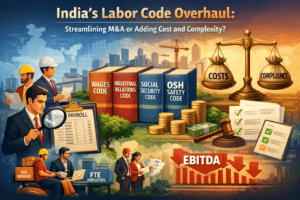
India’s Labor Code Overhaul: Streamlining M&A or Adding Cost and Complexity?
The journey to transform a labyrinth of 29 laws into four unified codes marks the beginning of a new era for Indian business, where every rupee saved on compliance could be offset by higher statutory costs and every M&A deal requires a microscope on the payroll ledger.
The consolidation of India’s 29 central labor statutes into four comprehensive Labour Codes—covering Wages, Industrial Relations, Social Security, and Occupational Safety—is now a reality . This monumental reform, effective from November 21, 2025, fundamentally reshapes the terrain for mergers and acquisitions . For dealmakers, the promise of streamlined compliance and predictable regulations is tempered by immediate financial pressures: a broader definition of wages inflates statutory costs, expanded worker classifications create hidden liabilities, and stringent new penalties elevate operational risks . In 2026, successful M&A in India will hinge on treating workforce diligence not as a legal afterthought but as a core financial and strategic exercise, directly impacting valuation, deal structure, and post-merger integration .
A Double-Edged Sword: Efficiency Gains vs. Immediate Cost Pressures
The new framework aims to dismantle decades of regulatory fragmentation. Historically, navigating 29 different laws with inconsistent definitions created a compliance maze, turning labor due diligence into a reactive, box-ticking chore that often failed to uncover hidden liabilities until late in a transaction . The new codes promise a unified system with standardized definitions, digital-first compliance (like single online registrations and returns), and clearer employer obligations .
However, this simplification coexists with a transitional dual regulatory environment. While the central codes are in force, individual Indian states are still formulating their specific rules, a process experts predict could take two to eight months . This creates significant uncertainty for businesses and acquirers, who must model compliance and cost scenarios under both old and emerging new rules, especially for targets with operations across multiple states .
The most immediate and universal financial impact stems from the new, uniform definition of “wages” under the Code on Wages . A critical 50% rule now caps the portion of total remuneration that can be classified as excludable allowances (like special allowances). Any amount exceeding 50% must be added back to the “wage” base for calculating statutory contributions . For companies that historically structured compensation with a low basic salary and high allowances to minimize provident fund (PF) and gratuity costs, this triggers an inescapable cost increase.
Sector-Specific Implications of the New Labour Codes
The following table outlines how key reforms affect major business sectors, highlighting both new obligations and strategic opportunities:
| Sector | Key Code Impact | M&A & Operational Takeaway |
| Manufacturing & Engineering | Unified national safety standards (OSH Code); Formalized fixed-term employment (FTE) . | Predictable pan-India factory compliance aids ESG goals; FTE model offers staffing flexibility for projects . |
| IT/ITES & Global Capability Centers (GCCs) | Mandatory salary timelines; Explicit permission for women’s night shifts with safeguards . | Ensures transparent payroll; Supports greater women workforce participation and 24/7 operations . |
| Platforms & Gig Economy | First-ever legal definitions for “gig” and “platform” workers; Mandatory 1-2% turnover contribution to social security fund . | Clear regulatory framework for scaling; Direct new cost line impacting valuation and unit economics . |
| Construction & Infrastructure | Strengthened protections for inter-state migrant workers; Enhanced principal employer liability for contract worker welfare . | Increases due diligence on contractor management; Higher compliance burden for on-site welfare . |
From Compliance to Cash Flow: Reshaping M&A Fundamentals
The financial ramifications of the wage definition shift directly hit a company’s bottom line. A broader wage base increases employer contributions to the Employees’ Provident Fund (EPF), gratuity, bonus, and Employees’ State Insurance (ESIC) . These are not one-time penalties but recurring operational cost increases, leading to a structural reduction in Earnings Before Interest, Taxes, Depreciation, and Amortization (EBITDA) . In labor-intensive sectors like manufacturing, logistics, or retail, where payroll is a major expense, this EBITDA compression can be significant, forcing a downward recalibration of enterprise value and purchase price .
Beyond traditional employees, the codes dramatically expand the universe of “workers” entitled to statutory benefits. The Code on Social Security formally brings gig workers and platform workers under its umbrella. For digital aggregators (like ride-sharing or food delivery companies), this introduces a direct new cost: a contribution of 1-2% of their annual turnover to a social security fund for these workers . This turns what was often an off-balance-sheet workforce into a clear financial liability that must be modeled in deals.
Similarly, fixed-term employees (FTEs) are now entitled to gratuity after completing just one year of service (down from five), aligning their benefits much more closely with permanent staff . For businesses reliant on project-based hiring, this creates higher-than-expected accrued liabilities. These changes force acquirers to conduct granular workforce classification audits. Misclassifying a consultant or commission-based agent could lead to inheriting massive, unprovided liabilities for backdated PF, gratuity, and ESIC contributions .
Strategic Shifts in Deal Structuring and Integration
The new regime offers a mixed bag for post-merger integration. On one hand, it increases flexibility: the threshold for seeking government approval for layoffs, retrenchment, or closure has been raised from 100 to 300 workers . This significantly reduces regulatory friction for mid-sized acquisitions, allowing faster, synergy-driven workforce rationalization.
On the other hand, the cash cost of exits has risen. Employers must now contribute an amount equivalent to 15 days’ wages per retrenched worker to a new Re-skilling Fund, on top of existing retrenchment compensation . Furthermore, all final settlements must be paid within two working days of an employee’s exit—a dramatic tightening of timelines that puts immense operational and liquidity pressure on integration teams, especially in large business transfers .
The penalty regime under the new codes, particularly the Occupational Safety, Health and Working Conditions (OSH) Code, elevates compliance from a routine matter to a material transaction risk. While the number of imprisonable offenses has been reduced, financial penalties have surged substantially—reaching up to INR 200,000 (approx. USD 2,400) for serious safety violations—and director liability has been emphasized . A legacy safety violation discovered post-acquisition can now result in a major fine, not just a nominal slap on the wrist.
Consequently, labor due diligence is moving decisively into the pre-signing phase. Dealmakers are responding with more sophisticated risk allocation mechanisms, moving beyond generic indemnities to demand labor-specific escrows, ring-fenced indemnity caps for legacy violations, and detailed conditions precedent requiring clean safety audits before closing .
Practical Checklist for M&A Under the New Labour Codes
For deal teams and investors evaluating Indian targets in 2026, a proactive and financially-oriented approach is essential:
- Re-Model EBITDA with New Costs: Do not rely on historical payroll data. Stress-test the target’s financials by applying the new 50% wage definition to recalculate PF, gratuity, and ESIC outflows. Model the impact of the 1-2% turnover levy for platform companies .
- Conduct a Granular Workforce Census: Go beyond the employee headcount. Map all gig workers, platform workers, FTEs, and contract staff. Quantify the potential liability if any group is reclassified by authorities .
- Fund the Exit Strategy Upfront: If workforce rationalization is part of the integration plan, budget for the additional 15-day Re-skilling Fund contribution per retrenched worker and ensure liquidity to meet the strict two-day final settlement rule .
- Negotiate Specific Protections: Insist on transaction documents that address forward-looking cost increases from the codes, not just historical non-compliance. This includes specific indemnities, purchase price adjustments, and extended survival periods for labor-related reps and warranties .
- Plan for State-Level Variability: For multi-state targets, build contingency into the deal timeline and cost models for varying state rule implementations. Engage local counsel to monitor state notifications closely .
The long-term vision of India’s labor reform is a more transparent, predictable, and efficient business environment—one that aligns with global governance and ESG standards and reduces the “inspector raj” . For the M&A community, this means the end of interpretative arbitrage and hidden labor cost subsidies. In 2026 and beyond, labor will be unequivocally quantifiable as a financial variable on the balance sheet. The acquirers who thrive will be those who recognize this shift early, embedding deep workforce diligence into their financial modeling and deal structuring from the very first meeting. The era of labor as a compliance footnote is over; it is now a central pillar of valuation and risk.
You must be logged in to post a comment.