
India’s Jet Fuel Shock: How a War 2,000 Miles Away Is Emptying Pockets From Mumbai to Manila
Amid the ongoing US-Israel war with Iran, India’s jet fuel prices have hit a record high of over ₹207,000 per kiloliter—more than double the previous peak—prompting the government to stagger the increase for domestic flights to cushion airlines and passengers, while commercial LPG cylinders also rose by ₹195.5, straining the hospitality sector. The crisis has disrupted supply chains, affecting even condom manufacturing due to petrochemical shortages, and sparked opposition criticism of the government’s handling of rising essentials. Meanwhile, India launched its long-delayed 2027 population census with a new online self-enumeration option, and Delhi’s mayor received a hoax bomb threat linked to Khalistan slogans.
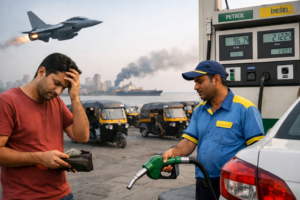
India’s Jet Fuel Shock: How a War 2,000 Miles Away Is Emptying Pockets From Mumbai to Manila
New Delhi – For a few fleeting hours on April 1, millions of Indians scrolled past the headlines hoping it was a cruel joke. The news that jet fuel prices had more than doubled—crossing the psychological barrier of ₹200,000 per kiloliter for the first time in history—felt too absurd to be true.
It wasn’t a prank. It was the price of a world on fire.
As the US-Israel war with Iran enters its second month, the tremors have finally reached the Indian tarmac and the corner tea stall. While the geopolitical world watches for missile strikes and diplomatic back-channels, in India, the crisis has manifested in a more intimate, visceral way: the soaring cost of getting from Delhi to Bengaluru, and the even more punishing cost of keeping a hotel kitchen running.
This is the story of how a conflict in the Strait of Hormuz is redefining the economics of everyday life for 1.4 billion people—and why your next flight just became a luxury good.
The Red Line: Why Jet Fuel Broke the Bank
To understand the panic inside India’s civil aviation ministry, you have to understand the math of flying in the subcontinent. In India, jet fuel (or ATF—Aviation Turbine Fuel) accounts for nearly 40% of an airline’s operating costs. It is the single largest variable expense.
On Wednesday, state-run oil marketing companies did the unthinkable. They raised the price of ATF to ₹207,341 per kiloliter in Delhi. To put that in perspective, during the 2022 Russia-Ukraine war—when the world last saw energy chaos—prices peaked at around ₹110,000.
This is nearly double that.
For a country that prides itself on being the world’s fastest-growing aviation market, this is an existential shock. IndiGo, SpiceJet, and Air India are suddenly staring at a fuel bill that has exploded overnight. The immediate instinct would be to pass the entire burden to the passenger. But there is a problem: India is a price-sensitive market. A ticket from Mumbai to Goa suddenly costing as much as a flight to Dubai would trigger a demand collapse.
The Government’s “Staggered” Lifeline
In a rare move that surprised even industry veterans, the government stepped in not with a subsidy, but with a scalpel.
The Ministry of Petroleum, in consultation with the Ministry of Civil Aviation, ordered PSU oil companies to stagger the pain. Instead of the full 107% increase, domestic airlines were asked to absorb a partial increase of just 25% (roughly ₹15 per liter) for now. The full price remains for international flights, meaning Indians flying abroad will feel the immediate brunt, but domestic routes get a temporary shield.
“Their timely intervention will go a long way in helping airlines navigate one of the most challenging global crises,” said Ajay Singh, CEO of SpiceJet, in a statement that sounded more like a sigh of relief than a press release.
But this is not a solution; it is a bandage. The government is essentially asking oil marketing companies to eat the loss temporarily, hoping the war de-escalates before the debt piles up. For travelers, it means the dreaded “fuel surcharge” is already back on tickets, but the complete meltdown of airfare pricing has been delayed.
Beyond the Airport: The LPG Squeeze on the Street
While the middle class worries about flight prices, the hospitality industry is fighting for survival. Commercial LPG cylinders—the 19-kg orange beasts that power every restaurant, dhaba, and five-star hotel kitchen in the country—saw another sharp hike of ₹195.5 per cylinder.
In Delhi, a commercial cylinder now costs ₹2,078.5.
This is the fourth hike in as many months. For a small eatery in a place like Majestic in Bengaluru or Chandni Chowk in Delhi, margins are already razor-thin. A chef who spoke to local media this week put it bluntly: “We can increase the price of chai by two rupees, but we cannot increase it by twenty. People will stop coming.”
The opposition has seized on this. Congress President Mallikarjun Kharge didn’t mince words, accusing the Modi government of “looting” the public during a crisis. While that language is politically charged, the data is not. Food inflation is creeping up, and the closure of the Strait of Hormuz has made petrochemicals—used in everything from plastic packaging to medicines—scarce.
The Unlikely Victim: India’s Condom Conundrum
In the most bizarre twist of this war, the supply chain disruption has hit India’s bedroom.
According to a report in The Indian Express, domestic condom manufacturers are facing a severe crisis. Why? Because petrochemicals, derived from crude oil, are a key ingredient in both the production and packaging of contraceptives.
India’s condom industry runs on a “high volume, low margin” model. Indians are notoriously price-sensitive about prophylactics. With the government reducing petrochemical production to prioritize fuel and LPG, manufacturers are facing raw material shortages and price volatility.
Industry insiders warn that if condom prices rise, it could directly impact family planning efforts in the world’s most populous nation. It is a stark reminder that in a globalized world, a missile hitting a refinery near the Persian Gulf can alter the price of a packet of condoms in a pharmacy in Lucknow.
The Quiet Geopolitics: Pakistan’s Moment?
As India grapples with domestic economic pain, a fascinating geopolitical subplot is unfolding. Analyst Murali Krishnan points out a bitter pill for New Delhi to swallow: while India is stuck in a neutral, cautious stance—calling the conflict “worrisome” but focusing on economic resilience—Pakistan is positioning itself as a mediator.
For decades, India has been the dominant strategic player in South Asia. But the Iran war has forced a realignment. Pakistan’s proximity to Iran and its complex relationship with the US allows it to play a shuttle diplomacy role that India, given its tight strategic partnership with Israel and the US, cannot easily replicate.
This has left New Delhi in an uncomfortable position. It is trying to secure its energy supplies and protect its 9 million citizens working in the Gulf, all while watching its rival take a diplomatic victory lap.
The Census: Counting 1.4 Billion in a Time of Crisis
Amid the chaos of rising fuel prices and bomb threats to the Delhi Mayor’s office (which turned out to be a hoax related to Khalistani slogans), India quietly launched its long-delayed 2027 population census.
This is the first digital-first census in Indian history. Citizens have 15 days to self-enumerate online before three million officials fan out across the subcontinent. The last census (2011) recorded 1.21 billion people. Today, estimates suggest India is home to over 1.4 billion.
Crucially, this census will attempt to collect caste data again—a politically explosive exercise. While the government claims it is necessary for welfare distribution, critics argue it entrenches identity politics. But for now, the debate is secondary to the logistics. Counting a billion people while the economy is reeling from an oil shock is a Herculean task.
The Road Ahead: A Summer of Discontent
As the sun sets on April 1, the reality sinks in. There is no joke here. The Indian rupee is under pressure (its worst performance in 14 years), the Strait of Hormuz remains volatile, and the US has shown no sign of backing down.
For the average Indian, the coming months will be a test of endurance. Domestic air travel will become a luxury for the upper middle class. Eating out will cost more. Even the price of a cup of tea at a roadside stall is likely to creep up as commercial LPG burns a hole in the vendor’s pocket.
The government’s decision to stagger the jet fuel hike has bought time, but not peace. Until the guns fall silent in West Asia, every Indian will pay the price—one liter of fuel, one cylinder, and one airline ticket at a time.
You must be logged in to post a comment.