
India’s Hidden Talent Crisis: Building a Skills Passport for the AI Era
As 2025 concludes, India’s primary challenge in the AI era is not technological adoption but the systemic inability to rapidly recognize and deploy its workforce’s evolving skills. Despite a silent boom in self-driven upskilling through online platforms, traditional hiring remains anchored to outdated proxies like degrees and college brands, creating a critical visibility gap where acquired competencies in fields like AI and cybersecurity go unrecognized. This disconnect between dynamic skill acquisition and static credential-based validation leads to widespread talent underutilization, constraining productivity and growth. The solution lies in building a national digital skills passport—a verified, portable record of capabilities—to complement degrees and shift hiring towards assessing demonstrated skills, thereby unlocking India’s human capital and turning its demographic dividend into a competitive advantage for a $5-trillion economy.
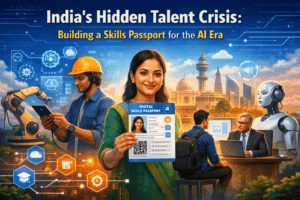
India’s Hidden Talent Crisis: Building a Skills Passport for the AI Era
Why the world’s fastest-growing digital economy is struggling to recognize its own workforce’s capabilities—and what must change.
As 2025 comes to a close, India stands at a crossroads familiar yet unprecedented. The nation has embraced artificial intelligence with characteristic enthusiasm, from bustling tech parks in Bengaluru to digital governance initiatives in remote districts. Yet, beneath this surface of progress lies a quiet, systemic fault line: India’s future competitiveness will be determined not by how quickly it adopts AI, but by how effectively it can redeploy, retrain, and recognize its human capital in response.
Globally, the skills required for AI-exposed roles are evolving at a breathtaking pace—66% faster than in less-exposed jobs, according to PwC. For India, with one of the world’s youngest and largest workforces, this velocity isn’t just a statistic; it’s a demographic imperative. The real disruption AI is causing isn’t mass unemployment—it’s the accelerating obsolescence of traditional education and hiring systems in the face of jobs that mutate faster than credentials can keep up.
The Broken Compact: Degrees No Longer Guarantee Relevance
India produces a staggering 1.5 million engineering graduates annually. Yet, for years, industry surveys have echoed a sobering refrain: fewer than half possess the immediately applicable skills needed for emerging roles in AI, cybersecurity, or cloud computing. This isn’t a reflection of intelligence or effort. It’s a profound misalignment between learning pathways, market needs, and recognition systems.
Historically, a degree was a durable signal—a once-and-for-all testament to employability. Today, in fast-evolving fields, its shelf life has shrunk to two or three years. The result is a national paradox: abundant talent on paper, but acute shortages in practice. Employers scramble to find AI engineers while fresh graduates struggle to bridge the gap between textbook theory and real-world application.
The Silent Upskilling Revolution Already Underway
What’s often missed in this narrative is that Indian workers aren’t waiting for the system to catch up. Over the past five years, the country has witnessed a silent, self-driven learning boom. Platforms like Coursera, SWAYAM, and numerous private skilling providers report soaring enrollments in tech-centric courses. India ranks among the top three global markets for online professional learning, with a significant portion of this upskilling happening alongside full-time jobs.
This shift is critical. Upskilling is no longer just remedial—something pursued after a job loss. It has become anticipatory and continuous, driven by the dual engines of fear (obsolescence) and aspiration (upward mobility). Government initiatives like Skill India, PMKVY, and the National Education Policy 2020 have lent legitimacy to this culture of lifelong learning. Yet, there remains a stubborn lag where it matters most: the hiring floor.
The Visibility Gap: When Skills Are Acquired But Not Seen
Here lies the core inefficiency. While millions are proactively acquiring relevant skills, employers continue to rely on outdated proxies for capability: prestigious college brands, specific degrees, and years of experience in linear roles. This creates a widespread “visibility gap”—workers possess current, job-ready skills that remain invisible to recruiters entrenched in traditional screening methods.
The World Economic Forum’s Future of Jobs 2025 report estimates that 44–46% of core job skills in India will change by 2030. In such an environment, judging a candidate based on a decade-old degree is like assessing a smartphone’s capabilities by its exterior design—it misses the entire updated operating system within.
The economic cost is substantial. India faces persistent shortages in critical areas like AI engineering, semiconductor fabrication, cybersecurity, and green energy—sectors vital for its strategic ambitions. Concurrently, millions of trained or trainable youth remain underemployed, their potential locked away by a system that cannot “see” their true capabilities.
Digital India for Everything—Except Skills Recognition
India’s achievement in building world-class digital public infrastructure—Aadhaar for identity, UPI for payments, DigiLocker for documents—is justly celebrated. Yet, when it comes to skills, the system remains stubbornly analogue. Credentials are scattered across paper certificates, private platform dashboards, institutional archives, and unverified informal experience. There is no unified, trusted, and portable record of what a person can actually do.
This gap becomes a critical bottleneck as India positions itself in high-growth sectors. How can labor mobility across states and industries be fluid if a certified cloud architect from a non-IIT background must start from scratch to prove their competency to every new employer?
The Case for a National Digital Skills Passport
The solution is not to discard degrees, but to complement and contextualize them with dynamic, verified proof of skill. India needs a National Digital Skills Passport—a secure, privacy-protected, and continuously updated record of an individual’s capabilities, aggregating learning from universities, online courses, apprenticeships, industry certifications, and on-the-job projects.
Linked to DigiLocker, this passport would allow employers to verify competencies directly, moving from inferring ability from pedigree to assessing demonstrated skill. The building blocks already exist in fragments: the National Skills Qualification Framework (NSQF), sector skill councils, and various digital credential initiatives. The challenge is integration, standardization, and—most critically—driving employer adoption.
From Credential-Based to Skills-First Hiring: A Necessary Shift
Implementing such a system requires a multi-stakeholder shift:
- Integration of Learning Ecosystems: Bringing platforms (public and private) into a shared, interoperable skills registry.
- Employer Nudging & Incentives: Encouraging both public sector and corporate hiring managers to adopt skills-first practices, potentially through preferential procurement policies or tax benefits.
- Outcome-Linked Skilling: Aligning government and corporate skilling subsidies with actual employment and wage outcomes, not just course completion.
- Continuous Learning Support: Introducing “learning leave” provisions, skill savings accounts with tax benefits, and employer co-investment models for staff upskilling.
Conclusion: The Human Infrastructure for a $5-Trillion Economy
If the 2010s were India’s decade of digital infrastructure, and the 2020s its phase of rapid AI adoption, then the 2030s must be defined by mastering human capital agility. The nation’s next productivity leap will come not from importing more technology, but from fully mobilizing and deploying the talent it already has.
The question is no longer whether India has talent. The evidence of a self-driven upskilling revolution proves it does. The pivotal question is whether India can build the recognition systems that see, trust, and deploy that talent at the speed the AI era demands. A Digital Skills Passport isn’t just a policy suggestion; it is the logical next layer of India’s digital public infrastructure—the layer that connects human potential to economic destiny. Without it, the nation risks building the future on a foundation of invisible talent. With it, India can turn its demographic dividend into an undeniable competitive advantage.
You must be logged in to post a comment.