
India’s Green Fuel Breakthrough: How Indigenous DME Technology Could Slash LPG Imports by ₹9,500 Crore Annually
Indian scientists at CSIR-NCL have developed an indigenous technology to produce Dimethyl Ether (DME), a clean-burning fuel that can be blended with LPG up to 20% as per new BIS standards, potentially reducing the country’s massive cooking fuel import bill by an estimated ₹9,500 crore annually through just 8% substitution. The breakthrough centers on a cost-effective Indian-developed catalyst and reactor system that operates at moderate pressures compatible with existing LPG infrastructure, requiring no modifications to cylinders or burners for low-concentration blends. Beyond household cooking, DME offers applications as an automotive fuel, aerosol propellant, and chemical intermediate, while its combustion produces substantially lower emissions of soot and pollutants than conventional fuels. With a pilot plant already operational at 250 kg per day and plans for a 2.5-tonne demonstration facility within months, the technology represents a strategic pathway toward enhanced energy security, reduced import dependence, and cleaner household energy for millions of Indian families.
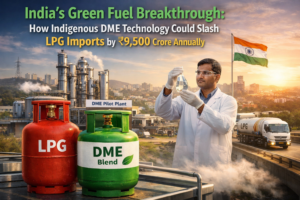
India’s Green Fuel Breakthrough: How Indigenous DME Technology Could Slash LPG Imports by ₹9,500 Crore Annually
The Hidden Vulnerability in India’s Energy Security
On the outskirts of Pune, inside the sprawling campus of the CSIR-National Chemical Laboratory (CSIR-NCL), a team of scientists has spent years perfecting a chemical reaction that could fundamentally alter India’s energy import calculus. Their achievement—an indigenous technology to produce Dimethyl Ether (DME)—arrives at a moment when global energy markets have reminded India, in the harshest possible terms, about the perils of import dependence.
When the press release went out on March 13, 2026, it contained numbers that deserve closer scrutiny than they typically receive in our 24-hour news cycle. India imports over 80% of its fossil energy requirements. In 2024 alone, we brought in nearly 21 million tonnes of Liquefied Petroleum Gas (LPG). The Pradhan Mantri Ujjwala Yojana, one of the world’s most ambitious household energy access programs, has provided 10.5 crore connections to families who previously cooked with biomass. But those connections come with a recurring cost: every refill is partially subsidized, and every subsidy is exposed to the vagaries of international energy markets.
The recent disruptions in global supply chains weren’t abstract economic events for millions of Indian households. They translated directly into higher LPG prices, creating a ripple effect through family budgets already stretched thin by inflationary pressures. This is the real-world context that makes the DME breakthrough at CSIR-NCL more than just another laboratory success story.
Understanding DME: The Fuel You’ve Never Heard Of
Dimethyl Ether occupies a curious position in the energy landscape. Chemically the simplest ether, with the formula CH₃OCH₃, it has been known to organic chemists for generations. But its potential as a fuel has remained largely untapped outside of niche applications, primarily because economical production methods remained elusive.
What makes DME attractive is its behavior under pressure. Like LPG, it liquefies at moderate pressures, making storage and transportation straightforward using existing infrastructure. Unlike LPG, it contains no carbon-carbon bonds, which means it burns with a clean, soot-free flame. When combusted, DME produces substantially lower emissions of particulate matter, nitrogen oxides (NOx), and sulfur oxides (SOx) compared to conventional fossil fuels.
Dr. Thirumalaiswamy Raja, who led the research team at CSIR-NCL, explains the significance in practical terms: “The thermal efficiency is comparable to LPG, but the environmental footprint is considerably smaller. For households that have spent generations breathing smoke from chulhas, or for urban families concerned about indoor air quality, this difference matters.”
The Bureau of Indian Standards has already recognized DME’s potential. Standard IS 18698:2024 now permits up to 20% blending of DME with LPG for domestic, commercial, and industrial applications. This regulatory approval removes a significant barrier to adoption—households and businesses can start using DME-blended fuel without waiting for new regulations or permissions.
The Indian Innovation: Why This Technology Is Different
What sets the CSIR-NCL development apart from existing DME production methods is its elegant simplicity. The conventional approach to DME production involves two steps: methanol is first produced from synthesis gas, then dehydrated to form DME. The Indian team has focused on optimizing the second step—methanol dehydration—with a catalyst that represents a genuine advance in the field.
The catalyst developed at CSIR-NCL is both highly active and cost-effective, two attributes that don’t always coexist in chemical processing. More importantly, the team integrated catalyst chemistry with reactor engineering from the outset, ensuring that what worked in laboratory-scale glassware could translate to industrial-scale steel reactors.
“The challenge wasn’t just making DME,” Raja notes. “It was making DME in a way that would be economically viable at Indian scales, with Indian cost structures, and using inputs that could eventually be sourced domestically.”
The process operates at approximately 10 bar pressure—significantly lower than many alternative methods—which enables direct filling into existing LPG cylinders with minimal additional equipment or operational costs. This pressure requirement is crucial: it means that cylinder filling stations don’t need expensive compressors or high-pressure handling systems to accommodate DME blending.
The team has already demonstrated the technology at a pilot scale of 250 kilograms per day, proving that the chemistry works outside the laboratory. Over the next six to nine months, they plan to scale up to an industrial demonstration plant with 2.5 tonnes per day capacity, partnering with a process engineering firm to validate the economics at larger scales.
The ₹9,500 Crore Question: What 8% Substitution Actually Means
Numbers like “8% substitution” and “₹9,500 crore savings” get thrown around in press releases, but translating them into real-world impact requires understanding how India’s LPG ecosystem actually functions.
Consider the 10.5 crore connections under the Ujjwala scheme. Each connection represents a family that transitioned from biomass cooking to LPG—a transition that brings health benefits, time savings, and dignity, particularly for women who previously spent hours collecting firewood or tending smoky chulhas. But each connection also represents a recurring cost to the exchequer, as LPG prices remain subsidized for these households.
Meeting just the 8% substitution target for Ujjwala beneficiaries alone would require 1,300 tonnes of DME production capacity daily. Spread across all Indian LPG consumption, 8% substitution represents approximately 1.68 million tonnes annually. At current international prices, that’s foreign exchange outflow that could remain in India.
But the savings aren’t merely financial. Every tonne of DME produced domestically reduces exposure to supply chain disruptions, shipping bottlenecks, and geopolitical tensions that can suddenly inflate import costs. For a country that has experienced the economic pain of oil price shocks repeatedly since the 1970s, this diversification of energy sources carries strategic value that transcends quarterly budget calculations.
Beyond the Kitchen: DME’s Broader Applications
While headlines naturally focus on cooking fuel—it touches every household, after all—DME’s utility extends far beyond the kitchen. The CSIR-NCL team points to several applications that could create industrial demand alongside household consumption.
As an automotive fuel, DME has attracted attention from diesel engine manufacturers. Its high cetane number (55-60) makes it suitable for compression ignition engines, and it burns without producing soot—eliminating the need for complex particulate filters that diesel vehicles require. Several European and Japanese manufacturers have experimented with DME trucks and buses, demonstrating that the technology works.
In aerosol products, DME offers an environmentally benign alternative to traditional propellants. It has zero ozone depletion potential and contributes negligibly to photochemical smog formation, making it attractive for everything from deodorants to industrial spray applications. As global regulations tighten around volatile organic compounds, DME’s clean profile becomes increasingly valuable.
The chemical industry also has use for DME as an intermediate. It can be converted to lower olefins—building blocks for plastics and synthetic fibers—through processes that offer alternatives to petroleum-based routes. Dimethyl sulfate and methyl acetate, both industrial chemicals with established markets, can also be produced from DME.
This diversity of applications matters for commercial viability. A DME producer isn’t betting everything on the cooking fuel market; they have multiple potential customers across different sectors, which improves the business case for investment.
The Infrastructure Question: What Changes for Consumers?
One of the most frequently asked questions about new fuels is whether consumers need to replace their equipment. The answer, in this case, is reassuring: for blends up to 8%, existing LPG cylinders, regulators, hoses, and burners work without modification.
This compatibility is not accidental. The CSIR-NCL team specifically targeted operating parameters that would align with India’s existing LPG infrastructure. They understood that asking 10.5 crore Ujjwala beneficiaries to buy new stoves would be a non-starter, regardless of the long-term benefits.
For higher blends, or for pure DME applications, modifications become necessary. The institute has already developed and patented a burner prototype that operates flexibly from 100% LPG to 100% DME, including any blend in between. This burner has undergone testing at the LPG Equipment Research Centre in Bengaluru, validating its performance and safety.
The existence of a tested burner design matters for the future. It means that as DME production scales up and experience accumulates, India could eventually transition to higher blend ratios or even dedicated DME applications without waiting for new product development cycles.
The Commercialization Pathway: From Laboratory to Market
Between a successful pilot plant and commercial reality lies a valley that many promising technologies never cross. CSIR-NCL’s strategy for bridging this gap reflects lessons learned from previous technology transfers.
The immediate next step is the 2.5 tonne-per-day demonstration plant, planned for completion within six to nine months. This scale is large enough to generate meaningful operational data—energy consumption, catalyst lifetime, maintenance requirements, and product quality consistency—while remaining small enough to allow design iterations without catastrophic cost overruns.
A demonstration plant at this scale also serves a crucial marketing function. Potential licensees—major oil public sector undertakings, bioenergy companies, chemical manufacturers—can visit an operating facility, see the technology in action, and evaluate its economics with their own engineers before committing to commercial-scale investment.
The institute is actively seeking partnerships with these entities. The public sector oil companies, in particular, represent an obvious pathway to market. They already operate India’s LPG supply chain, from import terminals to cylinder distribution networks. Adding DME blending to their operations would require incremental investment rather than building entirely new systems.
Bioenergy companies offer another intriguing possibility. DME can be produced from biomass-derived methanol, creating a pathway to renewable DME that qualifies for carbon credits and green fuel incentives. As India pursues its climate commitments under the Paris Agreement, bio-based DME could become part of the renewable energy portfolio alongside ethanol blending and biodiesel.
The Catalyst Question: What Makes This Technology Indigenous?
In an era of globalized science and technology, the term “indigenous technology” requires definition. The CSIR-NCL development is genuinely indigenous in several important respects.
The catalyst formulation was developed from first principles by the Indian research team, drawing on their understanding of methanol dehydration chemistry and their experience with similar catalytic systems. This isn’t a copy of a foreign process or a licensed technology adapted for local conditions—it’s original intellectual property generated in Pune.
The reactor engineering approach similarly reflects Indian thinking about process economics. By optimizing for moderate pressure operation, the team prioritized compatibility with existing infrastructure over chasing theoretical efficiency gains that would require expensive new equipment.
The burner design, tested and patented, addresses specifically Indian cooking practices. Indian cooking involves different flame characteristics, different pot sizes, and different usage patterns than Western kitchens. A burner optimized for European or American households might not perform adequately for Indian users; the CSIR-NCL design was developed with Indian cooking in mind.
This indigenous character matters for more than national pride. It means that royalties and licensing fees stay in India rather than flowing overseas. It means that Indian engineers and scientists develop expertise that positions them for future innovations. And it means that technology transfer to Indian companies happens without the restrictions that foreign licensors might impose.
The Strategic Context: Energy Security in an Uncertain World
India’s energy import dependence has long been recognized as a strategic vulnerability. The 1973 oil shock, the 1979 Iranian revolution, the 1990 Gulf War, the 2000s oil price surge—each event reminded policymakers that relying on others for essential supplies carries risks.
Recent years have added new dimensions to this vulnerability. The COVID-19 pandemic demonstrated how supply chains can fracture unexpectedly. Geopolitical tensions have shown that energy can be weaponized. Climate commitments are adding complexity to long-term planning, as the fuels of the future may differ fundamentally from today’s hydrocarbons.
DME offers a hedge against these uncertainties. Produced domestically, it insulates India from international price volatility. Produced from diverse feedstocks—natural gas, coal, biomass, even CO2 captured from industrial sources—it provides flexibility as resource availability and environmental constraints evolve.
The 1,300 tonnes per day required for Ujjwala substitution represents an achievable target. For comparison, India’s methanol consumption already runs to several thousand tonnes daily, with much of it imported. Building domestic DME capacity would create demand for domestic methanol production, potentially catalyzing investment in that sector as well.
Environmental Implications: Beyond Carbon Emissions
Discussions of clean fuels typically focus on carbon dioxide and climate change. DME’s environmental benefits extend beyond greenhouse gas considerations to include pollutants that affect human health directly and immediately.
Particulate matter from cooking fuels is a major health concern in India, particularly for women who spend time in kitchens. The World Health Organization estimates that household air pollution from solid fuels causes millions of premature deaths annually, with India bearing a disproportionate share of this burden. DME’s soot-free combustion eliminates this particulate exposure entirely.
Nitrogen oxides (NOx) contribute to ground-level ozone formation and respiratory problems. Sulfur oxides (SOx) cause acid rain and damage lungs. Both are substantially reduced with DME combustion compared to conventional fuels. For households that currently use kerosene or biomass, the improvement would be dramatic.
Even compared to LPG, DME offers advantages. LPG contains traces of sulfur and can produce some particulate matter under real-world conditions. DME’s molecular structure contains no carbon-carbon bonds and no sulfur, so these emissions are essentially zero when combustion is complete.
The Road Ahead: What Happens Next
The next six to nine months will determine whether this technology remains a laboratory curiosity or becomes an industrial reality. The demonstration plant scale-up will test not only the chemistry but also the team’s ability to work with engineering partners, manage construction timelines, and maintain quality control during scale transitions.
If the demonstration succeeds, commercial plants with capacities of 50 to 100 tonnes per day could follow. These would be substantial industrial facilities, representing investments of hundreds of crores each. Multiple such plants would be needed to achieve national-scale impact.
The partnership discussions with oil companies and bioenergy firms will be equally critical. Technology without commercial champions rarely achieves scale. The institute’s willingness to seek partners early in the process, rather than waiting for demonstration completion, suggests they understand this reality.
For the average Indian household, the impact of this technology will be invisible. LPG cylinders will continue to arrive, stoves will continue to light, food will continue to cook. The only difference might be slightly lower prices, or more stable prices, or the quiet satisfaction of knowing that the fuel comes from Indian innovation rather than foreign shipments.
But invisibility is often the hallmark of successful technology. When things work well, they fade into the background of daily life. The CSIR-NCL team’s achievement will be measured not by headlines, but by millions of households cooking their meals with a fuel that is cleaner, more secure, and more Indian than what they use today.
The science is sound, the economics are promising, and the strategic logic is compelling. What remains is execution—turning chemical equations into industrial reality, and industrial reality into national benefit. If the coming months go well, March 2026 may be remembered as the moment when India’s journey toward cooking fuel self-sufficiency quietly began.
You must be logged in to post a comment.