
India’s Geopolitical Tightrope: Navigating the US-Israel Offensive Against Iran
India faces a deepening geopolitical dilemma as it navigates the US-Israel military offensive against Iran, caught between its historic 75-year partnership with Tehran and Prime Minister Narendra Modi’s ideological and strategic alignment with Israel. While India has urged restraint and maintains critical interests in Iran—including the Chabahar Port and energy security—its actions tell a different story: it was the only BRICS founder not to condemn the attacks, co-sponsored a UN resolution against Iran, and has built a defense relationship with Israel worth hundreds of millions while allowing bilateral trade with Tehran to collapse. Modi’s personal bond with Benjamin Netanyahu and the Hindu nationalist affinity for Israel’s ethno-nationalist model have tilted New Delhi away from its traditional balancing act. Despite cautious gestures like hosting an Iranian naval ship, India’s strategic autonomy is under threat, leaving it with a stark choice: continue aligning with the US-Israel axis or restore the diplomatic equilibrium that once allowed it to engage both rivals without sacrificing its interests.
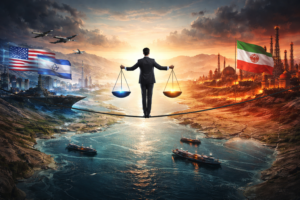
India’s Geopolitical Tightrope: Navigating the US-Israel Offensive Against Iran
New Delhi’s Delicate Balancing Act Between Old Allies and New Partnerships
The Middle East is once again on fire. Israeli and US air strikes have eliminated Iran’s supreme leader, Ayatollah Ali Khamenei, plunging an already volatile region into unprecedented uncertainty. As the world watches the escalating military confrontation, one country finds itself in an exceptionally precarious position: India.
For decades, New Delhi has practiced what diplomats euphemistically call “strategic autonomy”—the ability to maintain working relationships with rival powers while pursuing its own national interests. But that carefully cultivated balancing act is now facing its most severe test yet.
The Modi-Netanyahu Bond: More Than Just Diplomacy
When Israeli Prime Minister Benjamin Netanyahu’s government joined the United States in launching strikes against Iran, the timing was anything but coincidental. The military action came hot on the heels of Indian Prime Minister Narendra Modi’s whirlwind visit to Israel—a trip that produced a flurry of memoranda of understanding across artificial intelligence, cybersecurity, defence, and agriculture.
But the symbolism ran deeper than any signed agreement. Speaking before the Knesset, Israel’s parliament, Modi declared that India stands “firmly, with full conviction” alongside Israel. For this public display of loyalty, he received the Speaker of the Knesset Medal—an honour that, according to Israeli media reports, had never previously existed.
The Modi-Netanyahu relationship transcends conventional diplomatic ties. Both leaders represent right-wing nationalist movements that came to power promising to redefine their nations’ identities. For Modi’s Bharatiya Janata Party (BJP) and its Hindu nationalist supporters, Israel has become more than a defence partner—it represents an ideological model worth emulating.
The Transformation of India-Israel Relations
India’s relationship with Israel has undergone a remarkable transformation under Modi’s leadership. In 2017, he became the first Indian prime minister to visit Israel, a trip that reportedly was scheduled on the advice of the disgraced financier Jeffrey Epstein—a detail that speaks to the unusual backchannels sometimes involved in international diplomacy.
That same year, India emerged as the largest buyer of Israeli weapons, purchasing $715 million worth of military hardware, including the notorious Pegasus spyware. This surveillance technology would later make headlines for its use in monitoring opposition politicians, journalists, lawyers, and civil rights activists across India.
Today, more than 80 percent of India’s purchases from Israel consist of advanced technology designed for surveillance, protection, and precision military strikes. This defence relationship has fundamentally altered the strategic calculus between the two nations.
The Historic India-Iran Partnership
What makes India’s current predicament so challenging is its deep historical ties with Iran. Tehran was among the first nations to establish diplomatic relations with India after it became a republic. Over seventy-five years, the two countries have built something far more substantial than mere transactional diplomacy.
They signed a friendship treaty, issued the Tehran Declaration, and later the New Delhi Declaration—all frameworks designed to deepen cooperation across multiple domains. Iran has served as India’s gateway to Central Asia, its strategic partner in Afghanistan, and its counterbalance to Pakistan’s influence in the region.
Culturally, the connection runs even deeper. Persian influence permeates Indian architecture, cuisine, language, and literature. The shared civilisational history between the subcontinent and the Persian plateau predates modern nation-states by centuries.
Economically, Iran once supplied nearly 10 percent of India’s crude oil requirements. The Chabahar Port project in southeastern Iran—in which India has invested $120 million—was designed to provide New Delhi with direct land access to Afghanistan and Central Asia, bypassing Pakistan entirely.
The Strategic Cost of Realignment
India’s pivot toward Israel has come at considerable cost to its relationship with Iran. Bilateral trade has collapsed from approximately $17 billion in 2018 to roughly $1.68 billion in 2024-25. Indian investments in Iran’s oil and gas sector have largely stalled. And New Delhi has voted against Tehran at the International Atomic Energy Agency while halting Iranian oil imports after the United States reinstated sanctions.
The recent US-Israel air strikes reportedly targeted Chabahar specifically—a message that Washington and Jerusalem are willing to degrade Indian infrastructure to advance their strategic objectives.
India’s diplomatic positioning has also shifted. It was the only founding BRICS member that failed to formally condemn the attacks on Iran. Instead, New Delhi co-sponsored a UN resolution that condemned what it termed “egregious attacks” by Iran against Gulf Cooperation Council countries—language that effectively aligned India with the US-Israel position.
The Ideological Dimension
Understanding India’s current predicament requires acknowledging the ideological affinity between Hindu nationalism and Zionism. For many in Modi’s BJP, Israel represents a successful model of ethno-nationalist governance—a state that has secured international legitimacy while explicitly privileging the interests of its dominant religious group.
Critics of Modi’s government point to troubling parallels: Israel’s demolition of Palestinian homes, hospitals, and places of worship finds echoes in India’s destruction of Muslim residential and religious sites, often justified through language that portrays Muslims as “foreigners” or the “other.”
When Israeli forces launched their devastating campaign in Gaza, Hindu nationalist supporters celebrated openly. And when news broke of Khamenei’s death, similar celebrations erupted in Hindu nationalist circles, even as India’s Shia Muslim minority observed traditional mourning rituals.
What Comes Next?
Despite the clear tilt toward Israel, India has recently taken cautious steps to maintain its relationship with Iran. In late February, it granted safe harbour to the Iranian naval ship IRIS Lavan at Kochi, with its crew staying at Indian naval facilities since early March. Following the air attacks, India’s foreign secretary visited the Iranian embassy to sign the condolence book—a symbolic gesture of respect.
These small steps suggest that New Delhi recognises the enduring importance of its relationship with Tehran. But the broader strategic direction remains troublingly unclear.
India faces several immediate challenges. It must secure safe passage for its ships carrying liquefied petroleum gas through the Strait of Hormuz, a chokepoint that Iran has threatened to close in response to military action. It needs to manage rising energy costs at home while navigating complex sanctions regimes. And it must protect the nearly nine million Indian expatriates working across the Gulf region.
Longer-term, India would be wise to diversify its strategic relationships rather than putting all its eggs in the Israeli basket. The UAE has agreed to store some of its oil reserves in India—a model New Delhi could explore with Iran. Resuming negotiations on the Iran-Oman-India pipeline could significantly strengthen India’s long-term energy security. And naval cooperation with Iran would help protect vital shipping lanes in the Arabian Sea.
There are also opportunities for counterterrorism cooperation. Since the US withdrawal from Afghanistan, both India and Iran have expanded engagement with the Taliban. Joint counterterrorism exercises focused on groups operating from Pakistan could serve both nations’ interests.
A Defining Moment
The question now is whether Modi can step back from his ideological affinity with Netanyahu and pursue a more balanced approach. India’s founding prime minister, Jawaharlal Nehru, famously articulated a foreign policy of non-alignment precisely to avoid the kind of binary choices that the current crisis presents.
Yet Modi’s critics argue that his government has abandoned that tradition in favour of a more overtly partisan approach—one that aligns India with a right-wing nationalist bloc transcending national boundaries.
For a country of 1.4 billion people with vital interests across the Middle East, such alignment carries significant risks. India has too much at stake in the Gulf—energy supplies, trade routes, diaspora populations, and security relationships—to become entangled in conflicts it cannot control.
The air strikes that killed Ayatollah Khamenei may prove to be a turning point in Middle Eastern geopolitics. But they also represent a defining moment for Indian foreign policy. Will New Delhi continue down the path of ideological alignment with Israel, or will it rediscover the strategic autonomy that served it so well for decades?
The answer to that question will shape not just India’s relationship with Iran, but its broader role in a rapidly changing world order.
You must be logged in to post a comment.