
India’s Geopolitical Chessboard: Decoding the Oil Diplomacy with Russia and the Aviation Turbulence at Home
India’s recent geopolitical maneuvering around oil imports and domestic market scrutiny reveals a nation strategically balancing external autonomy with internal accountability. Following former U.S. President Donald Trump’s claim that India agreed to halt Russian oil purchases, the Kremlin’s response—affirming India’s sovereign right to diversify its crude sources—highlighted New Delhi’s pragmatic, non-ideological approach to energy security, built on securing affordable supplies rather than aligning with political blocs. Simultaneously, domestically, the Competition Commission’s probe into IndiGo over potential “artificial scarcity” from mass flight cancellations underscores a parallel commitment to regulating market dominance and protecting consumers. Together, these developments illustrate India’s dual path: asserting strategic independence on the global stage to fuel economic growth, while strengthening institutional frameworks to ensure that growth remains fair and competitive at home.
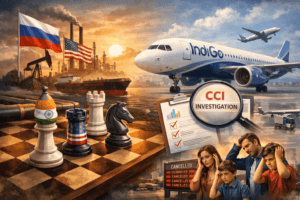
India’s Geopolitical Chessboard: Decoding the Oil Diplomacy with Russia and the Aviation Turbulence at Home
In the complex tapestry of global diplomacy and domestic market dynamics, two recent developments offer a profound look into India’s navigating act. On one front, a high-stakes energy dialogue involving Russia and the United States tests the nation’s strategic autonomy. On another, a regulatory probe into the country’s largest airline questions the very principles of market fairness and consumer trust. Together, they paint a picture of an emerging superpower balancing external pressures with internal accountability.
The Energy Tightrope: Why India’s “Freedom to Buy” is a Statement of Sovereignty
The Kremlin’s calm, almost dismissive response to claims that India would halt Russian oil imports speaks volumes. Dmitry Peskov’s statement—”India is free to purchase oil from any country”—was not just a diplomatic shrug. It was a recognition of a fundamental shift in global energy politics, one that India has masterfully leveraged since 2022.
The Backstory of a Strategic Pivot Following Russia’s invasion of Ukraine, Western sanctions created a unique opportunity. Russia offered its crude at steep discounts, and India, which imports nearly 90% of its oil needs, seized it. This wasn’t merely a bargain hunt; it was a calculated economic imperative. The influx of discounted Russian oil acted as a critical buffer against soaring global inflation, helped manage the current account deficit, and ensured energy security for a growing economy. At its peak, Russia supplied over 40% of India’s crude imports, up from a negligible pre-2022 figure.
The Trump Claim: Diplomacy or Deal-Making? The recent claim by former US President Donald Trump adds a layer of political theater. Announcing a “trade deal” following a call with Prime Minister Narendra Modi, Trump stated India had agreed to stop buying Russian oil and switch to American (and possibly Venezuelan) supplies. In return, the US would slash tariffs on Indian goods.
However, the devil is in the details—or rather, the omissions. PM Modi’s public response gratefully acknowledged the US tariff reduction but conspicuously avoided any mention of halting Russian imports. This discrepancy is classic Modi diplomacy: gracious, forward-looking, but leaving critical strategic decisions unconfirmed in public discourse. It underscores a core tenet of India’s foreign policy: strategic partnerships are not zero-sum games. Engaging deeply with the US does not necessitate severing ties that serve national interest, such as the economically crucial relationship with Russia.
The “Diversification” Narrative: A Prudent Long-Term Strategy The Kremlin spokesperson aptly noted there is “nothing new” in India diversifying its crude sources. This is the crucial insight. India’s recent slight dip in Russian oil imports—slipping to third place among Russia’s buyers in December—is likely a function of market mechanics, not political diktat. Narrowing discounts, payment logistics, and the need to maintain a balanced import portfolio from the Middle East, Africa, and the Americas are constant considerations.
Maria Zakharova’s point about the trade being “beneficial for both countries” remains valid. For Russia, India is a stable, large-volume buyer insulating it from Western isolation. For India, it remains a key source of cost-effective energy. This relationship is built on mutual benefit, not sentiment, and is unlikely to be abandoned overnight based on a single conversation.
The Real Insight: India’s oil import strategy is a masterclass in pragmatic multi-alignment. It treats energy security as a non-ideological, economic necessity. The government will continue to buy from whoever provides the most stable and affordable supply, while using its growing market heft to negotiate favorable terms with all, be it Russia, the US, Saudi Arabia, or Venezuela. The “freedom to buy” is its ultimate leverage.
The Skies of Scrutiny: When Market Dominance Meets Consumer Rights
While India plays chess on the global stage, at home, a significant move is being made to protect the common citizen. The Competition Commission of India’s (CCI) decision to probe IndiGo over mass flight cancellations in December 2025 is a landmark moment for market regulation.
Beyond Operational Glitches: The “Artificial Scarcity” Question Airlines cancel flights. It happens due to weather, technical snags, or operational restructuring. However, the CCI’s probe hinges on a more serious allegation: the potential abuse of dominant position. With a staggering market share exceeding 60% in domestic air travel, IndiGo is not just a player; it defines the market. The question regulators are asking is severe: did the airline create an “artificial scarcity” of flights by grounding aircraft, thereby manipulating capacity to drive up fares during a peak travel period?
The timing is critical. December is a month of high demand due to holidays and year-end travel. Mass cancellations during this period cause disproportionate consumer harm—exorbitant last-minute fares on remaining flights, disrupted travel plans, and a severe lack of alternatives given the market’s structure.
Why This Probe Matters for Every Indian This is not just about one airline’s bad month. It’s a test case for:
- Market Health: A dominant player’s actions can stifle competition and innovation. If proven, predatory capacity manipulation cripples smaller airlines and deters new entrants.
- Consumer Sovereignty: The Indian flyer, already burdened by high taxes and volatile fares, deserves transparency and fairness. An inquiry signals that market dominance cannot be a license for exploitation.
- Regulatory Teeth: The CCI’s action shows a willingness to intervene in complex markets. It moves beyond traditional sectors and scrutinizes modern, consumer-facing oligopolies.
The Broader Economic Link Both stories, though disparate, are connected by the thread of sovereign choice and accountable growth. In foreign policy, India fiercely guards its right to choose its partners based on national interest. In domestic economics, regulators are stepping up to ensure that corporate behemoths do not curb the choices of their own citizens.
The government walks a diplomatic tightrope to secure affordable energy for growth, while its institutions must ensure that the fruits of that growth are not undermined by anti-competitive practices at home.
Conclusion: The Dual Pillars of a Rising India
The week’s news presents a nation in dynamic equilibrium. Externally, India is a savvy negotiator, using its demographic and economic weight to craft relationships that defy blunt geopolitical blocs. It will continue to buy Russian oil as long as it makes economic sense, while simultaneously deepening energy ties with the US and others. This isn’t duplicity; it’s sophisticated strategy in a multi-polar world.
Internally, the same principle of balanced power applies. As businesses grow to dominant sizes, India is strengthening its regulatory frameworks to ensure the market serves the people, not the other way around. The IndiGo probe is a signal that growth must be responsible and competitive.
The ultimate insight is this: India’s path to becoming a $10 trillion economy is being paved by two parallel commitments—the commitment to strategic autonomy on the world stage, and the commitment to fair play and consumer justice at home. One ensures the energy flows in; the other ensures the economy functions fairly. Both are non-negotiable for the India of 2026 and beyond.
You must be logged in to post a comment.