
India’s Frigid New Year: Record Cold, Unusual Rain, and the Climate Patterns Behind the Chill
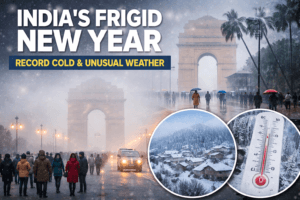
India’s Frigid New Year: Record Cold, Unusual Rain, and the Climate Patterns Behind the Chill
As 2025 drew to a close, India was gripped by an intense and widespread winter spell. From the record-shattering cold in the north to unseasonal showers in the west, the country stepped into 2026 under a dramatic meteorological tableau. This was not just a routine cold snap; it was a multi-faceted weather event that broke records, disrupted daily life, and offered a stark reminder of winter’s reach across the subcontinent.
The Core of the Chill: Delhi’s Historic Cold Day
The national capital served as the epicenter of this frigid narrative. On December 31, 2025, Delhi recorded its coldest December day in six years. The maximum temperature at the Safdarjung observatory plummeted to 14.2°C, a stark drop of more than 6°C below the seasonal norm and over 7°C lower than the previous day. This met the India Meteorological Department’s (IMD) official criteria for a “cold day,” which is declared when the minimum is below 10°C and the maximum is at least 4.5°C below normal.
The chill was even more severe in other parts of the city. Stations at Palam and Lodhi Road experienced “severe cold day” conditions, with maximums of 13.6°C and 13.4°C, respectively—each more than 6.5°C below normal. The Ridge station recorded the city’s lowest maximum at 13.1°C.
This historical context is crucial: the last time Delhi experienced a colder December day was in 2019. The conditions persisted into the New Year, with dense fog reducing visibility to as low as 50 meters and severely disrupting air and rail travel. On Wednesday alone, approximately 150 flights were cancelled and over 500 were delayed at Delhi’s IGI airport, with over 100 trains also running behind schedule.
A Nation in the Grip of Winter
While Delhi’s records captured headlines, a severe cold wave and dense fog had a stranglehold on a vast swath of the country. The IMD issued alerts for multiple states, warning of continued disruptions.
Northern and Northwestern Plains: Punjab, Haryana, and Rajasthan faced intense cold. In Rajasthan, Fatehpur in Sikar district recorded a bone-chilling 1.6°C on December 24, highlighting the extreme conditions in the region. Major cities like Jaipur saw temperatures drop to 8.8°C, while Amritsar in Punjab recorded lows of 6.1°C. The IMD forecasted that dense to very dense fog would persist over Punjab, Haryana, Chandigarh, and Delhi until at least January 6.
Eastern and Northeastern Regions: Jharkhand and Assam felt the bite acutely. Jharkhand’s government issued a yellow alert for dense fog in several districts, with Gumla recording a low of 3.9°C. In a significant move reflecting the severity, the Assam government ordered the closure of all schools from December 31 to January 6 to protect children’s health from the “prevailing extreme cold conditions”. Education Minister Ranoj Pegu directed district officials to assess local situations for further decisions.
The Himalayan Region: Contrary to expectations of extreme cold, Kashmir reported above-normal temperatures during its traditional ‘Chilla-e-Kalan,’ the 40-day period of harsh winter. While Gulmarg was the coldest at -1.6°C, this was still 4.3°C above the usual average for this time. This anomaly presents a striking contrast to the plains below.
The Western Anomaly: Mumbai’s New Year Rain
In a contrasting meteorological event, India’s western coast witnessed an unusual start to the year. Mumbai welcomed 2026 with light to moderate rainfall in several areas, including Mulund and Dadar. The early morning showers brought the city’s temperature down to 21°C, adding a winter chill to its typically humid climate.
The IMD forecasted a partly cloudy sky with light rain for the city and its suburbs throughout the day. While disruptive for some New Year’s plans, the rain had a silver lining: it helped improve air quality. Mumbai’s Air Quality Index (AQI) was recorded at 122, which falls in the ‘moderate’ category.
The Science Behind the Weather: Why So Cold?
Meteorologists pointed to a specific confluence of factors that created this extensive cold and fog event:
- Active Western Disturbances: These weather systems brought moisture into the northwestern plains.
- High Humidity and Easterly Winds: Moisture-laden easterly winds fed into the region, facilitating the formation of a thick, persistent fog layer.
- The Fog Blanket: This dense fog acted as an insulating lid. It trapped pollution and prevented sunlight from reaching the surface, which in turn inhibited daytime heating. This created a vicious cycle where “cold day” conditions became self-perpetuating.
- Upper-Level Clouds: Cloud cover at higher atmospheric levels further blocked solar radiation, exacerbating the lack of warming.
Forecast and Immediate Outlook
The IMD’s forecast suggested little immediate respite for North India. The agency predicted:
- Continued Cold Wave: Isolated cold wave conditions in Delhi were likely from January 2-5.
- Persistent Fog: Dense to very dense fog was expected during night and morning hours over Delhi and the northwestern plains for several days.
- Temperature Trend: A further dip of 2-4°C in minimum temperatures over Northwest India was forecast before a potential rise.
Table: 7-Day Weather Forecast for Delhi (Starting Jan 1, 2026)
| Date | Weather Forecast |
| 01.01.2026 | Partly cloudy sky. Shallow fog during early hours. |
| 02.01.2026 | Partly cloudy sky. Moderate to dense fog at many places. |
| 03.01.2026 | Mainly clear sky. Moderate to dense fog at a few places during morning hours. |
| 04.01.2026 | Mainly clear sky. Moderate fog during morning hours. |
| 05.01.2026 | Mainly clear sky. Shallow to moderate fog during morning hours. |
| 06.01.2026 | Mainly clear sky. Shallow to moderate fog during morning hours. |
| 07.01.2026 | Mainly clear sky. Shallow to moderate fog during morning hours. |
Impacts and Human Response
The severe weather had tangible effects on daily life:
- Travel Chaos: As mentioned, air and rail travel in North India faced massive disruptions due to low visibility.
- Health and Safety: The combination of extreme cold and persistently “very poor” air quality—Delhi’s AQI was 373 on December 31—posed significant health risks, especially for vulnerable populations.
- Administrative Actions: The school closures in Assam were a direct administrative response to safeguard public health. Similarly, authorities consistently advised caution during early morning travel.
A Broader Climate Perspective
This severe winter event invites questions about larger climate patterns. While a single cold spell cannot be attributed directly to climate change, the extremity and persistence of the conditions are noteworthy. The anomaly of a relatively warmer Kashmir alongside a record-cold Delhi and a rainy Mumbai illustrates the complex and regionally diverse impacts of global atmospheric changes.
The winter of 2025-2026’s dramatic entry underscores the importance of robust meteorological forecasting, public preparedness for extreme weather, and the ongoing need to study how broader climate trends manifest in localized, often disruptive, weather events across India’s diverse geography. As the IMD’s alerts remain in effect, the nation continues to navigate the challenges posed by this powerful winter spell.
You must be logged in to post a comment.