
India’s Fiscal Tightrope: Can Fiscal Discipline Power the Dream of a Developed Nation by 2047?
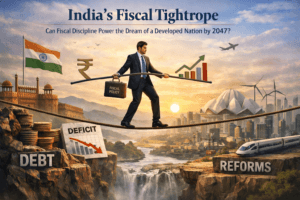
India’s Fiscal Tightrope: Can Fiscal Discipline Power the Dream of a Developed Nation by 2047?
India’s economic story is at a pivotal moment. Surging growth, declining unemployment, and historic low inflation paint a picture of an economy in a “goldilocks period” . Underpinning this optimism is an ambitious national goal: to transform into a developed economy, or ‘Viksit Bharat’, by the centenary of its independence in 2047 . Yet, beneath this impressive momentum lies a more sobering and complex narrative. The very engine needed to sustain this decades-long sprint—sound public finances—is under significant strain. The challenge is clear: India must walk a fiscal tightrope, balancing aggressive investment for growth against the imperative of macroeconomic stability. This balancing act is complicated by deep-seated structural issues, from a narrow tax base to stressed state finances, raising critical questions about the sustainability of its current path.
The Framework and the Fault Lines
India’s fiscal governance is built on a sophisticated constitutional and legal framework designed for discipline in a federal system. The Fiscal Responsibility and Budget Management (FRBM) Act of 2003 is its cornerstone, mandating deficit and debt targets for both the central and state governments . This framework is being tested. While the central government has made progress, reducing its fiscal deficit from a pandemic high of 9.2% to a target of 4.4% for FY 2025-26, the journey is fraught with pressures . Recent data shows that midway through the fiscal year, the deficit had already reached 62.3% of its annual target, indicating persistent challenges in revenue and expenditure management .
The situation at the state level is more concerning. States are the primary drivers of spending on health, education, and agriculture, making their fiscal health critical for inclusive development. However, a collective debt burden of 27.5% of GDP—far above the 20% target—and fiscal deficits breaching norms in 19 states reveal a system under stress . This creates a dangerous cycle: high debt leads to soaring interest payments, which in turn consume resources meant for development. For states, over 53% of their revenue is now locked into committed expenditures like salaries, interest, and pensions, drastically shrinking the fiscal space for productive capital investment .
The Triple Bind: Debt, Distortions, and Demographics
Navigating India’s fiscal challenges requires confronting a triple bind of interconnected constraints.
- The Debt Trap: A staggering portion of government revenue is pre-committed to servicing past borrowing. Interest payments alone are projected to consume nearly 37% of the central government’s revenue receipts in FY 2025-26 . This acts as a massive “crowding out” force, limiting the government’s ability to fund future growth engines and social safety nets.
- The Quality of Spending: Beyond how much is spent, what it is spent on is crucial. There is a constant tension between revenue expenditure (salaries, subsidies, day-to-day costs) and capital expenditure (infrastructure, assets). While the central government has pushed for higher capital outlays, the overall quality of spending is hampered by poorly targeted subsidies and populist measures, especially at the state level. Experts argue for a shift in sectors like agriculture—from blanket subsidies that distort crop choices to targeted incentives that encourage market-driven, diversified farming .
- The Demographic Window and the Jobs Puzzle: India’s young population is its most celebrated asset. With the working-age population set to grow until 2034, the potential for a demographic dividend is immense . However, this dividend is at risk of becoming a demographic burden. India’s unique economic transition—leapfrogging from agriculture directly to services, largely bypassing mass manufacturing—creates a structural jobs challenge . The services sector, while high-value, does not generate employment at the scale needed to absorb millions leaving agriculture. The result is a significant portion of the workforce remaining in low-productivity, informal sectors, which constrains wage growth, limits the tax base, and ultimately dampens the domestic consumption needed to fuel private investment .
The Reform Imperative: Beyond Numbers
Achieving the 2047 vision demands more than incremental adjustments; it requires a strategic overhaul of fiscal management centered on credibility, coordination, and capacity.
- From Deficit Targets to Debt Sustainability: The proposed shift to a debt-to-GDP anchor (aiming for ~50% by 2030-31) is a step in the right direction . This medium-term framework provides more flexibility than rigid annual deficit targets, allowing for counter-cyclical spending during downturns while maintaining a credible path for consolidation.
- Empowering States Through Incentives, Not Just Policing: The Centre’s relationship with state finances must evolve from oversight to partnership. Linking additional borrowing permissions to tangible reforms—such as power sector rationalisation, asset monetisation, and direct benefit transfer expansion—can create positive incentives . Strengthening institutions like the GST Council can serve as a model for better Centre-State coordination on other complex fiscal issues .
- Unlocking Revenue and Investment: India’s tax-to-GDP ratio remains stubbornly low, especially compared to OECD averages . Broadening the base through better compliance, formalisation of the economy, and rationalising the GST structure is essential. Simultaneously, reviving private investment, which has remained sluggish, is critical. This requires not just infrastructure spending but also addressing the root cause: weak domestic consumption stemming from inequality and informal employment .
Conclusion: The Foundation for a Century’s Ambition
India’s aspiration to become a developed nation by 2047 is not merely a function of headline GDP growth rates. It is fundamentally a question of fiscal sustainability and governance. The current “goldilocks” economic moment provides a crucial window of opportunity—a chance to implement tough reforms when growth is robust. The path forward is clear: credible medium-term fiscal consolidation, a relentless focus on the quality of expenditure, and deep structural reforms to mobilise revenue and create productive jobs.
The stakes could not be higher. Failure to strengthen these fiscal foundations risks leaving India in a middle-income trap, where growth is stifled by macroeconomic instability and inequality. Success, however, would secure the resources needed to invest in its people, build world-class infrastructure, and ensure that the journey to 2047 is not just rapid, but also resilient and inclusive. In the end, the dream of Viksit Bharat will be written in the nation’s balance sheets as much as in its policy visions.
You must be logged in to post a comment.