
India’s Eyes in Orbit: How Three Engineers Are Securing the Nation’s Strategic Vision
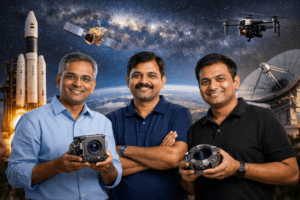
Three engineers from a medical background—Sanjay Kumar, Manoj Kumar Gaddam, and Punit Badeka—are building India’s first indigenous, high-precision satellite imaging systems at EON Space Labs, transitioning from developing eye surgery technology at the LV Prasad Eye Institute to creating sovereign “eyes in the sky.” Their flagship innovation, the MIRA telescope, is an ultra-lightweight, monolithic optical payload that reduces costly import dependency and enables frequent, real-time Earth observation. By providing detailed imagery and infrared data, these systems empower timely disaster warnings, agricultural monitoring, and border security, addressing the critical strategic need for India to control its own observational data. This effort is a key component of the nation’s growing private space ecosystem, enhancing self-reliance in defense and resource management by ensuring that the vital capability to see and respond to events on Earth originates from within the country.
India’s Eyes in Orbit: How Three Engineers Are Securing the Nation’s Strategic Vision
As satellites glide silently through the cosmos, their unseen gaze shapes critical moments on Earth—issuing flood warnings, guiding farmers to harvest, and helping rescuers navigate disaster zones. Yet, for years, a paradox defined India’s space prowess: the nation could launch satellites into orbit but did not fully control the sophisticated “eyes” that captured these life-saving images. This strategic gap is now being closed by an unlikely trio of engineers from a Hyderabad eye hospital, who are pioneering India’s first indigenous, high-precision satellite imaging systems. Their journey from restoring human eyesight to building the nation’s sovereign vision in space marks a pivotal shift in technological self-reliance.
The Unlikely Path: From Medical Precision to Cosmic Vision
Sanjay Kumar, Manoj Kumar Gaddam, and Punit Badeka did not convene in a space agency lab. Their partnership was forged at the LV Prasad Eye Institute, where their daily mission was to grant doctors unprecedented clarity into the living human eye. This grounding in medical precision became the unexpected bedrock for space innovation.
- Sanjay Kumar (Optics & Photonics): Trained at the Indian Institute of Space Science and Technology and IIT Madras, Sanjay developed adaptive optics systems that correct distortions smaller than a wavelength of light on a moving retina. “Precision becomes personal,” he notes, highlighting the extreme accuracy required.
- Manoj Kumar Gaddam (Mechanical & Systems Design): With a background in medical device engineering, Manoj operated on a core principle: “failure is not an option.” His expertise in creating stable, reliable systems where lives are at stake directly translates to the unforgiving environment of space.
- Punit Badeka (Precision Manufacturing): At LV Prasad, Punit established an ultra-precision optics manufacturing line, working at the nanometre scale. “You stop thinking about products and start thinking about processes,” he reflects—a mindset perfectly suited to space and defence technology.
During the COVID-19 lockdown, this team confronted a critical question. They were already crafting contact lens moulds with nanometre accuracy. If such precision could correct a human eye, why couldn’t it form the mirrors of a space telescope? This simple yet powerful insight led them to establish EON Space Labs in December 2022, transitioning from medical research to the high-stakes arena of space optics.
Engineering Sovereignty: The MIRA Payload and Indigenous Integration
When EON’s founders surveyed India’s technological landscape, they identified scattered talent but a glaring absence of integrated capability. “India did not lack talent,” Manoj explains. “What it lacked was integration. No one was responsible for the entire journey, from optical design to a flight-ready payload”. They set out to build that complete, sovereign pipeline.
Their flagship achievement is MIRA, a revolutionary compact space telescope. Its design philosophy challenges conventional wisdom:
| Feature | MIRA’s Innovation | Strategic Impact |
| Design | Monolithic optics carved from a single block of fused silica. | Eliminates internal misalignment from launch vibrations, ensuring extreme stability in space. |
| Size & Weight | Ultra-compact (54 × 54 × 87 mm) and weighing just 502 grams. | Dramatically reduces launch costs (approx. $20,000/kg to orbit), enabling smaller, more affordable satellites. |
| Performance | Captures 9 multispectral bands at a 9.2-meter ground resolution. | Delivers high-quality data for agriculture, disaster management, and defence within an exceptionally small package. |
| Manufacturing | Over 90% indigenous content across optics, mechanics, electronics, and software. | Reduces foreign dependency, controls supply chains, and builds domestic expertise. |
The journey to this point required overcoming significant hurdles. The toughest challenge was accessing ultra-precision diamond-turning machines, which can cost between INR 30-40 million each, with a full setup requiring an investment of INR 100-120 million. Previously, Indian startups had to design around the limitations of available equipment. Through a strategic partnership with HHV Advanced Technologies in Bengaluru, EON gained access to this critical capability, allowing them to design optics to the full potential of the machinery. This collaboration turned a key weakness into a core strength.
A Multi-Domain Vision: From Orbit to the Coastline
EON’s technology is not confined to space. The company has adopted a triple-domain strategy, deploying tailored versions of its core optical intelligence across space, aerial, and ground platforms.
- In Space (MIRA): Designed for satellites, MIRA provides persistent, wide-area monitoring for agricultural assessment, border surveillance, and large-scale disaster mapping.
- In the Air (LUMIRA): Mounted on drones and UAVs, these gimbal systems offer dynamic, close-range surveillance and identification, serving both defence and civilian infrastructure inspection needs.
- On the Ground (BUHO Series): Fixed or pan-tilt systems like the Buho 225, installed at Vizag Port for the Indian Navy, can detect and track ships up to 10-11 kilometres offshore. Coupled with AI software, they can also identify humans, vehicles, and drones.
This approach ensures that intelligence gathered from orbit can be seamlessly cross-referenced with tactical data from drones or ground sensors, creating a comprehensive operational picture.
The Critical Why: Strategic Autonomy and Timely Action
The push for indigenous capability is driven by more than national pride; it’s a strategic imperative. As of 2023, India relied on foreign providers for nearly 80% of its high-resolution satellite imaging data. This dependence creates vulnerabilities in cost, timelines, and control, especially during geopolitical tensions or rapid-onset disasters.
The value of sovereign, timely data cannot be overstated. Research underscores that in disaster response, information delivered within 24 hours is most critical, acting as a vital resource akin to “water, food, medicine, or shelter”. EON’s systems address the critical delay—or latency—in Earth observation by pairing lightweight optics with satellites that have frequent revisit times and onboard AI. This AI processes data in orbit, sending only actionable insights to Earth, turning what used to take days into a process of hours or even minutes.
“Whether you are imaging a retina or the Earth, the responsibility is the same. You must see clearly, and you must see in time to act.” — Sanjay Kumar, Co-founder & CEO of EON Space Labs.
This philosophy is being validated on the ground. Under the Ministry of Defence’s iDEX programme, EON’s optics have demonstrated the ability to detect drone movements beyond 2 km and human movement at over 1.5 km using short-wave infrared—all tested in challenging real-world conditions of fog, salt spray, and motion.
The Bigger Picture: India’s Commercial Space Ecosystem Ascends
EON Space Labs is not operating in a vacuum. Its rise coincides with a historic transformation in India’s space policy, marked by the opening of the sector to private players and a push for self-reliance. This ecosystem is now achieving major milestones.
A landmark development is the approval of India’s first fully indigenous commercial Earth Observation (EO) constellation. A private consortium led by Pixxel Space India, under a Public-Private Partnership (PPP) with IN-SPACe, will invest over ₹1,200 crore to build and operate a network of 12 advanced satellites. This ambitious project signifies a strategic shift from government-built infrastructure to industry-operated national assets and will significantly enhance India’s geospatial intelligence sovereignty.
EON is a key enabler within this new ecosystem. The company has already partnered with other Indian NewSpace startups like Galaxeye, Dhruva Aerospace, and Kepler Aerospace, providing them with the essential imaging payloads they would previously have imported. In a significant endorsement, Kepler Aerospace selected a MIRA variant for a six-satellite surveillance constellation for India’s Defence Space Agency. These collaborations illustrate how a domestic supply chain for critical components is rapidly coalescing.
Looking Ahead: Resilience and the Road to Orbit
The path of innovation is rarely linear. EON experienced this firsthand when its first MIRA payload, aboard the MOI-1 satellite developed with partner TakeMe2Space, was lost in the PSLV-C62 mission anomaly in January 2026. The team’s response highlighted the resilience required in the space sector. They immediately refocused on preparing their next payload for the MOI-2 satellite, targeting a mid-2026 launch and demonstrating the “fail-fast, learn-fast” ethos essential for a thriving private space industry.
Backed by $1.2 million in pre-Series A funding from MountTech Growth Fund and strategic investor HHV Advanced Technologies, EON is scaling its vision. The goal is clear: to cement India’s ability to not just launch satellites, but to equip them with its own intelligent eyes—eyes that can safeguard borders, empower farmers, protect communities from disasters, and secure a future where the nation’s strategic vision is, unequivocally, its own.
The story of EON Space Labs is more than a technical triumph; it is a testament to the power of interdisciplinary thinking. It proves that the precision required to heal human sight can be scaled to protect a nation, and that the journey to secure India’s vision in space began, quite fittingly, in a hospital dedicated to helping the world see.
You must be logged in to post a comment.