
India’s Energy Ascent: How a Nation’s Drive for Security is Reshaping Asia’s Upstream Landscape
Discover how India’s 50 new upstream projects will reshape Asia’s energy market and supply security by 2030. Read our in-depth analysis for strategic insights.
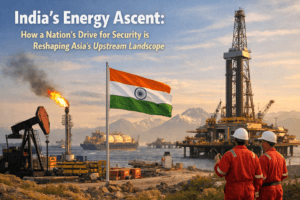
India’s Energy Ascent: How a Nation’s Drive for Security is Reshaping Asia’s Upstream Landscape
A profound shift is underway in Asia’s energy geography. For decades, the narrative centered on the Middle East’s supply and East Asia’s insatiable demand. Now, a new chapter is being written, with India poised to become the engine of upstream oil and gas project development across the continent. According to GlobalData’s latest analysis, between 2026 and 2030, India is scheduled to bring an astonishing 50 new production projects online, leading a charge that includes Indonesia and Malaysia. This isn’t just a story of drilling rigs and production quotas; it’s a tale of national ambition, economic transformation, and a strategic recalibration in the face of global uncertainty.
The Indian Imperative: More Than Just Growth
India’s projected dominance in project starts is not accidental; it’s the direct result of powerful, converging forces. At its heart is a demographic and economic reality: rapid urbanization and industrialization are accelerating energy consumption at a pace that existing domestic production cannot match. The resulting import bill is a colossal strain on the economy and a persistent vulnerability in terms of energy security.
This vulnerability has crystallized into a clear policy directive: reduce import dependence. While renewables are a critical part of the long-term portfolio, the immediate bridge fuel and industrial feedstock must come from hydrocarbons. This is where the commitment of public sector behemoths like ONGC and IOC becomes crucial. Their continued capital investment, even amidst global energy transitions, signals a state-backed resolve to unlock domestic resources.
What’s particularly striking about India’s 50-project pipeline is that over 70% are greenfield developments—brand-new ventures on fresh sites. This indicates a move beyond just squeezing more from mature fields; it’s a full-scale expansion of the country’s hydrocarbon frontier. Furthermore, the dominance of conventional gas projects (over half of the total) reveals a strategic prioritization. Gas is seen as the cleaner transitional fuel that can power cities, fertilize agriculture, and feed industry while curbing the more carbon-intensive coal and oil.
However, a critical insight lies in the developmental stage: most of these projects are still in the feasibility or approval phases. This presents both a promise and a peril. The promise is of significant future capacity; the peril is in execution risk. Land acquisition, environmental clearances, and complex logistics could delay timelines. India’s upstream surge, therefore, is a bet on its own administrative and project management capabilities to translate plans into flowing wells.
The Supporting Cast: Indonesia and Malaysia’s Infrastructure Advantage
While India leads in sheer volume, the story in Southeast Asia is one of leveraging entrenched advantage. Indonesia, with 47 project starts, and Malaysia, with 23, are not newcomers. Their strength lies in established ecosystems.
Indonesia’s 47 projects (a mix of new builds and expansions) are also heavily weighted toward conventional gas, driven by domestic and industrial demand. Unlike India, however, a portion of its projects are already in the construction or commissioning stages, suggesting a nearer-term production bump. Indonesia’s challenge will be balancing its role as a key LNG exporter with the political imperative to supply its growing domestic market, a tension that has influenced policy in the past.
Malaysia’s narrative is perhaps the most nuanced. With “established export/LNG-linked infrastructure,” its project economics are inherently stronger. New fields can often be tied back to existing pipelines and processing facilities, dramatically shortening time-to-market and improving commercial viability. This infrastructure advantage acts as a magnet for investment, even for smaller or more complex reservoirs. It’s a lesson in how legacy assets, when maintained and expanded, can create a virtuous cycle of upstream development.
The Human Insight: The Geopolitics of Self-Sufficiency
Beneath the project counts and production charts, a deeper human and geopolitical drama unfolds. The collective push by these three Asian giants underscores a region-wide loss of faith in purely globalized energy markets. The volatility of the past decade—from price crashes to supply disruptions—has made “security” the paramount concern.
For India, every new project is a step away from the precariousness of the Straits of Hormuz. For Indonesia and Malaysia, it’s about reclaiming agency and ensuring that energy wealth fuels national development first. This drive for self-sufficiency is reshaping alliances and investment flows. It suggests a future where intra-Asian energy trade (via pipeline or LNG) may grow, but where each major player seeks a firmer domestic foundation.
Furthermore, this upstream surge complicates the global energy transition dialogue. These are long-cycle investments with decades-long lifespans. The companies and governments involved are making a calculated bet that gas, and to a lesser extent oil, will remain essential components of the energy mix well beyond 2030, even as renewables scale up. This isn’t necessarily a contradiction to climate goals—gas can displace dirtier fuels—but it highlights the pragmatic, messy reality of development in economies where growth is non-negotiable.
Challenges on the Horizon: The Other Side of the Boom
The optimism in the projections must be tempered with realism.
- Capital Intensity: In an era where ESG-focused capital is shifting elsewhere, funding these projects will rely heavily on national oil companies and strategic investors comfortable with hydrocarbon risk.
- Technical Complexity: Many of the remaining resources are in challenging environments—deepwater, high-pressure, or remote locations—demanding advanced technology and expertise.
- The Climate Pressure: Both domestic and international scrutiny on emissions will intensify. The industry’s social license to operate will depend on embracing best-in-class flaring reduction, methane leak detection, and carbon capture technologies from the project design phase.
- Global Price Volatility: A sustained drop in oil or gas prices could render some of the more complex greenfield projects uneconomic, potentially stalling them in the feasibility stage where many currently reside.
Conclusion: A Continent Taking Control
The period from 2026 to 2030 is set to be a defining one for Asian energy. Led by India’s unprecedented project pipeline and supported by the mature hubs of Indonesia and Malaysia, Asia is not just consuming energy—it is actively, aggressively building its own supply foundation.
This upstream boom is more than an industry trend; it’s a statement of intent. It speaks to a continent determined to fuel its own destiny, mitigate external vulnerabilities, and navigate the turbulent waters between developmental needs and climate responsibilities. The success of these projects will resonate far beyond balance sheets and production graphs. It will influence national economic stability, regional geopolitics, and the global energy equation for decades to come. The drilling is about to begin, and the world will feel the tremors.
You must be logged in to post a comment.