
India’s E-Waste Paradox: The Rs 50,000 Crore Chasm Between Goldmine and Garbage
India’s e-waste recycling sector is caught in a critical paradox: while the country is the world’s third-largest generator of electronic waste, its formal recycling industry is starved for raw material and requires a massive investment of Rs 50,000 crore to scale effectively.
This funding is essential to build advanced recycling facilities and efficient collection networks, but the industry’s primary hurdle is that over 90% of e-waste is diverted to a dominant informal sector, which offers higher upfront prices to consumers but uses hazardous methods that recover only a fraction of the valuable materials and poison the environment.
Bridging this gap demands a multi-pronged strategy, including stringent enforcement of Extended Producer Responsibility rules, financial incentives, integration of the informal workforce, and greater consumer awareness to transform this growing environmental crisis into a sustainable economic opportunity.
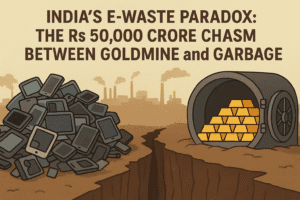
India’s E-Waste Paradox: The Rs 50,000 Crore Chasm Between Goldmine and Garbage
Beneath the relentless hum of India’s digital revolution lies a growing, silent crisis. It’s in the forgotten drawers of old smartphones, the graveyards of discarded laptops, and the tangled heaps of defunct refrigerators. This is India’s e-waste challenge—a problem of staggering scale that, paradoxically, hides an even more staggering opportunity. Recent reports from industry experts have put a number to this opportunity, and it’s a monumental one: India needs an investment of Rs 50,000 crore to scale its e-waste recycling capacity. But the real story isn’t just the money; it’s the complex, almost contradictory hurdle the industry faces: a critical shortage of the very raw material it’s designed to process.
The Scale of the Avalanche: More Than Just a Number
First, let’s grasp the magnitude of the problem. India is the third-largest generator of electronic waste in the world, after China and the United States. According to the Central Pollution Control Board (CPCB), we generated over 1.6 million tonnes of e-waste in 2021-22, a figure that is projected to explode in the coming years. For context, that’s the weight of approximately 160 Eiffel Towers worth of discarded electronics, piling up annually.
But this “waste” is a misnomer. It’s a resource in disguise. A typical smartphone contains over 60 different elements, including precious metals like gold, silver, and platinum, critical raw materials like cobalt and lithium, and substantial amounts of copper and high-grade plastics. When processed informally, these components become toxins that poison soil, water, and air. When processed formally, they are the building blocks for a circular economy, reducing our dependency on volatile international mining and import markets.
The Rs 50,000 Crore Question: Where is the Investment Going?
The call for Rs 50,000 crore isn’t a plea for a bailout; it’s a strategic blueprint for building a national infrastructure. This colossal investment is needed across several fronts:
- Formal Recycling Facilities: This is the core. We need large-scale, integrated recycling plants equipped with state-of-the-art technologies like pyrometallurgical smelters, electrolytic refining systems, and advanced shredders. These are capital-intensive, requiring significant investment in land, machinery, and environmental safeguards to handle e-waste without causing secondary pollution.
- Reverse Logistics & Collection Networks: The biggest bottleneck is getting e-waste from the consumer to the formal recycler. A massive investment is required to build a seamless, nationwide collection network. This includes setting up convenient drop-off points, creating tech-enabled pick-up services, and integrating the informal sector (kabadiwalas) into a structured supply chain through fair pricing and incentives.
- R&D and Indigenous Technology: Much of the highest-end recycling technology is imported. Investment in domestic R&D can lead to cost-effective, localized solutions for recovering rare-earth elements and handling complex composite materials, making the entire process more economically viable.
- Skill Development and Formalization: Moving from informal burning and acid-stripping to high-tech recycling requires a skilled workforce. Funds are needed for training programs to turn waste-pickers into certified e-waste handlers and technicians, ensuring safer practices and better livelihoods.
The Raw Material Shortage: The Industry’s Greatest Irony
Here lies the most perplexing part of the story. Despite the mountains of e-waste generated, formal recyclers are operating at just 30-40% of their capacity. Why? Because they are starved of raw material.
This shortage is a direct result of a deeply entrenched informal sector. An estimated 90% of India’s e-waste is handled by this informal network. Here’s why:
- The Price Paradox: The informal sector, operating without the overheads of environmental compliance, worker safety, or taxes, can offer a higher immediate price to consumers and aggregators for their old devices. A formal recycler, bound by regulations, cannot compete on this upfront cost.
- Convenience and Reach: The local kabadiwala is a trusted, accessible figure who comes to your doorstep. The formal collection system, while more responsible, is often less visible and convenient for the average consumer.
- Value Extraction through Hazardous Means: Informal operators focus on quick, high-value extraction. They will burn circuit boards to recover traces of gold, use acid baths to leach out copper, and crudely smash CRT monitors for leaded glass. This not only recovers a fraction of the total value but does so at an immense cost to human health and the environment. The leftover, now-hazardous carcass is then discarded, meaning the formal sector loses access to the remaining materials.
This creates a vicious cycle: formal recyclers can’t get enough e-waste to become profitable, which discourages new investment, which keeps the sector from scaling, which perpetuates the dominance of the informal channel.
Bridging the Chasm: A Multi-Pronged Strategy for a Sustainable Future
Solving this paradox requires more than just capital; it demands a coordinated, multi-stakeholder approach.
- Policy and Enforcement with Teeth:The E-Waste Management Rules 2022 are a step in the right direction with their Extended Producer Responsibility (EPR) mandate. However, enforcement needs to be stringent. Producers must be held accountable for the entire lifecycle of their products, incentivizing them to design for recycling and create robust take-back systems. Simultaneously, a crackdown on the most hazardous informal practices is non-negotiable.
- Financial Ingenuity:Beyond large-scale investment, innovative financial models are needed. This could include:
- Green Bonds: Dedicated bonds for funding recycling infrastructure.
- Tax Incentives: For manufacturers using recycled materials and for consumers who return their e-waste formally.
- Viability Gap Funding: The government could bridge the cost difference between informal and formal collection for critical components, making it economically feasible for formal players to compete.
- The “Carrot” for the Informal Sector:Instead of purely punitive measures, the informal sector must be integrated. This means creating models where kabadiwalas become franchisees or collection agents for formal units, provided with safety gear, fair pricing, and a stable income. This transforms them from competitors into partners.
- The Consumer as the Catalyst:Ultimately, the chain begins with us. Public awareness campaigns that move beyond “don’t litter” to “your old phone is a mini-mine” are crucial. Consumers need to see thevalue and responsibility in disposing of e-waste correctly. Convenient collection drives, buy-back schemes, and deposit-refund models can powerfully influence behavior.
Conclusion: From Linear Consumption to a Circular Destiny
The Rs 50,000 crore figure is not just a price tag; it is the cost of India’s transition from a linear “take-make-dispose” model to a circular, sustainable, and self-reliant economy. It is an investment in preventing the toxic legacy of our digital age and in securing the precious metals needed for our green future, from electric vehicles to solar panels.
The raw material shortage is a symptom of a system in its infancy, not a dead end. By strategically deploying capital, strengthening policy, integrating the informal workforce, and empowering consumers, we can transform this paradox into a powerhouse. The e-waste chasm is deep, but the bridge we build across it won’t just solve a waste problem—it will pave the way for a new, green, and prosperous industrial sector for India.
You must be logged in to post a comment.