
India’s e-B-4 Visa: A Digital Gateway for Chinese Manufacturing Expertise
India’s new e-B-4 Production Investment Business e-Visa creates a streamlined, fully digital pathway for Chinese nationals engaged in specific industrial and technical work, such as equipment installation, plant commissioning, and training, replacing older paper-based systems. The process requires the inviting Indian company to first register and generate a mandatory digital sponsorship letter through the government’s National Single Window System (NSWS) portal, after which the applicant submits their visa application online with required documents, including this letter. This reform strategically aligns immigration policy with economic development goals, facilitating smoother cross-border collaboration essential for India’s manufacturing sector by offering predictability and reducing bureaucratic delays, while shifting responsibility and compliance oversight to the sponsoring companies through a transparent, digital framework.
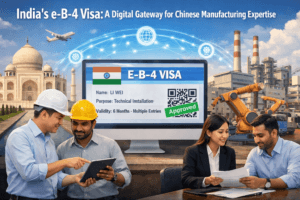
India’s e-B-4 Visa: A Digital Gateway for Chinese Manufacturing Expertise
India’s new e-B-4 Visa represents a strategic shift, streamlining access for Chinese technical professionals essential to India’s manufacturing ambitions. This fully digital visa pathway replaces outdated paper systems, aiming to reduce friction for companies building factories, installing equipment, and transferring critical technical knowledge. For businesses engaged in the complex dance of India-China industrial collaboration, this reform is a tangible step toward predictable, efficient cross-border exchanges.
The launch marks a deliberate effort to align immigration policy with economic goals, specifically supporting sectors where Chinese expertise and investment are pivotal.
1 The Strategic Shift: From Bureaucracy to Business Enablement
India’s manufacturing sector has long relied on foreign, and particularly Chinese, expertise for setting up plants, commissioning machinery, and optimizing production lines. However, the visa pathway for these critical professionals was often mired in complexity. Activities like the installation of equipment supplied under contract sometimes fell into a gray area between business and employment visas, causing delays and uncertainty for projects.
The new e-B-4 (Production Investment Business) Visa, introduced through a pivotal August 2025 circular from the Ministry of Home Affairs (MHA), directly addresses this. It consolidates and clarifies the rules, creating a dedicated sub-category under the business visa regime for a defined set of production-linked activities. Notably, it brings two key activities formally under the business visa umbrella: the installation and commissioning of equipment as part of a supply contract, and technical work for which an Indian company pays fees or royalties. This reclassification acknowledges the project-based, non-employment nature of such work.
Concurrently, the government has discontinued the older e-PLI (Production Linked Incentive) business visa, folding its purposes into the new, broader e-B-4 framework. The result is a more unified and predictable system.
Comparison: The Old Process vs. The New e-B-4 System
| Feature | Old/Previous System | New e-B-4 Visa System |
| Core Philosophy | Ministry-driven, approval-based | Company-led, facilitation-based |
| Application Channel | Mixed paper and digital processes | Fully digital, end-to-end |
| Sponsorship Letter | Often required manual attestations | Instantly generated via NSWS portal |
| Key Dependency | Recommendation from relevant Line Ministry | Automated authentication via MCA, GSTN databases |
| Processing Predictability | Variable, often lengthy | Streamlined, with defined steps |
| Scope Clarity | Ambiguous for technical/installation work | Clearly defined eligible activities |
2 A Step-by-Step Guide to the e-B-4 Visa Process
The process is a two-party digital handshake between the Indian company and the Chinese professional. Understanding each role is crucial for a smooth application.
For the Indian Company: Generating the Digital Sponsorship
The journey begins with the Indian entity on the National Single Window System (NSWS), a portal designed to simplify government-to-business interactions.
- Registration & Access: The company must log in using its credentials. New users register on the NSWS portal.
- Select Service: Within the NSWS “Marketplace,” the user selects “Production Investment Business Registration (Indian Company).”.
- Submit Details: The company fills a consolidated online form providing its details, information about the production project, and particulars of the Chinese professional(s) it intends to invite.
- Generate Letter: Upon submission, the system automatically generates a digitally signed sponsorship letter with a unique reference number. This is possible because the system auto-populates and authenticates data using existing government databases like the Ministry of Corporate Affairs (MCA) and the Goods and Services Tax Network (GSTN), eliminating the need for separate ministry approvals.
Important Note: This sponsorship letter is a mandatory document for the visa application, but it does not guarantee visa issuance. It is a company undertaking that enables the foreign national to apply.
For the Chinese Professional: Applying for the e-Visa
Armed with the sponsorship letter, the Chinese national applies through the official Indian government visa website.
- Prepare Documents: The applicant must gather:
- Passport copy (valid for at least six months).
- The digital sponsorship letter from the Indian company.
- A dispatch letter from their current Chinese employer.
- Proforma details of the employer.
- Hukou (household registration) document.
- A detailed resume.
- All documents must be certified copies translated into English.
- Apply Online: The application is submitted on the Indian Visa Online portal, where the unique sponsorship number must be quoted.
- Post-Arrival Registration: Within 14 days of landing in India, the visa holder must complete electronic registration with the local Foreigners Regional Registration Office (FRRO), regardless of their intended stay duration.
Critical Advisory: Applicants should only use the official government portal (https://indianvisaonline.gov.in) to avoid fraudulent websites that may dupe applicants. The Indian Embassy in China has explicitly warned against such third-party sites.
3 Implications and Strategic Insights for Businesses
This reform is more than a procedural update; it’s a tool for strategic planning with real-world implications.
- For Indian Companies: The e-B-4 visa offers speed and predictability. The ability to generate a sponsorship letter instantly online allows for better project timeline management. However, with this empowerment comes greater responsibility. The company’s declaration on the NSWS is a formal compliance undertaking. Internal alignment between project, legal, and HR teams is essential to ensure the declared scope of work matches the professional’s actual activities on the ground.
- For Chinese Professionals and Firms: The visa provides a clearer, more legitimate pathway for short to medium-term technical deployments (the e-B-4 visa is typically valid for six months with multiple entries). The key is to maintain strict alignment between the sponsorship letter, visa application, and on-site work. Engaging in activities outside the permitted scope—such as taking up a managerial role that constitutes local employment—can lead to complications at immigration or future visa restrictions.
- The Bigger Picture: This move should be seen as part of India’s broader push to improve its ease of doing business and attract production-linked investment. It complements existing industrial incentives by smoothing a critical operational pain point. Furthermore, it continues a trend of liberalizing visa access for Chinese nationals, building on the 2019 introduction of a five-year e-tourist visa for China. It signals a pragmatic approach to bilateral engagement, facilitating necessary economic exchanges while maintaining regulatory oversight through a digital, traceable system.
4 Navigating the New Normal: Actionable Recommendations
To leverage the e-B-4 visa effectively, stakeholders should:
- Start Early with Digital Readiness: Indian companies should complete their NSWS registration and familiarize themselves with the portal before an urgent need arises. Having corporate documents digitally verified in advance will speed up the process.
- Documentation is Key: Chinese applicants must meticulously prepare their documents, ensuring all are properly certified and translated into English. Inconsistencies between the resume, employer dispatch letter, and the Indian company’s sponsorship details are a common red flag.
- Clarity on Scope of Work: Both parties should draft a precise, detailed description of the activities to be performed in India. Vague terms like “provide support” should be replaced with specific terms like “commission the XYZ assembly line” or “conduct operational training on ABC machinery.”
- Post-Arrival Compliance is Non-Negotiable: The 14-day FRRO registration rule is mandatory. Companies should have a protocol to assist incoming professionals with this step to avoid inadvertent non-compliance.
Conclusion
India’s e-B-4 Visa is a significant, pragmatic reform that replaces bureaucratic ambiguity with a structured digital process. For the intricate and vital manufacturing partnerships between Indian and Chinese companies, it provides a much-needed framework for legal and efficient collaboration. While the system simplifies sponsorship, its success hinges on the compliance diligence of both the inviting company and the visiting professional. In the competitive landscape of global manufacturing, such streamlined processes for transferring expertise are not just administrative improvements—they are strategic necessities.
You must be logged in to post a comment.