
India’s Dual-Track Economy: Robust Services and Cautious Businesses
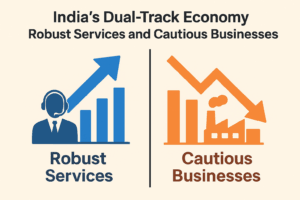
India’s Dual-Track Economy: Robust Services and Cautious Businesses
Amid a shifting global economic landscape, India presents a study in contrasts: a vibrant, domestically-driven services sector propelling forward, while manufacturing and investment decisions reveal a cautious undertone among businesses. The latest economic indicators tell a story of resilience tempered by hesitation, exposing a growing confidence gap between solid macroeconomic fundamentals and private sector sentiment. Understanding this dual-track dynamic is essential to grasping India’s current economic momentum and the opportunities that lie ahead.
The Services Engine: Unabated Domestic Momentum
India’s services sector continues to be the undisputed growth leader, demonstrating remarkable resilience and expansion. In November 2025, the HSBC India Services Purchasing Managers’ Index (PMI) rose to 59.8, up from 58.9 in October. This marks 52 consecutive months of expansion—a streak that has continued unbroken since August 2021. The driving force behind this growth is robust domestic demand, with new business intakes accelerating sharply in November.
Significantly, this strength is not a fleeting phenomenon but part of a sustained trend. The sector hit a record high in August 2025, with the PMI reaching 65.6 points according to preliminary data. Even as growth moderated to 60.9 in September, it represented the fourth consecutive month the index remained above the critical 60-point threshold, signaling exceptional expansion. Key segments like finance, insurance, and information technology have shown particularly strong performance, underscoring the diversified nature of India’s services boom.
Manufacturing Moderation: The Export Challenge Emerges
In stark contrast to the services sector, India’s manufacturing engine showed signs of cooling as 2025 drew to a close. The Manufacturing PMI eased to 56.6 in November, down from 59.2 in October and marking the slowest improvement in operating conditions since February. This softening was broad-based, affecting new orders, output, and employment growth. While still firmly in expansion territory (above 50), the sector’s momentum has palpably slowed.
The data reveals a critical vulnerability: weakening external demand. New export orders increased at their slowest pace in over a year in November. This slowdown echoes trends observed earlier in the year. In August 2025, when manufacturing PMI hit a 17-year high of 59.3, underlying data already showed a deceleration in international order growth to a five-month low. Economists have linked this export softness directly to heightened global trade tensions and the uncertainty created by significant U.S. tariff increases on Indian goods.
The Confidence Conundrum: Strong Fundamentals, Cautious Sentiment
This sectoral divergence has unfolded against a backdrop of generally positive economic fundamentals, creating what appears to be a curious disconnect. Input cost inflation for services retreated to its lowest level since August 2020, while output price inflation remained modest. Similarly, in manufacturing, both input cost and output price inflation moderated to multi-month lows in November. This benign inflation environment provided the Reserve Bank of India with room to support growth through monetary policy, including a widely anticipated 25 basis point rate cut.
Despite these favorable conditions, business confidence has notably waned. For the services sector, business sentiment regarding the 12-month outlook slipped to its lowest level since July 2022. In manufacturing, while remaining positive, the degree of optimism for the year ahead also fell to its lowest level since mid-2022. Approximately 95% of surveyed service sector firms reported no change in payroll numbers in November, indicating that expansion in activity has yet to translate into significant job creation. This hiring hesitation reflects a cautious stance by companies, despite rising output and orders.
Global Headwinds and Domestic Resilience: India’s Strategic Position
To understand this caution, one must examine the global context in which Indian businesses are operating. Paul Gruenwald, global chief economist at S&P Global Ratings, notes that while the initial shock of U.S. tariff policies was less severe than feared—with actual collected tariffs closer to 10% rather than the headline 17%—uncertainty persists. India, along with Brazil, remains among the few large economies with unresolved tariff issues with the U.S., though Gruenwald suggests an agreement could be forthcoming.
The broader global realignment presents both challenges and opportunities for India. S&P Global Market Intelligence analysis indicates that increasing trade protectionism may ultimately catalyze supply-chain diversification, potentially benefiting India as companies seek alternatives. India’s relative insulation as a less trade-dependent economy (with moderate dependence on external trade for growth) provides a buffer. Foreign investors increasingly view India as the fastest-growing major emerging market, with the “global growth baton” having passed from China to India.
Investment and Policy Imperatives: Bridging the Confidence Gap
The current economic landscape reveals several critical areas for attention to translate strong fundamentals into broader-based investment and growth:
- Manufacturing Competitiveness: India’s share in global manufacturing exports has remained largely flat over the past decade at just 1.8% in 2024. The government’s target to increase manufacturing’s contribution to GDP to 25% (from 17.2%) remains ambitious. While Production Linked Incentive schemes have boosted sectors like electronics and mobile phones (exports soared from zero in 2016 to $20.4 billion in 2024), broader progress is needed.
- Resource Availability: According to S&P Global’s Strategic Opportunity Index, while India scores well on finance availability (89.6 out of 100), it lags significantly in labor availability (50 out of 100). The availability of labor with skills required for value-added manufacturing remains a persistent challenge.
- Financial Flows: There’s a notable divergence in where financial resources are flowing. Between 2021 and 2025, the share of total loans going to households and services increased, while manufacturing’s share declined from 12.7% to 11.1%. Recent tentative signs of faster manufacturing lending growth in early 2025 are encouraging but need to be sustained.
- Policy Direction: Experts like Gruenwald emphasize that India doesn’t need dramatic policy swings but rather consistent economic performance to maintain investor confidence. Steady growth of 6-7% would represent strong performance and deliver substantial compounding benefits over time. As S&P Global Market Intelligence notes, supply-chain diversification strategies could add about 1.3 percentage points to India’s real GDP by fiscal 2034-35.
Table: Sectoral Performance Contrast in India’s Economy (November 2025)
| Indicator | Services Sector | Manufacturing Sector |
| PMI Reading | 59.8 (up from 58.9) | 56.6 (down from 59.2) |
| Key Driver | Robust domestic demand | Softening new orders |
| Export Performance | Growth at 8-month low | Growth at slowest pace in over a year |
| Price Trends | Input cost inflation at lowest since Aug 2020 | Input cost inflation at 9-month low |
| Business Confidence | Lowest since July 2022 | Lowest since mid-2022 |
| Employment | 95% of firms reported no payroll change | Growth at softest rate in 21 months |
The Path Forward: From Caution to Confidence
India stands at an economic inflection point. The country’s fundamental strengths—demographic dividend, digital infrastructure, and domestic market scale—remain robust. The services sector continues to demonstrate that strong domestic consumption can power significant growth even amid global headwinds.
The challenge lies in translating this domestic strength into broader economic dynamism that revitalizes manufacturing, boosts exports, and creates jobs across sectors. This will require addressing the confidence gap through consistent, growth-oriented policies and creating an environment where businesses feel empowered to make long-term investments.
As S&P Global’s analysis suggests, India’s manufacturing sector possesses significant potential amid global supply chain realignment. Realizing this potential will require concerted efforts to enhance competitiveness, particularly in logistics efficiency and skilled labor availability.
The current moment presents a crucial opportunity for India’s economy. With inflation controlled, domestic demand strong, and global capital seeking alternatives in a rebalancing world economy, the conditions are aligning for accelerated growth. How quickly businesses move from caution to confidence may well determine whether India merely maintains its position as the world’s fastest-growing large economy or accelerates into a new phase of transformative expansion that leverages both its domestic strengths and emerging global opportunities.
You must be logged in to post a comment.