
India’s Dual Crisis: Evacuating Nationals from Iran Amid Airspace Chaos
Amid escalating US-Iran tensions and Iran’s sudden closure of its airspace, India has initiated preparations to evacuate approximately 10,000 of its nationals—primarily students and pilgrims—from Iran, with the first batch instructed to be ready for departure. Concurrently, the airspace closure has severely disrupted Indian aviation, forcing Air India and IndiGo to reroute flights around Iran, leading to longer flight times, payload penalties, cancellations, and significant operational headaches, especially for IndiGo’s narrow-body aircraft servicing CIS countries. This crisis is compounded by Pakistan’s pre-existing ban on Indian overflights, squeezing westward routes and highlighting the fragile interplay between geopolitics, aviation logistics, and citizen safety.
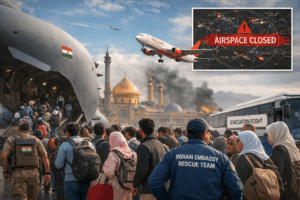
India’s Dual Crisis: Evacuating Nationals from Iran Amid Airspace Chaos
The ancient city of Qom, a spiritual heartland in Iran, is usually a place of quiet study and pilgrimage. But on the morning of January 16, 2026, a different kind of urgency hummed through its seminaries and student accommodations. For the thousands of Indian students and pilgrims there, instructions from the Indian embassy were clear: be ready by 8 AM. Pack essentials, keep documents handy, and prepare to leave. This directive marked the beginning of a complex, large-scale evacuation of approximately 10,000 Indian nationals from Iran, unfolding against a backdrop of rising regional tensions and a sudden, disruptive closure of Iranian airspace that sent global aviation into a tailspin.
The Spark: Geopolitical Tensions and a Sudden Airspace Shutdown
The catalyst for this unfolding situation is a significant escalation in US-Iran tensions, details of which remain strategically vague but potent enough for Iran to temporarily seal its skies. For over four hours, a key east-west flight corridor over Iran went silent. This wasn’t just a regional inconvenience; Iran sits astride a critical global aviation highway. The closure, though brief, triggered a cascade of delays, cancellations, and reroutes for airlines worldwide, with Indian carriers Air India and IndiGo squarely in the impact zone.
The Indian government’s move to initiate evacuations, led by its Ministry of External Affairs (MEA), is a precautionary measure steeped in recent experience. The embassy in Tehran had already been proactive, registering students and collecting passport details, a lesson in preparedness learned from past crises in conflict zones. Their advisory for Indians to avoid protest sites and their announcement of emergency helplines (+989128109115, +989128109109, among others) and a dedicated email (cons.tehran@mea.gov.in) signaled a shift from observation to active contingency planning.
The Human Dimension: Who Are the 10,000?
The Indian community in Iran is diverse, not a monolithic group. It includes:
- Theological Students in Qom: A significant number of Indian students study in Shia seminaries in Qom, a centre of Islamic learning.
- Pilgrims in Mashhad: Many travel to visit the Imam Reza shrine, one of the holiest sites in Shia Islam.
- Medical and General Students in Tehran and Isfahan: Iranian universities attract Indian students, particularly in medical fields, offering quality education at competitive costs.
- Professionals and Business Personnel: A smaller cohort works in various trades and industries.
For students, the evacuation order brings acute anxiety—not just about safety, but about academic disruption, unfinished semesters, and an uncertain return. The logistics of moving such a dispersed population are daunting. The first batch, primarily students, was told to prepare for an early morning departure, with subsequent flights planned in the coming days. This operation requires meticulous coordination with Iranian authorities, secure ground transportation to airports, and the procurement of safe aerial corridors out of the country.
The Aviation Quagmire: Longer Routes, Burnt Fuel, and Hard Choices
While the MEA handles the human evacuation, Indian airlines face a separate operational nightmare. The temporary closure of Iranian airspace, and the subsequent decision by Air India and IndiGo to voluntarily avoid it due to “unpredictable situation,” has brutally exposed the geopolitical fragility of modern air travel.
For Air India, the national carrier with deep roots in West-bound routes, the problem is one of time, fuel, and payload. Flights to North American destinations like New York, Newark, and Chicago that typically traverse Iran now skirt it, often dipping into Iraqi airspace before heading north over Turkey or the Caspian Sea. This adds roughly 60-90 minutes of flight time. In aviation, extra minutes are not trivial. An hour of additional flying for a wide-body aircraft like the Boeing 777 or Airbus A350 can consume thousands of kilograms of extra fuel. To carry this fuel, the aircraft must be lighter. This leads to “payload penalty”—reducing the number of passengers or cargo it can carry to stay within safe takeoff weight limits. This directly hits profitability.
The incident on Thursday, where an Air India A350 ingesting a cargo container after being forced to return to Delhi due to the airspace closure, underscores the chain-reaction of such disruptions. It’s a stark reminder that safety risks multiply on the ground during chaotic operational changes.
For IndiGo, which operates a fleet of narrow-body Airbus A320s and A321s, the challenge is even more existential for some routes. Its flights to key cities in the Commonwealth of Independent States (CIS) like Tbilisi (Georgia), Baku (Azerbaijan), Almaty (Kazakhstan), and Tashkent (Uzbekistan) are heavily dependent on overflying Iran. Avoiding Iran pushes these flights beyond the range of a fully-loaded A320. The alternatives are bleak: make technical refuelling stops in a third country (dramatically increasing journey time and cost), cancel flights outright, or re-evaluate the long-term viability of these routes. IndiGo’s cancellations on Thursday and Friday for CIS destinations show the immediate severity.
This crisis is compounded by a pre-existing handicap: Pakistan’s airspace ban on Indian aircraft since late April 2025. With Iran now a no-fly zone and Pakistan closed, Indian flights to the west are squeezed into a narrow, northern corridor. It effectively re-routes a substantial portion of India’s international connectivity, adding cost, time, and carbon footprint to every journey.
The Bigger Picture: India’s Evolving Crisis Response and Citizen-Centric Diplomacy
This event is more than a logistics story; it is a window into India’s evolving foreign policy and crisis management posture. The systematic registration of citizens abroad, the swift establishment of communication channels, and the activation of an evacuation plan reflect a more proactive, citizen-centric diplomatic machinery—a system honed by experiences in Ukraine, Sudan, and Afghanistan.
Furthermore, India walks a delicate tightrope. It maintains historically cordial relations with Iran, a key partner for energy and connectivity to Central Asia via the Chabahar port. Simultaneously, it nurtures a strategic partnership with the United States and Israel, both adversarial to Tehran. The evacuation is a necessary step for citizen safety, but its execution must be handled with diplomatic finesse to avoid perceived alignment. India’s interest is unequivocally in de-escalation and regional stability.
Looking Ahead: Uncertainty in the Skies and on the Ground
As of now, the situation remains fluid. While Iranian airspace has reopened, Indian carriers continue to avoid it, evaluating safety “on a day-to-day basis.” For the evacuated students and nationals, returning home is just the first step. They face uncertainty about when they can resume their studies or work. For Indian aviation, this is a stress test on network resilience. It forces a hard look at fleet planning (the need for longer-range aircraft), route diversification, and the profound impact of regional politics on global business.
The events of January 16, 2026, tell a twin tale. One is a human story of a community in transition, supported by a state machinery swinging into action. The other is a technical, high-stakes story of global interconnectedness, where a decision in Tehran can echo in delay announcements at Delhi and Mumbai airports, and where the safety of citizens abroad is inextricably linked to the complex dance of geopolitics and aviation logistics. The coming days will reveal how smoothly India can navigate both.
You must be logged in to post a comment.