
India’s DPDP Act Decoded: A Business Guide to the New Rules of Data Accountability
India’s data protection landscape has undergone a fundamental transformation with the Digital Personal Data Protection Act (DPDP Act) of 2023 and its 2025 Rules, which replace the previous fragmented regime under the IT Act and SPDI Rules. This new framework establishes a unified, principle-based approach for all digital personal data, moving away from narrow categories like “sensitive” data. It enforces core principles—including purpose limitation, data minimization, storage limitation, and security—through explicit obligations for Data Fiduciaries and empowers individuals with enforceable rights like access, correction, and erasure. Backed by substantial penalties, especially for security failures and breaches, the regime mandates that organizations build proactive, privacy-by-design compliance programs, shifting from box-ticking to operational accountability and transforming data protection into a critical component of business risk and trust in the Indian digital economy.
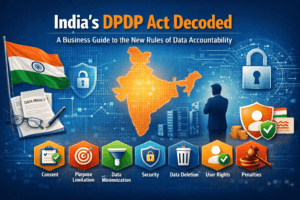
India’s DPDP Act Decoded: A Business Guide to the New Rules of Data Accountability
For over a decade, India’s data privacy landscape was a patchwork of vague principles and narrow rules. The Information Technology Act, 2000, and its 2011 SPDI Rules offered a fragmented shield, applying core data protection principles—like purpose limitation and security—only to a limited category of “Sensitive Personal Data.” This left vast amounts of personal information in a regulatory gray area and created a compliance maze for organizations. The Digital Personal Data Protection Act (DPDP Act) of 2023, operationalized by the 2025 Rules, dismantles this old framework. It isn’t merely an update; it’s a fundamental reset that establishes a unified, principle-based, and enforceable regime for the digital age. For any business operating in or with India, understanding this shift isn’t about legal checkboxes—it’s about foundational risk management and building digital trust.
From Fragmented Categories to a Unified Principle: The End of the SPDI Era
The most profound conceptual shift in the DPDP Act is its move away from categorizing data to regulating processing. The old SPDI Rules created a binary world: “Sensitive Personal Data” (like passwords, financial info, health records) triggered specific duties, while other personal data languished under weaker general provisions. The DPDP Act adopts a single, broad definition of “personal data”—any data about an identifiable individual. The special category of “SPDI” vanishes from the main statute.
This doesn’t mean sensitivity is ignored. Instead, the Act introduces a more dynamic, risk-based approach:
- Significant Data Fiduciaries: The government can designate entities as such based on the volume and sensitivity of the data they process, subjecting them to stricter audits, impact assessments, and appointments.
- Children’s Data: Recognized as inherently vulnerable, it receives special guardrails, including verifiable parental consent and a prohibition on tracking or processing that harms a child’s well-being.
- Sectoral Synergy: High-risk data like financial, health, or Aadhaar details continue to be protected under the heightened mandates of regulators like RBI, IRDAI, and UIDAI. The DPDP Act forms the baseline, over which sector-specific rules layer additional obligations.
The consequence is clear: once fully in force, the SPDI Rules will be obsolete. Compliance is no longer about classifying data into silos but about applying a consistent set of principles to all digital personal data processing.
The Seven Pillars: Core Principles Made Actionable
The DPDP Act crystallizes global data protection best practices into enforceable legal obligations for Data Fiduciaries (the entities that determine the “why and how” of processing). These are not abstract ideas but operational mandates:
- Lawful, Fair & Transparent Processing (The Foundation): Every processing activity must have a lawful basis—primarily voluntary, specific, and informed consent, or certain “legitimate uses.” The Rules mandate clear, plain-language notice at collection, explicitly stating the purposes.
- Purpose Limitation: Personal data can only be used for the purpose it was collected for, as stated in the notice. This walls off secondary, unspecified use and is a direct check against mission creep in data analytics.
- Data Minimisation: Perhaps the most transformative principle, it mandates that only data necessary for the stated purpose can be collected. This challenges the pervasive “collect now, figure it out later” data hoarding mindset, forcing a lean-by-design approach.
- Data Accuracy: Fiduciaries must maintain the completeness, accuracy, and consistency of personal data. This is reinforced by a Data Principal’s right to seek correction, making data integrity a shared responsibility.
- Storage Limitation & The “Deemed End” Rule: Data must be deleted once its purpose is fulfilled. The 2025 Rules introduce a crucial innovation: the “deemed end-of-purpose.” After a defined period of complete user inactivity, the purpose is legally treated as ended, triggering automatic erasure obligations. This forces active lifecycle management and purges dormant, stale data—a major security and compliance risk.
- Security Safeguards & Accountability: Fiduciaries must implement “reasonable security measures” as per prescribed standards (like ISO 27001) and remain accountable for the actions of their Data Processors (vendors). This extends liability to the entire data supply chain.
- Breach Notification: In the event of a personal data breach, fiduciaries must notify the Data Protection Board of India and affected individuals within stipulated timeframes, moving from secrecy toward transparent accountability.
Rights as Levers: How Principles Become Real for Individuals
Under the DPDP Act, the rights of the Data Principal (the individual) are the mechanisms that bring the principles to life. They transform passive protection into active user agency:
- Right to Access & Know: Individuals can request a summary of their data, processing activities, and a list of fiduciaries with whom their data has been shared. This enables meaningful oversight.
- Rights to Correction, Erasure, and Grievance Redressal: These are the direct enforcement tools for the accuracy and storage limitation principles. The right to erasure, coupled with the right to withdraw consent “as easily as it was given,” gives users a real exit ramp from data processing.
- The Nomination Right: A uniquely Indian provision, allowing individuals to nominate someone to exercise their privacy rights upon death or incapacity, bringing continuity to digital legacy.
For businesses, this means these rights are not mere support tickets. They are statutory compliance events that require accessible, streamlined, and legally sound response mechanisms.
The Price of Non-Compliance: A Penalty Regime Designed to Deter
The DPDP Act backs its principles with substantial financial teeth, with penalties scaled to the severity of the violation:
- Top Tier (Up to ₹250 Cr): Reserved for failures in implementing reasonable security safeguards that lead to a data breach, and for failing to report a breach. This directly ties cybersecurity investment to regulatory risk.
- Second Tier (Up to ₹200 Cr): For violations involving children’s data or breach notification duties, highlighting the heightened responsibility around vulnerable groups and transparency.
- Third Tier (Up to ₹150 Cr for Significant DF, ₹50 Cr for others): Captures a wide range of core failures: ignoring data principal rights (access, correction, withdrawal), violating purpose limitation or minimization, and failing to erase data.
The message is unambiguous: negligence in security and breach response is the costliest, but systemic disregard for user rights and data stewardship also carries severe financial consequences.
The Road Ahead: From Compliance to Competitive Advantage
The transition from the IT Act’s suggestive principles to the DPDP Act’s enforceable framework represents a cultural shift. Organizations must move beyond viewing this as a legal burden. The task now is to build privacy-by-design programs anchored in these principles.
Operationally, this means:
- Mapping Data Flows to apply purpose limitation and minimization.
- Revamping Consent & Notice Mechanisms for clarity and ease of withdrawal.
- Implementing Robust Data Governance with clear policies for accuracy, storage limitation, and the automated handling of “deemed end-of-purpose.”
- Fortifying Security & Incident Response plans to meet the “reasonable safeguards” standard and strict breach timelines.
- Establishing Efficient Rights Fulfillment & Grievance Redressal channels as a core customer service function.
In conclusion, India’s DPDP regime signals the end of ambiguity. It provides a clear, principle-based roadmap for the responsible use of digital personal data. For forward-thinking organizations, early and earnest compliance is more than risk mitigation—it’s an opportunity to build trust, demonstrate accountability, and secure a license to operate in one of the world’s most critical digital markets. The principles are now set. The onus is on fiduciaries to make them live in practice.
You must be logged in to post a comment.