
India’s Crackdown on ‘Dark Fleet’ Shipbreaking: New Rules Target Fraudulent Vessel Recycling
India has implemented stricter documentation verification procedures for end-of-life vessels entering its shipbreaking yards at Alang, aiming to prevent sanctioned “dark fleet” ships from using fraudulent registration papers to gain entry for scrapping, following an International Maritime Organisation report identifying 529 vessels operating with fake documents globally. The new rules come amid concerns from industry players like Wirana Shipping Corporation that allowing these vessels through with counterfeit papers creates unfair competition for legitimate ship recyclers who cannot match the lower prices of sanctioned tonnage, potentially undermining Alang’s recycling sector while also posing environmental and safety risks from poorly documented hazardous materials aboard these shadowy vessels.
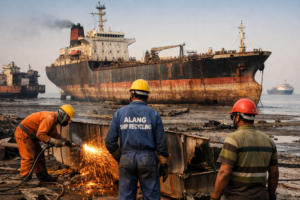
India’s Crackdown on ‘Dark Fleet’ Shipbreaking: New Rules Target Fraudulent Vessel Recycling
India introduces stricter documentation verification for end-of-life vessels as authorities move to block sanctioned ships from entering Alang’s beaches under fake papers.
The shipbreaking yards of Alang, India—long known as one of the world’s largest graveyards for end-of-life vessels—are facing a quiet transformation. New regulatory checks are being tightened at Indian ports to prevent so-called “dark fleet” vessels from slipping through with forged registration documents, a practice that has threatened to undermine both global sanctions and local recycling businesses.
According to a recent report citing Wirana Shipping Corporation, Indian authorities have begun implementing additional documentation verification procedures before clearing end-of-life vessels for scrapping. The move comes as the International Maritime Organisation (IMO) secretariat has identified 529 vessels currently operating with fraudulent registration documents worldwide—a symptom of the shadowy world of sanctioned shipping.
The Dark Fleet Problem Reaches India’s Shores
The term “dark fleet” refers to vessels that operate outside conventional regulatory frameworks—often carrying sanctioned oil, evading insurance requirements, or concealing their true ownership through complex shell company structures. These ships frequently engage in deceptive practices including disabling automatic identification systems (AIS), conducting ship-to-ship transfers in international waters, and, increasingly, fabricating registration documents.
What brings this issue to India’s doorstep is simple mathematics: aging vessels eventually need to be scrapped. As Wirana’s CEO Rakesh Khetan noted, sanctioned ships are now making their way to Alang’s recycling facilities, enabled by fake documentation that allows them to clear customs and port entry requirements.
“We are seeing sanctioned ships making their way to ship recycling facilities in Alang, India, made possible with fake documentation,” Khetan said in the report.
The timing is significant. Recent shifts in United States sanctions policy toward Venezuela have eased certain restrictions in the oil and gas sector, potentially freeing up vessels that were previously idled or operating in constrained markets. For shipowners sitting on aging tankers that have spent years in sanctioned trades, the economics are straightforward: scrap prices in Alang remain attractive, and if fraudulent papers can get a vessel through, the incentive to try is substantial.
How the Fraud Works
The mechanics of dark fleet vessel scrapping involve multiple layers of deception. A ship may arrive at anchorage off Alang flying one flag, with registration documents from a flag state that may or may not be aware of the vessel’s presence. Insurance certificates, international tonnage certificates, and safety equipment certifications must all appear in order before port clearance is granted.
What authorities are now discovering is that some of these documents are complete fabrications—flag states that don’t exist, insurance providers that never issued policies, or legitimate registries that have no record of the vessel in question.
The IMO’s identification of 529 vessels operating with fraudulent documents suggests this is not a fringe issue but a systemic challenge facing global shipping governance. For a flag state to have its documents forged means that somewhere along the chain of vessel documentation, oversight has failed.
Economic Distortion in Alang’s Recycling Market
Beyond the obvious sanctions-evasion concerns, the influx of dark fleet vessels creates tangible economic distortions in Alang’s ship recycling industry. Legitimate ship recyclers who purchase vessels through proper channels, with clean titles and verifiable documentation, find themselves unable to compete.
“If this practice continues, the ship recycling sector in Alang, India, is at risk of gradually being killed off,” Khetan warned.
The mathematics are brutal but simple. A sanctioned vessel, unable to trade in mainstream markets and facing limited options for disposal, can be sold for scrap at a significant discount. When that vessel arrives at Alang with forged papers, the recycler who purchases it obtains steel at below-market prices. Competing against such pricing becomes impossible for recyclers who play by the rules, source vessels transparently, and pay fair market value.
This creates a classic “race to the bottom” scenario. If fraudulent vessels consistently underprice legitimate ones, the economic pressure on Alang’s recyclers to cut corners becomes intense. Some may look the other way. Others may be tempted to participate more actively in document fraud. The entire ecosystem risks contamination.
Regulatory Gaps and Banking Complexities
One of the more nuanced aspects of India’s current situation involves the banking sector. According to Wirana’s analysis, Indian banks do not currently affect fund transfers for sanctioned vessels in the way that some international banks might. There is also no specific regulation in India that explicitly bans the recycling of sanctioned vessels.
This regulatory gap places Indian authorities in a difficult position. International sanctions regimes are complex, frequently updated, and enforced differently across jurisdictions. For Indian customs officials and port authorities, verifying whether a vessel is truly sanctioned—or whether its documents are genuine—requires access to international databases, familiarity with evolving sanctions lists, and the ability to spot sophisticated forgeries.
The additional documentation checks now being implemented appear designed to close precisely these gaps. By subjecting end-of-life vessels to more rigorous scrutiny before scrapping clearance is granted, authorities hope to intercept fraudulent entries before steel touches the beach.
Environmental and Safety Dimensions
The dark fleet problem extends beyond sanctions evasion into environmental and worker safety concerns. Vessels that have operated outside regulatory frameworks for years—sometimes decades—often carry accumulated hazardous materials, poorly maintained equipment, and incomplete waste inventories.
For Alang’s recyclers, who have invested significantly in improving environmental standards and obtaining certifications like the Hong Kong Convention compliance, accepting a dark fleet vessel means accepting unknown environmental liabilities. What hazardous materials lie in the vessel’s tanks? What asbestos-containing materials were improperly documented? What pollutants have accumulated in bilges and void spaces during years of unregulated operation?
The workers who manually dismantle vessels on Alang’s tidal beaches face these risks directly. Fraudulent documentation that misrepresents a vessel’s condition, its hazardous material inventory, or its maintenance history puts human lives at risk during the cutting and demolition process.
The Global Context: Policing the End-of-Life Phase
India’s tightened rules reflect a broader international recognition that the dark fleet problem must be addressed at every stage of a vessel’s lifecycle—including its final moments on the beach. While much attention focuses on dark fleet operations during active trading—sanctions evasion, illicit cargoes, AIS manipulation—the disposal phase has received less scrutiny.
Yet the logic is inescapable. A vessel that has spent years hiding its movements, falsifying its papers, and evading regulators does not suddenly become compliant when its owner decides to scrap it. The same incentives for deception that drove its trading生涯 continue to operate.
The IMO’s identification of 529 vessels with fraudulent documents is likely an undercount. These are the vessels that have been caught or whose documents have been positively identified as fraudulent. The true number operating in the shadows is almost certainly higher.
What the New Rules Mean
While specific details of India’s enhanced documentation checks remain under development, the direction is clear. Expect more rigorous verification of:
- Flag state registration and confirmation directly with registries
- Insurance certificates and confirmation with providers
- International tonnage certificate validity
- Safety equipment certification and survey histories
- Previous port state control inspection records
- Vessel tracking data and AIS history
For recyclers, this means longer clearance times and greater certainty—if they are buying legitimate vessels. For those tempted to accept questionable tonnage, the risks of detection and seizure have just increased.
Khetan noted that sanctioned vessels may still obtain clearance in India “if genuine flag states and insurance companies accept business for sanctioned vessels.” This caveat is important. Sanctions are political tools, and not all countries recognize all sanctions. A vessel sanctioned by the United States but flagged in a country that does not enforce US sanctions, with insurance from a provider willing to cover sanctioned trades, might still enter India legitimately—provided its documents are genuine.
The key distinction India appears to be drawing is between genuine vessels operating in sanctioned trades and fraudulent vessels operating with fake papers. The former may be politically controversial but legally ambiguous. The latter are simply criminal.
Implications for Alang’s Future
Alang has transformed significantly over the past decade. What was once a largely informal, hazardous, and environmentally destructive industry has moved—however slowly and imperfectly—toward greater regulation, improved safety standards, and international certification. Major recyclers have invested in concrete plots, crane infrastructure, and hazardous waste management facilities.
The dark fleet influx threatens this progress. If fraudulent vessels undermine legitimate pricing, the economic viability of compliant recyclers suffers. If sanctioned vessels bring unknown environmental liabilities, Alang’s reputation as a responsible recycling destination suffers. If fraudulent documentation becomes normalized, Alang risks becoming a disposal site of last resort for the world’s most problematic ships—with all the environmental, safety, and reputational costs that entails.
India’s tightened rules signal that authorities recognize these risks. Whether enforcement keeps pace with fraud remains to be seen.
The Road Ahead
For shipowners sitting on aging sanctioned tonnage, India’s new scrutiny means exploring alternative disposal options. Bangladesh and Pakistan remain significant recycling destinations, though both face similar documentation challenges. Turkey’s recycling industry offers higher environmental standards but lower prices. The economics of scrapping may shift.
For Alang’s recyclers, the coming months will test the effectiveness of India’s enhanced verification. Will fraudulent vessels still find ways through? Will clearance times extend significantly, imposing costs on legitimate business? Will Indian authorities develop the capacity to distinguish genuine documents from sophisticated forgeries?
The answers to these questions will shape not only Alang’s immediate future but the broader global effort to police the dark fleet through its entire lifecycle—including its final voyage to the breaking yard.
As Khetan framed it, the issue is ultimately about fairness and sustainability: “Allowing sanctioned vessels causes problems for ship recyclers who buy clean vessels, as they are unable to compete with units sold at a lower price.” In an industry where margins are thin and competition is fierce, fairness matters. India’s new rules aim to restore some of that fairness—if they can be made to work.
You must be logged in to post a comment.