
India’s Colder January: A Double-Edged Sword for Harvest and Humanity
India’s Colder January: A Double-Edged Sword for Harvest and Humanity
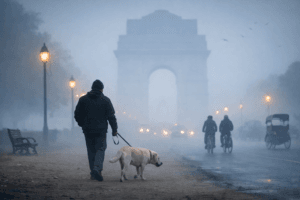
A man walks his dog in dense morning fog in New Delhi, India, December 30, 2025. (Photo by Reuters)
Across India’s vast northern plains, a deep chill is setting in—one that carries with it a mix of profound agricultural hope and significant human challenge. The India Meteorological Department (IMD) has forecast a January with below-average maximum and minimum temperatures and an above-average number of cold-wave days, particularly across central and eastern India. For a nation whose agricultural heartbeat follows the rhythm of the monsoon and winter seasons, this forecast is more than a weather update; it is a pivotal economic signal.
This shift towards a colder winter comes as a welcome reversal after several years of above-normal temperatures from January to March, which have consistently adversely affected yields of critical winter crops. The IMD’s prediction for a colder January is thus being met with cautious optimism by farmers and policymakers alike, who see it as a key to unlocking a “bumper” winter harvest.
However, the cold is not an unalloyed blessing. The same meteorological patterns bringing agricultural promise are also unleashing dense fog and severe cold waves, disrupting daily life, crippling transportation networks, and posing serious health risks to millions. This duality makes India’s current winter a compelling story of how climate and weather intersect with the economy, food security, and human resilience.
The Geographic Reach of the Chill
The cold wave and its impacts are not uniform but are concentrated in regions critical to India’s agriculture and transportation corridors.
| Region/State | Primary Forecasted Impact | Key Agricultural/Infrastructure Relevance |
| Punjab, Haryana, Uttar Pradesh, Delhi | Dense to Very Dense Fog (until at least Jan 7); Cold Wave | Top wheat-growing zone; Major national highway & rail networks; Key airports (Delhi, Chandigarh). |
| Madhya Pradesh, Eastern Uttar Pradesh, Bihar | 1-3 Additional Cold-Wave Days; Dense Fog | Major wheat, rapeseed, and chickpea growing areas. |
| Rajasthan | Cold Wave (East: Jan 4-8; West: Jan 5-8) | Significant agricultural state. |
| Assam, Meghalaya, Odisha, Gangetic West Bengal | Dense Fog conditions | Eastern agricultural regions and transport hubs. |
Why Cold is Gold for Winter Crops
India’s winter or rabi crops, sown from October to December, are biologically programmed to thrive in cooler conditions. Wheat, rapeseed, and chickpeas, which form the backbone of this season, require cold weather during their growth and grain-filling stages for optimal development.
- Physiological Benefits: Sustained cold slows down crop respiration, allowing plants to direct more energy into grain production, leading to better size, weight, and overall yield. For wheat, in particular, a proper “wintering” period is crucial for strong tillering (the development of grain-bearing shoots).
- Contrast with Recent Years: The positive outlook for 2026 is sharpened by recent history. Warmer winters have become a troubling trend, shortening the crucial maturation period and reducing productivity. This year’s forecast offers a reprieve, creating a more stable and favorable environment.
- Sowing Confidence: Farmers have already responded to early favorable conditions. Data shows planting across 61.4 million hectares, a 1.1% increase from the previous year. This expanded acreage, combined with promising weather, sets the stage for a potentially strong harvest.
Beyond the Farm: Economic Ripple Effects
A successful rabi harvest has far-reaching implications for India’s economy and its people.
- Curbing Food Inflation: Wheat is a staple for hundreds of millions. A bumper crop would help stabilize domestic food prices and ease pressure on household budgets. It also strengthens the government’s ability to manage its food security programs and grain reserves.
- Boosting Farmer Incomes & Rural Economy: After facing volatile and often damaging weather in recent seasons, a high-yield harvest promises improved incomes for farming families. This influx of capital can stimulate the broader rural economy, where agriculture remains a primary driver.
- Global Market Context: While India currently maintains an export ban on wheat, a strong harvest reinforces its domestic food security buffer. Globally, wheat markets are well-supplied, with record production expected in 2025/26 from the EU, Russia, and the US. India’s potential surplus adds to a global picture of ample stockpiles, which analysts at ING suggest will “limit the upside” in international wheat prices for the foreseeable future.
The Dark Side of the Deep Freeze: Travel and Health
While farmers watch their fields with hope, the cold wave presents a severe test for infrastructure and public health.
- Transportation Gridlock: The IMD has issued explicit warnings of major disruptions. Dense to very dense fog dramatically reduces visibility, leading to:
- Flight cancellations and delays at major airports.
- Train schedules thrown into disarray across northern and eastern routes.
- Dangerous highway conditions, causing accidents and long traffic delays.
- Authorities are advising travelers to stay in constant touch with airlines and railway services for updates.
- A Serious Health Hazard: The IMD cautions that dense fog often acts as a reservoir for particulate matter and pollutants. Prolonged exposure can lead to these particles becoming lodged in the lungs, reducing lung capacity and exacerbating respiratory issues like asthma, leading to increased episodes of wheezing, coughing, and shortness of breath. The very young, elderly, and those with pre-existing conditions are most at risk.
A Delicate Balance in a Changing Climate
This winter’s forecast sits within a larger narrative of climate volatility. The year 2025 was marked by erratic weather—a warm winter, a scorching summer, and a harsh monsoon—all of which stressed India’s agricultural sector. The current cold, while beneficial for winter crops, is part of this pattern of extremes.
Furthermore, the IMD links the expected below-average rainfall in northwestern states to a trend of fewer and weaker Western Disturbances. These storm systems, originating in the Mediterranean, are crucial for winter precipitation in the region. Their decline is a long-term climatic shift with uncertain implications for future winter seasons.
Conclusion: A Season of Contrasts
India’s colder January is a story of stark contrasts. For the agricultural sector, it is a beacon of hope, promising robust yields of essential crops, economic stability for farmers, and greater food security for the nation. The fields of Punjab, Haryana, and Madhya Pradesh stand to gain immensely.
Yet, this same meteorological phenomenon brings with it a blanket of fog that shrouds roads, railways, and runways in danger, and air that can harm the health of millions. It underscores the complex reality that “favorable” weather is often a matter of perspective, deeply tied to one’s livelihood and location.
As January unfolds, the nation will navigate this duality. The success of the harvest will be measured in millions of tonnes of wheat and rapeseed, while the cost of the cold wave will be tallied in delayed journeys, strained health, and the resilience of its people to face nature’s frigid, albeit fruitful, embrace.
You must be logged in to post a comment.