
India’s Climate Crucible: A Nation Confronts Year-Round Weather Extremes
India’s Climate Crucible: A Nation Confronts Year-Round Weather Extremes
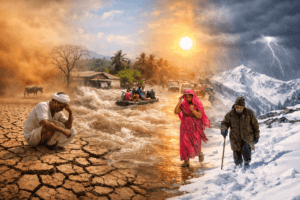
Extreme weather became a near-daily reality for India in 2025, affecting the country on over 99% of the days in the first eleven months of the year. What unfolded was not just a series of isolated disasters, but a persistent, nationwide assault that shattered previous records and rewrote the rulebook on seasonal weather patterns. A relentless cascade of floods, heatwaves, and landslides claimed thousands of lives and devastated millions of hectares of farmland, revealing a dangerous new climate normal and exposing critical gaps in the nation’s preparedness and response systems.
The Unrelenting Toll: A Statistical Portrait of Loss
The human and economic cost of India’s climate crisis in 2025 is staggering in both scale and detail. According to official data presented to Parliament, hydro-meteorological disasters have killed 13,384 people between 2020-21 and late 2025, with 2,388 lives lost in 2025 alone up to November 23. This six-year period also saw the loss of 4.31 lakh cattle, damage to 28.7 lakh houses, and devastation across 587.8 lakh hectares of cropped area.
The year 2025 marked a sharp escalation. An independent analysis by the Centre for Science and Environment (CSE) found that from January to November, extreme weather events occurred on 331 of 334 days, claiming at least 4,419 lives and affecting approximately 17.4 million hectares of cropped land. This represents a 47% increase in fatalities and a near nine-fold explosion in agricultural damage compared to 2022 figures.
Geographic Distribution of Impact
The devastation was widespread but uneven, with different regions bearing distinct burdens of the crisis.
| State/Region | Primary Impact | Key Statistic | Source |
| Himachal Pradesh | Highest frequency of events & crop loss | Extreme weather on ~80% of days; 324.27 lakh hectare crop loss | CSE/Down To Earth, Govt. Data |
| Punjab | Severe flooding | Over 1,000 villages flooded; worst flood in decades | NDTV Report |
| Andhra Pradesh | Highest fatalities (2025, regional) | 608 deaths reported | CSE/Down To Earth Analysis |
| Maharashtra | Largest cropped area affected | 8.4 million hectares damaged | CSE/Down To Earth Analysis |
| North-West India | Highest regional death toll | 1,459 deaths recorded | CSE/Down To Earth Analysis |
From Isolated Events to Cascading Catastrophes
A critical shift in 2025 was the transformation of the monsoon from a seasonal weather pattern into a “system of cascades,” where hazards trigger one another in a deadly domino effect. The science is clear: in the Himalayas, warm monsoon air rises rapidly against mountain walls, dumping intense rainfall. When these cloudbursts—defined as rainfall exceeding 100mm per hour over a small area—hit already saturated slopes, the result is almost guaranteed collapse.
This pattern played out repeatedly. In Himachal Pradesh, a season of rainfall 16% above normal primed the landscape for disaster. Subsequent storms triggered compounded landslides and flash floods that severed highways, wrecked power schemes, and caused over 320 deaths by early August. Similarly, a cloudburst over Dharali in Uttarkashi, Uttarakhand, on August 5, funnelled a torrent through a pilgrim hub, sweeping away infrastructure despite prior meteorological warnings.
These events underscore a systemic failure. As Dr. Sanjay K. Srivastava, a disaster risk reduction expert, notes, “The lag between forecast and action remains the fatal gap” in the Himalayas. Warnings are issued, but translating them into preventive evacuations and shutdowns remains inconsistent, with tragic consequences.
The Crushing Blow to Agriculture and Livelihoods
Beyond the immediate loss of life, the most damaging long-term impact of the 2025 extremes may be on India’s agricultural foundation and rural livelihoods. The scale of crop loss is unprecedented. Himachal Pradesh, an important region for fruits and off-season vegetables, reported a staggering 324.27 lakh hectares of crop loss since April 2025—the highest of any state. This is not just a statistic; it represents the ruin of countless smallholder farmers and a threat to regional food security.
The damage extended across the nation:
- Maharashtra lost 75.42 lakh hectares
- Karnataka lost 14.81 lakh hectares
- Punjab, India’s grain bowl, saw 1.93 lakh hectares damaged during its catastrophic floods
This agricultural devastation is exacerbated by the erosion of seasonal boundaries. Heatwaves were reported in 19 states, including the Himalayan regions of Himachal Pradesh and Ladakh during the pre-monsoon period—a clear indicator of warming at higher altitudes. Furthermore, extreme weather occurred daily through nine months of the year, eliminating the traditional recovery window farmers relied upon between seasons.
The Stark Relief Deficit and Institutional Response
In the face of this unprecedented devastation, India’s financial relief mechanism has been revealed as critically inadequate. In the 2024-25 fiscal year, states collectively requested Rs 17,169 crore from the National Disaster Response Fund (NDRF) for weather disasters but received only Rs 812 crore—a mere 5% of the required amount.
The shortfall affected states across the country:
- Tripura sought Rs 6,337 crore and received Rs 175 crore
- Tamil Nadu asked for Rs 3,075 crore and got Rs 522 crore
- Himachal Pradesh requested Rs 1,202 crore and was granted Rs 107 crore
- States like Bihar and Andhra Pradesh received nothing at all from the NDRF for weather-related disasters that year
This glaring deficit forces states to divert funds from development projects or leave affected populations without adequate support for rebuilding.
Amid this systemic shortfall, the heroic efforts of India’s armed forces provided a critical lifeline. During the Punjab and Jammu floods, the Indian Air Force launched extensive rescue missions, deploying five Mi-17 helicopters, one Chinook, and a C-130 transport aircraft. They successfully winched 101 Army and BSF personnel to safety from various locations and evacuated 46 stranded civilians, while airdropping hundreds of kilograms of essential supplies. These operations highlight the indispensable role of the military in disaster response but also underscore the scale of calamities that overwhelm civilian systems.
Building a Resilient Future: From Reaction to Systemic Prevention
Experts unanimously argue that India must transition from a cycle of disaster and relief to a strategy of systemic resilience and anticipatory action. The solutions are known but require political will and investment.
- Closing the “Last Mile” Gap in Early Warnings:Technology must be coupled with community empowerment. As Dr. Srivastava emphasizes,“warnings must reach ground actors in minutes, not hours” and must activate local leadership. This involves simple, reliable communication channels and pre-defined community response protocols.
- Rethinking Infrastructure for a New Climate:Bridges, roads, and dams must be designed towithstand debris flows and extreme water volumes, not just fair weather. This includes applying a “climate lens” to all development projects in vulnerable regions, assessing long-term risk alongside immediate cost.
- Managing the Himalayan “Multiplier”:Specific strategies for mountain regions includemonitoring and proactively draining glacial lakes before they burst, and managing tourism and pilgrimage as “risk operations” with caps, shelters, and strict stop protocols during alerts. The National Disaster Management Authority’s Glacial Lake Outburst Flood (GLOF) project, with its USD 20 million shield, needs scaling to a permanent monsoon defense system.
- A Global Imperative with Local Action:Sunita Narain, Director General of CSE, frames the challenge globally:“We have to reduce the amount of CO₂ we are pumping into the atmosphere, because no amount of adaptation is going to be possible with the scale of disasters we are now witnessing”. Yet, parallel to demanding global climate justice, India must “reimagine development” to be low-carbon and climate-resilient at home.
The disasters of 2025 are a definitive warning. The Himalayas are “speaking in torrents and broken roads,” and the message is that India can no longer afford to treat extreme weather as a surprise. The choice is between continuing to pay a mounting human and economic price or investing in the systemic changes that will protect lives, livelihoods, and the nation’s future in an era of climate disruption.
You must be logged in to post a comment.