
India’s Car Market Opens Up: How the EU Trade Deal Redefines Global Trade and Consumer Choice
In a landmark shift from its long-standing protectionist stance, India has agreed to slash import duties on European Union cars from as high as 110% down to 40% as part of a major free trade pact, marking the most significant opening of its vast automotive market.
The immediate reduction applies to a quota of around 200,000 combustion-engine vehicles priced above €15,000, with plans to lower duties further to about 10% over time, providing European automakers like Volkswagen, Mercedes-Benz, and BMW a crucial opportunity to expand beyond their current sub-4% market share in India’s 4.4-million-unit annual market. However, the deal strategically excludes battery electric vehicles from duty cuts for the first five years, creating a protective shield for domestic investments by companies like Tata Motors and Mahindra & Mahindra in the nascent EV sector. This calibrated opening serves as a strategic lever for India, securing preferential access for its own exports to the EU while carefully managing foreign competition to foster its domestic auto industry’s growth.
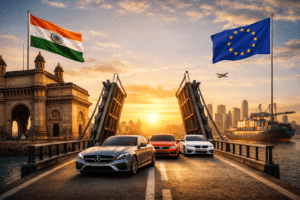
India’s Car Market Opens Up: How the EU Trade Deal Redefines Global Trade and Consumer Choice
After nearly two decades of protracted negotiations and strategic recalibrations, India and the European Union have concluded a landmark Free Trade Agreement (FTA) in January 2026. The most headline-grabbing element of this “mother of all deals” is a dramatic reshaping of India’s automotive import policy. The agreement proposes slashing import duties on EU-made cars priced above 15,000 euros (approximately $17,739) from a prohibitive high of 110% down to 40% immediately, with a binding commitment to reduce them further to around 10% over time. This policy shift is not merely about cheaper luxury cars; it’s a calculated move in a global chess game of economic sovereignty, offering a glimpse into the future of international trade in an increasingly protectionist world.
The “Mother of All Deals”: More Than Just Tariffs
The India-EU FTA represents one of India’s longest-running and most complex trade negotiations, beginning in 2007 and covering 24 comprehensive chapters including goods, services, and investment. For India, the deal is a strategic pivot. It secures preferential access for key exports like textiles, garments, gems, and jewellery to the massive EU market, especially vital as these sectors face steep 50% tariffs from the United States. With the EU as India’s largest goods trading partner (bilateral trade stood at $136.53 billion in 2024-25), the agreement cements a crucial economic partnership.
For the European Union, the deal is a cornerstone of a broader strategy to reduce economic over-reliance on any single partner and deepen ties with strategic partners in the Global South. The automobile sector, a pillar of European industry employing 13.6 million people and contributing over 8% of EU GDP, gains a significant foothold in the world’s third-largest car market.
Key Provisions of the Automobile Tariff Agreement
A quick overview of the planned changes:
| Aspect | Current Duty | New Duty (Immediate) | Future Duty | Key Conditions |
| Import Duty on Cars | Up to 110% | Reduced to 40% | Phased down to ~10% | Applies to EU cars with import price > €15,000 |
| Annual Import Quota | Not applicable | 200,000 vehicles (proposed) | To be determined | For internal combustion engine vehicles only |
| Electric Vehicles (EVs) | Up to 110% | Excluded from cuts for 5 years | To align with new duty after 5 years | Protects domestic EV investments |
| Domestic Market Impact | European brands hold <4% market share | Expected growth in premium/luxury segment | Increased competition and model variety | Market dominated by Suzuki, Tata, Mahindra |
A Protected Fortress Lowers Its Drawbridge
India’s automotive market has long been one of the world’s most protected. With annual sales of approximately 4.4 million units, it trails only China and the United States in size, yet foreign automakers have struggled to gain a meaningful share. This is largely by design. Tariffs of 70% to 110% on fully built imported cars acted as a formidable barrier, encouraging global manufacturers to “Make in India” if they wanted to compete seriously. The policy fostered a market dominated by Japanese Suzuki (through its Maruti Suzuki joint venture) and homegrown champions like Tata Motors and Mahindra & Mahindra, which together command about two-thirds of all sales.
European brands like Volkswagen, Mercedes-Benz, and BMW collectively hold less than 4% of the market. They have local manufacturing operations but have been constrained in offering a full, updated model lineup due to the high cost of importing completely built units (CBUs). This deal fundamentally changes that calculus.
Winners, Losers, and the Cautious Consumer
The immediate beneficiaries are clear: European automakers and Indian consumers seeking more choice in the premium and luxury segment. As Hardeep Singh Brar, President of BMW Group India, stated, a duty cut “could enable the growth of the luxury car segment,” which currently forms only about 1% of the passenger vehicle market. Carmakers can now import niche models, high-performance variants, and luxury SUVs at significantly lower prices, testing market appetite without immediately committing to costly local production lines.
For consumers, this means the potential arrival of cars like the Renault Arkana, VW Golf GTI, or a more affordable BMW M2 Competition—models previously priced astronomically due to the tax burden. However, analysts and industry observers caution against expecting a flood of cheap European cars. The initial duty cut applies to a proposed quota of 200,000 vehicles per year, a tiny fraction of the total market. As one industry watcher on the Team-BHP forum noted, this primarily serves “a tiny niche of luxury brands” and is more about “brand-building” than mass-market disruption. The deal is structured to avoid a direct assault on the heart of the Indian market—the affordable compact car segment where Maruti Suzuki and Tata reign supreme.
The European Automobile Manufacturers’ Association (ACEA) has welcomed the deal’s conclusion but expressed concern that benefits could be undermined if the final pact is too restricted by quotas and residual tariffs. They advocate for “deep and meaningful access” with an eye on India’s projected growth to 6 million units annually by 2030.
The Electric Elephant in the Room: A Five-Year Shield
Perhaps the most telling part of the agreement is the five-year exclusion for battery electric vehicles (EVs) from any duty reduction. This clause reveals the Indian government’s strategic priorities. It is a deliberate shield for domestic automakers Tata Motors and Mahindra & Mahindra, who have made aggressive investments in building a local EV ecosystem.
India’s EV market is nascent but growing rapidly, and domestic players currently lead the charge. Allowing cheaper European EVs—from brands like Volkswagen, Mercedes-Benz, or BMW—to enter immediately could stifle this homegrown industry before it reaches maturity. The five-year grace period provides a critical window for Indian companies to solidify their technology, scale up production, and build brand loyalty without facing unfettered competition from global giants. This nuanced approach shows New Delhi is opening its market, but on its own carefully considered terms.
A New Blueprint for Global Trade?
The timing and substance of the India-EU FTA send a powerful message beyond bilateral trade. Concluded amid a period of rising global protectionism and significant U.S. tariff hikes, the deal exemplifies a strategic decoupling and diversification of economic alliances. As one commenter on social media noted, this agreement, following the indefinite postponement of a major U.S. deal, is part of a pattern where major economies are actively “restructuring their economies to be less dependent on the dollar” and moving ties away from the United States.
For India, this agreement is a masterclass in calibrated globalization. It opens a protected sector to generate consumer benefits, attract investment, and secure valuable trade concessions, all while implementing robust safeguards for its strategic domestic industries, particularly in the high-stakes EV race. For the world, it may offer a new model: trade agreements that are not about wholesale liberalization but about strategic, managed openness designed to build resilient and sovereign economic blocs for the 21st century.
You must be logged in to post a comment.