
India’s Blueprint for Manufacturing Autonomy: Inside the Consultation to Build a National Advanced Manufacturing Systems Mission
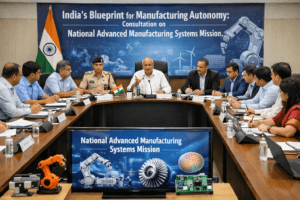
A pivotal stakeholder consultation, co-organized by the Office of the Principal Scientific Adviser and the Ministry of Heavy Industries at CMTI Bengaluru, brought together over 220 leaders from government, industry, and academia to shape India’s proposed Advanced Manufacturing Systems (AMS) Mission, aimed at achieving technological sovereignty in critical areas like CNC machine tools, robotics, and additive manufacturing. The discussions, which featured insights from Principal Scientific Adviser Prof. Ajay Kumar Sood on the need for resilient supply chains and indigenous precision manufacturing, focused on bridging the gap between research and industrial deployment through a structured, Technology Readiness Level-aligned approach. Key outcomes included the inauguration of India’s first Ball Screw Lead Error Testing facility at CMTI and detailed deliberations in thematic sessions that identified critical gaps in localizing components, building precision supply chains, and establishing shared testing infrastructure, with the collective inputs now set to form the blueprint for a coordinated national mission to bolster India’s advanced manufacturing ecosystem.
India’s Blueprint for Manufacturing Autonomy: Inside the Consultation to Build a National Advanced Manufacturing Systems Mission
Bengaluru, February 26, 2026: On a Monday afternoon at the Central Manufacturing Technology Institute (CMTI) in Bengaluru, a quiet but significant event took place that could define the trajectory of Indian industry for the next decade. It wasn’t a product launch or a corporate announcement, but a stakeholder consultation—a word often associated with bureaucratic formalities. However, the weight of the participants and the urgency in the discussions suggested something far more substantial was taking shape: the foundational architecture for India’s Advanced Manufacturing Systems (AMS) Mission.
Co-organized by the Office of the Principal Scientific Adviser (OPSA) and the Ministry of Heavy Industries (MHI), the gathering on February 23, 2026, was the culmination of a year-long consultative process aimed at answering a critical question: How does India achieve technological sovereignty in the machines that build all other machines?
The “Mother Machine” Strategy: Why Advanced Manufacturing Matters Now
For decades, India’s manufacturing policy has focused on attracting investment and building scale in sectors like automotive and pharmaceuticals. While successful, this approach has often relied on importing the “means of production”—the high-precision CNC machine tools, the industrial robots, and the advanced testing equipment that ensure quality and efficiency.
Prof. Ajay Kumar Sood, Principal Scientific Adviser to the Government of India, set the tone for the consultation by framing advanced manufacturing not just as an industrial sub-sector, but as the backbone of a self-reliant, technologically advanced nation. “Technological sovereignty and resilient supply chains require strong indigenous capabilities in high-precision machines, production systems, CNC controllers, sensors, and quality infrastructure,” he told the gathering of over 220 representatives from industry, academia, and government.
His emphasis on “technological sovereignty” is key. In a world of fragmented supply chains and strategic competition, access to the latest manufacturing technology can no longer be taken for granted. For India’s aspirations in aerospace (building civilian and military aircraft), defence (indigenous platforms like Tejas), electronics (semiconductor fabs and mobile phone assembly), and green energy (solar and wind power equipment), the ability to design and build the underlying factory tools is paramount.
This mission, as envisioned, is a direct line to the vision of a ‘Viksit Bharat’ (Developed India) by 2047. A developed nation cannot be a permanent importer of high-value capital goods.
Bridging the “Valley of Death”: From Lab to Factory Floor
One of the most persistent challenges in Indian technology development has been the gap between a brilliant proof-of-concept in a research lab and a reliable, market-ready product on a factory floor. Dr. Parvinder Maini, Scientific Secretary at OPSA, elaborated on how the proposed mission aims to bridge this chasm.
She highlighted the need for a “systems-level approach and a Technology Readiness Level (TRL)-aligned mission architecture.” In essence, the mission would not just fund basic research (low TRL) or just support mass production (high TRL). It would create a structured pathway with dedicated funding and infrastructure for the messy middle—the prototyping, piloting, testing, and certification stages where most promising technologies fail.
This is where the “Valley of Death” is deepest. A startup may have a novel design for a robotic arm, but without access to precision manufacturing partners or accredited testing labs to certify its performance, it cannot break into the market. The proposed mission, with its emphasis on “shared testing infrastructure” and “internationally benchmarked certification systems,” seeks to lower these barriers dramatically.
The Trinity of Transformation: Machines, Robotics, and Additive Manufacturing
The consultation was structured around three parallel technical sessions, each dissecting a critical domain. This wasn’t a high-level policy talk; it was a deep dive into India’s technological gaps.
- CNC Machine Tools, Testing, and Metrology: The Quest for PerfectionThis session tackled the heart of the capital goods sector. CNC machine tools are the “mother machines” that produce precision components. India has a long history in this sector but has struggled to compete with global leaders in high-end, five-axis machines and, crucially, theCNC controllers—the brains of the operation. Discussions here highlighted a stark reality: while India can manufacture the iron and steel structures of a machine, critical aggregates like spindles, ball screws, and controllers are still largely imported. The localisation of these components is not just an industrial goal; it’s a matter of supply chain security. The inauguration of CMTI’s new Ball Screw Lead Error Testing and Certification System by Prof. Sood is a direct response to this. As the first such facility in India, it allows domestic manufacturers to test and certify a critical component for accuracy, breaking a long-standing dependency on foreign labs.
- Robotics and Robotic Arms: Physical AI Takes Centre StageThe robotics session moved beyond simple automation. The discussion centred on “robotics and physical AI” as key enablers. This means robots that are not just programmed for repetitive tasks but can sense, adapt, and learn from their environment. For Indian industry to move up the value chain, it needs these intelligent systems. The conversation here was mature, acknowledging ecosystem constraints. It’s not just about building a robot; it’s about building a precision supply chain for reducers, motors, and controllers. It’s about creating a skilled workforce that can deploy and maintain these systems. The consensus was that a coordinated national effort, driven by active industry participation (defining the problems they need solved), is the only way to build a sustainable robotics ecosystem.
- Advanced Additive Manufacturing (3D & 4D Printing): From Prototyping to ProductionIndia has a vibrant community of additive manufacturing (AM) startups and users, but the technology is often confined to prototyping. The session aimed to chart a path for AM to become a true production technology. The key bottlenecks identified werematerials and process qualification. If you 3D-print a critical bracket for an ISRO rocket or a biomedical implant, how do you prove it is as strong and reliable as a traditionally forged part? This requires deep collaboration between material scientists, machine manufacturers, and end-users to develop standards and data. The call for “industry-defined problem statements” and “stronger academia-industry collaboration” reflects a desire to move away from academic curiosity projects towards solving real-world manufacturing challenges, such as printing complex geometries for defence or lightweight parts for aviation.
A New Funding Architecture: Beyond Grants and Subsidies
A significant undercurrent of the discussions was how this mission would be funded. Prof. Sood pointed to two existing, but crucial, enablers: the industry-led Research, Development and Innovation (RDI) Fund and the grant-based Anusandhan National Research Foundation (ANRF) .
The RDI model is particularly noteworthy. It suggests a shift from the government simply doling out subsidies to one where industry pools resources and defines research priorities, with the government providing co-funding and support. This ensures that the research funded has a clear market pull, not just a technology push. The proposed AMS Mission would act as an umbrella, channelling resources from these and other sources into a coherent, time-bound programme with clear milestones, budgets, and risk mitigation measures.
The CMTI Showcase: Demonstrating Indigenous Capability
The consultation wasn’t just about talking. A visit to the CMTI laboratories provided a tangible glimpse of what a focused national effort can achieve. Dignitaries witnessed demonstrations of machines and instruments designed and developed in-house:
- Vertical Planetary Mixing Machines: Critical for advanced materials processing.
- Aerospace Line Replaceable Units (LRUs): Showcasing capability in high-reliability electronic assemblies for aviation.
- Automatic Optical Inspection Systems: Vital for quality control in electronics manufacturing, especially for PCB assemblies.
- Developments from the Sensor Technology Development Centre: Sensors are the eyes and ears of any smart factory, and indigenous development here is crucial for Industry 4.0 readiness.
These demonstrations served as a powerful counter-narrative to the idea that India cannot do high-tech manufacturing. They proved that with sustained investment and a clear mission, institutions like CMTI can become hubs of deep-tech innovation.
The Road Ahead: From Consultation to Mission Mode
As Dr. Rakesh Kaur from OPSA noted, the mission framework is still being shaped. The inputs from the breakout working groups—which meticulously discussed 16 sub-themes, from strategic priorities to risk mitigation—are invaluable.
The synthesis of these discussions will feed directly into the draft Advanced Manufacturing Systems proposal. The goal is to create a “coordinated national architecture” that seamlessly integrates R&D, validation, testing, and industrial deployment.
For the 220 stakeholders present, the message was clear: India is moving from a fragmented approach to manufacturing policy to a mission-oriented one. The success of this mission will be measured not by the number of reports generated, but by the number of indigenous CNC controllers controlling machines on factory floors, by the Indian-made robotic arms assembling iPhones or cars, and by the 3D-printed parts certified for flight on Indian aircraft.
The consultation at CMTI was a foundational step. It laid the groundwork for a future where India doesn’t just make products, but builds the very factories that make them, securing its place as a true manufacturing powerhouse in the decades to come.
You must be logged in to post a comment.