
India’s Bioenergy Boom: Powering a Cleaner Future from Farms and Waste
Over the past decade, India has significantly advanced its bioenergy sector by installing 2,362 MW of biomass power capacity, 228 MW from waste-to-energy projects, and an impressive 2.88 lakh biogas plants, forming a strategic pillar in its diversified renewable energy strategy. Driven by the National Bioenergy Programme and complementary policies like the National Policy on Biofuels, this growth addresses multiple national priorities: it provides dispatchable, clean power to complement intermittent solar and wind energy, transforms agricultural residue and municipal waste from environmental hazards into valuable resources, creates rural income streams, and delivers clean cooking fuel to households. While still a smaller component of India’s overall energy mix, bioenergy’s unique ability to simultaneously tackle energy security, waste management, and rural development makes it a vital and pragmatic component of the country’s sustainable energy transition and climate goals.
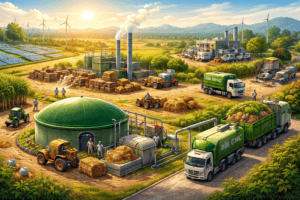
India’s Bioenergy Boom: Powering a Cleaner Future from Farms and Waste
India’s ambitious energy transition is a story of grand scale and stark contrasts. While headlines celebrate record-breaking solar and wind installations, a quieter but equally vital transformation is taking place on the ground—in fields, sugar mills, and rural households. Over the past decade, India has built a substantial bioenergy foundation, adding 2,361 MW of biomass power capacity, 228 MW of waste-to-energy projects, and an impressive 288,000 biogas plants.
This progress, supported by strategic government programmes, positions bioenergy as a critical but often overlooked pillar in India’s quest for energy security and sustainability. As the nation navigates the dual challenge of meeting skyrocketing electricity demand and fulfilling its climate commitments, turning agricultural residue and municipal waste into power is emerging as a pragmatic solution with deep socio-economic roots.
The Bigger Picture: India’s Energy Transition Tango
To appreciate the role of bioenergy, one must first understand the complex energy landscape it operates within. India is engaged in what analysts call an “energy addition” strategy rather than a straightforward transition. In the first half of 2025 alone, the country added a record 22 gigawatts (GW) of renewable capacity. This surge has helped non-fossil fuel sources (including large hydro and nuclear) claim a slender majority—51.37%—of the nation’s total 505 GW installed capacity.
However, this installed capacity tells only part of the story. Fossil fuels, primarily coal, still dominate actual electricity generation, supplying about 75% of the power consumed. The government also has plans to add a substantial 80 GW of new thermal (coal-based) power projects to ensure grid stability and meet base-load demand. This reality underscores a critical point: for India, renewables like solar and wind are essential, but their intermittent nature creates a need for dispatchable, reliable clean power. This is where bioenergy, capable of generating power on demand from stored biomass, finds its strategic niche.
Decoding the National Bioenergy Programme
The structured growth in this sector is largely driven by the National Bioenergy Programme (NBP), Phase-I, which was formally notified in 2022 with a budget outlay of ₹858 crore (later revised to ₹998 crore) for the period 2021-22 to 2025-26. The programme is a consolidated framework that brings three distinct but interconnected streams under one umbrella:
- Waste to Energy Programme: Focuses on generating Biogas, Bio-CNG, or power from urban, industrial, and agricultural waste.
- Biomass Programme: Supports the manufacturing of biomass pellets/briquettes and promotes biomass-based cogeneration in industries.
- Biogas Programme: Promotes small to medium-sized biogas plants for cooking and decentralized power, primarily in rural areas.
The following table summarizes the focus and impact of these three pillars:
| Programme Pillar | Primary Focus | Key Impact & Example |
| Waste to Energy | Converting municipal & industrial waste into power or Bio-CNG. | Reduces landfill pressure, tackles urban waste crisis, and produces fuel under the SATAT scheme for vehicles. |
| Biomass Programme | Promoting biomass co-firing in industries and pellet manufacturing. | Provides a market for crop residue (like paddy straw), reducing harmful stubble burning in northern states. |
| Biogas Programme | Installing small-scale household and community biogas plants. | Offers clean cooking fuel to rural households, improves health, and creates organic fertilizer as a byproduct. |
More Than Megawatts: The Human and Environmental Dividend
The true value of India’s bioenergy push extends far beyond the megawatts added to the grid. Its most profound impact is socio-economic and environmental.
- Transforming Rural Livelihoods: For farmers, agricultural waste like paddy straw, which was once burned causing severe air pollution, is now becoming a source of additional income. The Biomass Programme creates a supply chain for this residue, benefiting farmers and reducing the seasonal air quality crises in cities like Delhi. Similarly, the 288,000 biogas plants installed across the country, especially in cattle-rich regions, provide households with clean cooking fuel (biogas), freeing women and children from indoor air pollution caused by wood-fired chulhas. The nutrient-rich slurry left behind acts as a high-quality organic fertilizer, reducing dependence on chemical alternatives.
- A Engine for Decentralized Energy and Jobs: Unlike massive solar parks or coal plants, bioenergy systems are inherently local and decentralized. A biogas plant can serve a village, and a biomass cogeneration unit can power a sugar mill and its surrounding community. This decentralization reduces transmission losses and fosters local energy resilience. Furthermore, the sector is a significant green job creator, generating employment in biomass collection, transportation, plant operation, and maintenance, particularly in rural and semi-urban areas.
- Addressing the Urban Waste Crisis: India’s rapidly growing cities are drowning in waste. The Waste-to-Energy component tackles this problem head-on by scientifically processing municipal solid waste. While the current capacity of 856 MW from waste-to-energy is a small fraction of the total renewable mix, it represents a crucial shift in viewing waste not as a burden but as a resource for recovery, helping manage urban sanitation and methane emissions from landfills.
State Leaders and the Road Ahead
The growth of bioenergy has not been uniform across India. Certain states have emerged as clear frontrunners, often due to their agro-industrial profiles. Maharashtra, Karnataka, Punjab, Uttar Pradesh, and Haryana are among the leading states in terms of installed biomass power capacity. For instance, Tamil Nadu, a renewable energy leader overall, also contributes significantly to bioenergy, hosting about 1 GW of the national total.
The cumulative installed capacity for biomass power and cogeneration now stands at approximately 10.8 GW, with waste-to-energy adding another 0.86 GW. Yet, this 11.6 GW of modern bioenergy is just a beginning. The government has set an ambitious target for 20% ethanol blending in petrol by 2025-26 and is promoting Compressed Biogas (CBG) through the SATAT initiative, aiming for 15 million metric tonnes from 5,000 plants.
Challenges and the Path Forward
Despite its promise, the bioenergy sector faces significant hurdles. Supply chain logistics for collecting and transporting dispersed agricultural residue can be costly and inefficient. Technological efficiency in gasification and waste processing needs continuous improvement to enhance viability. There are also societal challenges, such as ensuring consistent community participation in waste segregation for urban plants or managing perceptions around plant locations.
The road forward requires a multi-pronged strategy:
- Strengthening Supply Chains: Developing efficient, farmer-centric models for biomass aggregation.
- Technology and Financing: Encouraging R&D for higher efficiency and providing blended finance to de-risk projects for private investors.
- Policy Synergy: The NBP must work in lockstep with other national missions, such as the National Green Hydrogen Mission (for which Bio-CNG could be a feedstock) and city-level waste management rules, to create a cohesive circular economy.
In conclusion, India’s decade-long build-out of bioenergy infrastructure is a testament to a pragmatic and multi-dimensional approach to clean energy. It is not just about generating green electrons. It is about cleaning farms and cities, empowering rural communities, creating jobs, and building a more resilient energy system from the ground up. As India marches toward its target of 500 GW of non-fossil capacity by 2030 and net-zero by 2070, bioenergy, derived from the very soil and waste of the nation, will be an indispensable partner in powering a sustainable future.
You must be logged in to post a comment.