
India’s Aviation Crisis: How Safety Rules Grounded an Airline Giant
India’s Aviation Crisis: How Safety Rules Grounded an Airline Giant
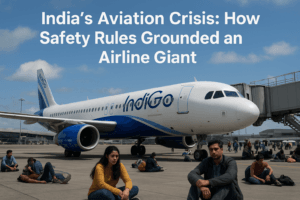
The past week has delivered a harsh lesson in the delicate balance of modern aviation. Across India, scenes of passengers stranded on airport floors, families missing weddings, and ticket prices soaring to shocking levels have exposed deep vulnerabilities in the nation’s air travel system. At the center of this storm is IndiGo, the country’s dominant airline, which canceled over 2,100 flights in early December 2025—a meltdown triggered by new safety rules it failed to plan for, and one that has sparked a fierce debate over profit, safety, and the future of Indian aviation.
The Spark: New Rules on Pilot Fatigue
The immediate cause of the crisis is the full implementation of updated Flight Duty Time Limitations (FDTL) rules by India’s aviation regulator. Designed to combat pilot fatigue—a critical safety concern—these rules represent a significant shift from the previous, more flexible regime.
The table below details the key changes that upended airline operations:
| Regulation Area | Old Rules | New Rules (Phase II) | Impact on Operations |
| Weekly Rest | 36 hours | 48 hours | Reduces available pilot flying hours per week. |
| Night Landing Limit | Up to 6 per week | Max 2 per week (midnight-6 AM) | Severely impacts airlines with dense late-night/early-morning schedules. |
| Daily Flight Hour Limit | More flexible | Max 8 hours (night: max 10 hours) | Reduces roster flexibility, especially for long or delayed flights. |
| Rest Between Duties | Shorter, more flexible | Must be twice the duty period; min 10 hrs in 24hrs | Makes quick turnarounds and schedule recovery more difficult. |
The rules, first drafted in early 2024 and rolled out in two phases (July and November 2025), gave airlines substantial notice. However, for IndiGo, whose business model was built on high aircraft and crew utilization, these changes collided with its operational DNA. The airline admitted that “lack of proper planning ultimately led to disruptions”.
Why IndiGo Was the Epicenter: A Perfect Storm of Scale and Strategy
IndiGo wasn’t just another airline affected; it became the crisis’s sole epicenter. This was due to a combination of its market dominance and specific internal strategies.
- Sheer Scale and Lack of Buffer: Operating over 2,200 daily flights and commanding nearly 63% of the domestic market, IndiGo’s network is vast. Its “lean manpower” strategy, aimed at cost control, meant it operated with minimal pilot buffers—reportedly as low as 4%. When the new rules instantly reduced the available flying hours per pilot, there were no spare crew to fill the gaps. A minor scheduling issue thus snowballed into a system-wide collapse.
- A Business Model at Odds with Safety Norms: Analysts note that IndiGo’s success was built on a high-frequency, point-to-point model that relied heavily on night operations (known as “red-eye” flights). The new cap of two night landings per week directly targeted this core operational pattern. The airline’s delayed hiring, despite years of advance notice on the rules, suggests a fundamental miscalculation.
- Compounding Factors: The regulatory shift occurred during India’s peak winter travel, wedding, and holiday season. Additional stresses like airspace restrictions, technical glitches (including an Airbus software advisory), and weather delays created a domino effect. Once a flight was delayed past midnight, it could breach the new night-duty limits, forcing cascading cancellations.
The Controversial Response: Rolling Back Safety for Stability
Faced with operational paralysis and public outrage, the government and the Directorate General of Civil Aviation (DGCA) took a dramatic step that has become the crisis’s most controversial chapter: they temporarily suspended key parts of the new safety rules.
On December 5, the DGCA granted IndiGo temporary exemptions, including relaxing the strict night landing cap and allowing more scheduling flexibility. The Civil Aviation Minister stated this was done “solely in the interest of passengers” and insisted safety was not compromised.
The pilot community responded with fury and fear. The Airlines Pilots’ Association of India (APAI) slammed the move, arguing it “undermined the very spirit of the FDTL regulations and gravely compromised the safety of the flying public.”. They accused IndiGo of creating an “artificial crisis” to pressure regulators and warned that pilots would now fly with “reduced rest and increased fatigue,” placing everyone at elevated risk.
This rollback raises a troubling question: in a clash between network stability and scientifically designed safety protocols, which should yield?
Beyond One Airline: Symptoms of a Distorted Ecosystem
While IndiGo’s planning failure is clear, the crisis illuminates systemic pathologies within Indian aviation itself.
- A Market Without True Competition: IndiGo’s 63% market share borders on monopoly power in many routes. This crisis demonstrated the national vulnerability that comes with such concentration. When IndiGo sneezed, the entire country’s travel plans caught a cold, with alternative airlines raising fares to extraordinary levels until the government imposed temporary price caps.
- The “Low-Cost” Mirage: Despite being branded a low-cost carrier (LCC), experts argue India lacks the ecosystem for a true, sustainable LCC model like those in Europe or Southeast Asia. Key enablers like low-tax aviation fuel, competitive secondary airports, and flexible labor markets are absent. Instead, carriers like IndiGo are forced to be “hybrid operators” absorbing high structural costs. Aviation turbine fuel (ATF) alone constitutes 40-50% of operating costs and remains outside the GST regime, keeping expenses punishingly high.
- Profit in a Sea of Red: A stark paradox defines the sector: planes are full, fares are high, yet only IndiGo is consistently profitable. Major competitors like Air India reported a net loss of ₹10,859 crore in FY2025. This indicates an industry where financial sustainability is elusive for most, creating a fragile system prone to shock.
The Road Ahead: Safety, Stability, and Systemic Reform
The immediate path involves IndiGo painfully rebuilding its schedule. CEO Pieter Elbers has publicly apologized and stated the airline aims for normalization between December 10-15, 2025, with full stability by February 10, 2026. The DGCA has demanded bi-weekly progress reports and issued a show-cause notice to the airline’s management.
For the long-term health of Indian aviation, deeper reforms are essential:
- Regulatory Credibility: The DGCA must enforce rules transparently and avoid ad-hoc exemptions that undermine safety standards. Approving flight schedules must be contingent on verified crew availability.
- Addressing Structural Costs: Bringing ATF under GST and reforming airport charges are necessary to create a viable operating environment for multiple airlines.
- Encouraging Healthy Competition: Policy should foster a market with 4-5 healthy airlines. This requires facilitating the development of cost-competitive secondary airports and ensuring a level playing field.
The IndiGo crisis is more than a story of mismanagement; it is a cautionary tale about what happens when exponential growth outpaces systemic resilience. It has exposed the tension between a drive for market dominance and the immutable requirements of safety, between commercial ambition and operational prudence. As India strives to become a global aviation powerhouse, the lesson is clear: sustainable success requires building an ecosystem where safety and stability are not negotiable costs, but the very foundation of flight.
You must be logged in to post a comment.