
India’s Art Renaissance: How a New Generation is Redefining Cultural Legacy
India’s Art Renaissance: How a New Generation is Redefining Cultural Legacy
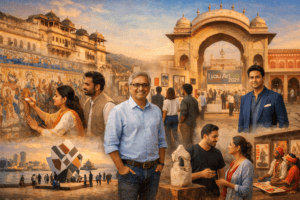
The murals in Bundi’s royal palace are becoming vibrant again, a 200-year-old home in Leh has been reborn as an arts centre, and across India, from Patna to Kochi, new galleries are emerging not just in traditional hubs but in warehouses, palaces, and restored mansions. This activity signals a profound cultural transformation. India’s art scene is experiencing a renaissance driven not by a single entity, but by a diverse coalition of young conservators, visionary institution-builders, and a new breed of collector. They are collectively shifting the landscape from one of preservation in isolation to one of dynamic, participatory engagement, ensuring art is a living, breathing part of the nation’s present and future.
The New Protagonists: From Stewards to Storytellers
At the heart of this change are individuals redefining their roles within the cultural ecosystem. They are moving beyond traditional labels, acting as bridges between heritage and modernity, private passion and public good.
- The Royal Conservator-Entrepreneurs: Young members of erstwhile royal families are leveraging their heritage as a platform for contemporary cultural entrepreneurship. In Rajasthan, siblings Janaki Kumari and Manavendra Pratap Singh are personally overseeing the restoration of 16th-century murals in Bundi’s palace, aiming to transform the city into a cultural destination. In Jaipur, Padmanabh Singh has launched the Jaipur Centre for Art within the historic City Palace, creating a deliberate dialogue between the grandeur of the past and the cutting-edge expressions of the present. Their work transcends restoration; it’s about recontextualizing heritage for new audiences.
- The Philanthropic Institution-Builders: Figures like former banker Sanjiv Kumar represent a strategic, philanthropic approach. His vision materialized as the Arthshila network—a growing chain of multi-arts centres from Santiniketan to Patna designed to bring contemporary, immersive cultural experiences to tier-2 cities. Similarly, the Inlaks Shivdasani Foundation supports the ecosystem by funding global residencies, helping Indian artists and curators gain international exposure and networks. Their focus is on creating sustainable infrastructure and opportunity.
- The Thoughtful Collector-Patrons: A new generation of collectors, profiled in discussions about the evolving art scene, is redefining what it means to collect art. For Mumbai-based Siddharth Somaiya, the drive is artist patronage, not acquisition. Inspired by his grandfather, he supports emerging artists’ practices and livelihoods, seeing it as a way to “bridge the early valleys of death” in their careers. For Nupur Dalmia of Vadodara’s upcoming Ark Museum, collecting is an act of public scholarship, building an institutional collection that narrates the story of post-Independence Indian art through the specific lens of Baroda’s influential scene. As art advisor Rhea Kuruvilla notes, this generation often sees themselves as “stewards and custodians,” building collections that serve as a personal and collective archive of the present.
A Changing Ecosystem: Democratization and Decentralization
The efforts of these individuals are catalyzing broader structural shifts in India’s art world, marked by two key trends:
- The Great Democratization: Art is increasingly leaving the rarefied air of exclusive galleries and moving into public view. Major events like the Kochi-Muziris Biennale, the open-air Lodhi Art Festival, and the expansive India Art Fair are recreating a “carnivalesque atmosphere” that breaks down social barriers and invites a wider cross-section of society to engage. The performance program at the 2026 India Art Fair, curated by the Kochi Biennale’s team, exemplifies this collaborative, public-facing spirit. This shift is what analyst Pramod Kumar K.G. calls a focus on “community-driven practices”.
- The Geographic Decentralization: The cultural map of India is being redrawn. New spaces are flourishing beyond Delhi and Mumbai. Kolkata’s Tri Art & Culture centre now operates from a restored 1940s mansion. In Bengaluru, the Miller Museum of Anamorphic Art offers a unique, specialized experience. In Kochi, Muziris Contemporary has established a gallery in a historic pepper warehouse, aiming to make the city a South Indian art epicenter. This decentralization is empowering local narratives and making art accessible to regional audiences.
Convergence of Old and New: Science Meets Scholarship
This renaissance is also characterized by a sophisticated convergence of methodology. Cutting-edge science and technology are now standard tools in the conservator’s kit, complementing traditional knowledge. National scientific bodies like the CSIR have undertaken mission-mode projects for heritage structures, developing technologies for 3D mapping, non-destructive evaluation, and environmental monitoring. Organizations like INTACH apply this scientific rigor across diverse projects—from restoring a 16th-century stone temple in Mandi by carefully removing modern paint layers to conserving delicate Phad scroll paintings and reverse glass artworks using reversible, scientifically analyzed methods. This marriage of traditional craft and modern science ensures that conservation is both authentic and sustainable.
The Market Reflects the Momentum
The vitality of this transformed ecosystem is reflected in a confident and maturing market. The 2026 India Art Fair, the largest edition yet with 87 galleries, explicitly positions itself as a “launchpad for South Asian talent”. There is a noticeable and growing institutional interest in Indigenous and tribal art, with galleries like Ojas Art developing an educated market for these practices, which are increasingly finding their way into major museums. Furthermore, the fair attracts major international galleries like David Zwirner, showcasing global stars like Yayoi Kusama alongside Indian talent, signaling the market’s integration into the global conversation. New collectors, such as Shankh Mitra, are making headlines with record bids for modern masters, adding fresh energy and capital.
The following table summarizes this transformative shift in India’s art landscape:
| Aspect of the Art Scene | Traditional Model | The New, Emerging Model |
| Primary Drivers | State bodies (e.g., ASI), elite private collectors, established metro-centric galleries | Diverse coalition: young conservators, philanthropic founders, community-focused curators, patron-collectors |
| Approach to Heritage | Preservation and protection, often in isolation | Active restoration and re-contextualization; integrating heritage into contemporary cultural discourse (e.g., palaces as art centres) |
| Geographic Focus | Concentrated in major metros like Delhi and Mumbai | Decentralized growth; tier-2 cities and cultural towns (Ahmedabad, Kochi, Patna, Jaipur) becoming new hubs |
| Audience Engagement | Often exclusive, targeting cultural elites and scholars | Democratic and participatory; public festivals, biennales, interactive installations, educational programs for all ages |
| Collector Mindset | Acquisition for investment, status, or personal enjoyment | Patronage and stewardship; supporting artist careers, building institutional legacies, viewing collections as archives of the present |
The Road Ahead: Sustaining the Renaissance
The momentum is clear, but the journey is ongoing. The true test for this renaissance will be its long-term sustainability. Can the new institutions being built today—from the Ark Museum in Baroda to the sprawling Arthshila network—secure enduring funding and public engagement? How will the market balance its commercial aspirations with the need for inclusive, critical discourse? The promising rise of Indigenous art, for instance, must be handled with ethical sensitivity to avoid exploitation.
Ultimately, India’s art renaissance is a story of reclamation and redefinition. It is about a new generation taking ownership of its vast cultural inheritance—not to lock it away in a vault of the past, but to actively reinterpret it. They are using every tool available, from ancestral responsibility and philanthropic capital to scientific conservation and digital platforms, to ensure that art remains a vital, questioning, and unifying force in Indian society. As Siddharth Somaiya powerfully articulates, the goal is not just to collect objects, but to support the artists who are the “knowledge creators” of our time. In doing so, they are not just guarding Indian art; they are passionately rewriting its future.
You must be logged in to post a comment.