
India’s AI Leap: How Intelligent Technology is Building a Healthier, Financially Empowered Nation
India is witnessing a transformative democratization of artificial intelligence, where AI is evolving from a premium tool into an accessible public utility, particularly within healthcare and finance. In healthcare, this means deploying multilingual, conversational AI assistants that provide remote diagnostics, triage, and patient management in local languages, shifting the system from reactive to proactive care while adhering to data sovereignty principles. In finance, AI agents are enabling inclusion by using alternative data for credit scoring, offering voice-based services to bridge the digital divide, and enhancing financial literacy—all while operating on the backbone of India’s digital public infrastructure. This convergence aims to create a holistic “ease of living,” using culturally intelligent, locally optimized AI to empower citizens nationwide with equitable access to critical services, thereby turning India’s vast diversity and scale into its next global advantage.
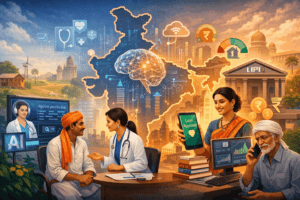
India’s AI Leap: How Intelligent Technology is Building a Healthier, Financially Empowered Nation
A quiet but profound revolution is unfolding across India, one that reaches far beyond the tech hubs of Bengaluru and Hyderabad. In a primary health center in rural Odisha, a farmer receives a preliminary diagnosis via a voice-enabled AI assistant in Odiya. Simultaneously, in a small town in Rajasthan, a shopkeeper secures a business loan in minutes through an automated system that assesses her creditworthiness using non-traditional data. This is the face of democratized technology—where artificial intelligence ceases to be an elite tool and becomes a public utility, actively bridging gaps in India’s most critical sectors: healthcare and finance.
This shift represents more than just digital adoption; it signifies a fundamental reimagining of service delivery. By leveraging AI that is culturally aware, linguistically diverse, and built on India’s robust digital public infrastructure, the nation is pioneering a model of inclusive growth where technology amplifies human potential rather than replacing it.
Healthcare: From Episodic Care to Proactive, AI-Powered Wellness
For decades, India’s healthcare system has been strained by a reactive model—long waits, fragmented records, and episodic visits that often address crises rather than prevent them. The integration of AI is dismantling this inefficient structure, creating a predictive and continuous care network.
The transformation is being led by Conversational AI Assistants—VoiceBots, ChatBots, and VideoBots—that act as first points of contact. These aren’t simple FAQ tools; they are sophisticated systems built on domain-specific Large Language Models (LLMs) or Small Language Models (SLMs). They can analyze a patient’s history, recent lab reports, and described symptoms while conducting a natural conversation in the patient’s native language, from Tamil to Bhojpuri. This linguistic flexibility is revolutionary, breaking down India’s most persistent access barrier: its profound linguistic diversity.
The real impact lies in proactive healthcare management. AI systems now enable remote patient monitoring, sending alerts for medication adherence or vital sign anomalies directly to both patients and their doctors. This creates a safety net for chronic disease management in areas with scarce specialist availability. For instance, an AI system can triage cases, prioritizing critical ones for a doctor’s immediate attention while managing routine follow-ups automatically, thus optimizing the healthcare workforce.
Crucially, this evolution aligns with the vision of Sovereign AI. By utilizing homegrown models trained on indigenous datasets (like BharatGPT) and ensuring health data is processed within national boundaries, India is building a culturally intelligent and privacy-preserving medical AI ecosystem. This means AI that understands local contexts, dietary habits, and common regional health issues, all while complying with the data standards of India’s Ayushman Bharat Digital Mission (ABDM). The goal isn’t to automate doctors out of the loop but to empower them with curated insights, enabling faster, more accurate clinical decisions.
Finance: AI as the Architect of Trust and Mass Inclusion
Parallel to the healthcare transformation, India’s financial sector is undergoing a seismic shift. As millions join the formal economy, traditional, manual processes for onboarding, credit assessment, and fraud detection are untenable. AI has become the essential engine for scaling trust and transparency.
AI Agents are now the new front office. These autonomous systems handle tasks from KYC document verification—cross-checking IDs with digilocker databases in real-time—to evaluating creditworthiness. By analyzing alternative data (such as utility payment histories, mobile recharge patterns, or even transaction behaviors on UPI), these agents can create financial identities for the “thin-file” or new-to-credit population, whom traditional banks often overlook. This is the bedrock of scalable inclusion.
Agentic AI takes this further by rewriting risk management. These systems can independently monitor transactional behaviors, detect sophisticated fraud patterns, and forecast potential loan defaults by analyzing market signals and individual repayment histories. This not only reduces non-performing assets for institutions but also safely expands credit access to underserved segments like small entrepreneurs and farmers.
Perhaps the most socially impactful innovation is Telephony AI. For rural, elderly, or less digitally-literate users, navigating apps can be daunting. Voice-based AI allows them to check balances, apply for loans, or dispute transactions through a simple, intuitive voice call in their language. This is democratization in action—bridging the last-mile digital divide by meeting citizens where they are, on the technology they already use.
Furthermore, Accessible AI is promoting financial literacy. Interactive bots explain complex financial products—from insurance policy clauses to mutual fund risks—in simple, regional languages. By demystifying finance, AI acts as an equalizer, empowering first-time users to make confident, informed decisions without reliance on intermediaries.
The Convergence: A Unified Vision for an “Ease of Living”
The true power of India’s approach is revealed in the convergence of these sectors, underpinned by its unique Digital Public Infrastructure (DPI). The interoperable layers of Aadhaar, UPI, and account aggregators (for consented data sharing) provide the rails upon which these AI innovations run.
Imagine a scenario: A citizen’s health data, with explicit consent, can inform a micro-insurance or loan product tailored to their lifestyle. An AI system that tracks recovery from an illness can also advise on managing associated financial stress. This connected ecosystem, powered by culturally aligned AI frameworks, moves the nation toward a holistic “ease of living” index, where well-being and financial security are interlinked and intelligently supported.
The Road Ahead: Democratization as India’s Global Blueprint
India’s AI market, projected to grow at a CAGR of 25-35%, reflects this broad-based momentum. However, the challenge remains to ensure these technologies are equitable, ethical, and effective. This requires continuous focus on:
- Reducing Bias: Actively working to ensure AI models don’t perpetuate societal biases.
- Maintaining the Human-in-the-Loop: Especially in healthcare, AI must assist, not replace, professional judgment.
- Building Digital Literacy: Ensuring citizens understand and can trust AI-driven services.
Democratizing tech in India is not merely an economic agenda; it is a social imperative. It represents a conscious choice to harness intelligence—both human and artificial—to build a system where a farmer in Vidarbha and a executive in Mumbai have access to the same quality of diagnostic support and financial tools. By making AI a public good that is sensitive to context, language, and local need, India is not just solving its own challenges; it is crafting a blueprint for inclusive technological adoption that the world can learn from. The revolution is here, and it speaks in a thousand tongues, promising a smarter, healthier, and more financially empowered India for all.
You must be logged in to post a comment.