
India’s Aerospace Ambition Takes Flight: Can the Adani-Embraer Pact Forge a New Manufacturing Frontier?
India’s Aerospace Ambition Takes Flight: Can the Adani-Embraer Pact Forge a New Manufacturing Frontier?
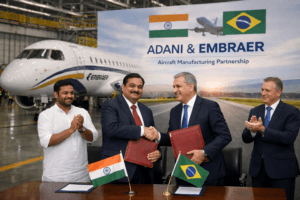
In a move poised to reshape the contours of India’s industrial landscape, the Adani Group and Brazil’s Embraer are set to sign a landmark agreement to establish a Final Assembly Line (FAL) for civilian aircraft in India. This isn’t merely another corporate memorandum of understanding; it is a strategic gambit that strikes at the heart of India’s long-held aspiration to become a manufacturing hub for advanced aerospace technology. Scheduled for January 27 in New Delhi, this announcement, presided over by Civil Aviation Minister K. Rammohan Naidu, represents the most concrete step yet in translating the “Make in India” vision from a slogan into tangible, high-value industrial output.
Beyond Headlines: Decoding the Strategic Partnership
At first glance, this is a story of a powerful Indian conglomerate and a renowned global aerospace manufacturer coming together. But delve deeper, and the layers reveal a meticulously calculated alignment of interests.
For Embraer, the world’s third-largest commercial aircraft manufacturer, India is the logical frontier. Dominated by Airbus and Boeing in the larger narrow-body segment, Embraer has carved a lucrative niche with its E-Jets, which seat up to 150 passengers. India’s aviation market, exploding with demand from tier-2 and tier-3 cities, presents a perfect use case for these regional jets. The company’s own projection of a need for 500 aircraft in the 80-146 seat range over two decades underscores the sheer scale of the opportunity. An local FAL isn’t just about tariffs or logistics; it’s a powerful statement of commitment. It allows Embraer to offer cost-competitive solutions, deeper customization for Indian operators, and faster delivery times—key advantages in a fiercely competitive airline market.
For the Adani Group, this is a masterstroke in vertical integration within its rapidly expanding aviation empire. Already a dominant force in airports (it operates and is developing several of India’s largest), aviation services, and even pilot training, the leap into aircraft assembly is a natural, albeit audacious, progression. It transforms Adani from an infrastructure and service provider into a core manufacturer, capturing value across the entire aviation ecosystem. The stated intent to eventually manufacture aircraft components signals a long-term plan to cultivate a domestic supply chain, potentially creating a hub akin to Hyderabad’s for aerospace components, but for regional jets.
The “Make in India” Crucible: More Than Assembly
The Indian government’s presence at the signing is symbolic of a broader national project. For decades, India’s aviation story has been one of consumption—buying planes, leasing them, and flying them. The maintenance, repair, and overhaul (MRO) sector has seen growth, as highlighted by Safran’s LEAP engine facility, but true blue-collar and white-collar aerospace manufacturing has remained elusive.
This FAL has the potential to be a catalyst. A final assembly line is the pinnacle of the aircraft production process, where major sub-assemblies—fuselage, wings, empennage, engines—are joined, systems installed, and the aircraft is tested and certified. Establishing this complex, certification-intensive operation in India does several things:
- Technology Transfer & Skill Genesis: It will necessitate the transfer of sophisticated aerospace engineering, systems integration, and quality assurance protocols. This creates a high-skilled workforce—technicians, engineers, and logistic specialists—whose expertise can permeate the broader manufacturing sector.
- Supply Chain Magnet: Historically, a lack of local final assembly has stunted the growth of a domestic component supply chain. An active FAL provides the anchor demand that can justify investments by smaller Indian MSMEs to produce precision parts, wiring harnesses, composites, and avionics assemblies, moving up the value chain from simple machining.
- Strategic Autonomy: While this venture is commercial, it builds foundational capabilities. The experience gained in civilian aircraft assembly dovetails with India’s defense ambitions. Embraer’s parallel discussions with Mahindra for the C-390 Millennium military transport aircraft program show a twin-track approach. The skills and ecosystem developed for civilian jets can inform and accelerate defense aerospace projects.
Navigating Turbulence: The Challenges on the Runway
The optimism, however, must be tempered with realism. The history of global aerospace manufacturing is littered with ambitious ventures that struggled with profitability, scale, and global competitiveness.
- The Scale Conundrum: Aerospace is the ultimate game of economies of scale. The break-even point for an assembly line is high. Will the demand from Indian regional airlines—currently a market served by a handful of players like Star Air—be sufficient to keep the line running at optimal capacity? The venture’s success is inextricably linked to the growth of India’s regional connectivity (RCS-UDAN) scheme and airlines’ willingness to commit to the E-Jet platform.
- Global Cost Competitiveness: Even with lower labor costs, the initial output will face competition from Embraer’s established lines in Brazil and elsewhere. The true cost advantage will only materialize with deep localization of components, a process that takes years and significant investment in supplier development.
- Certification and Quality: The Directorate General of Civil Aviation (DGCA) will need to work closely with Brazil’s ANAC and other global regulators to ensure aircraft rolling out of the Indian FAL meet every international standard without exception. Building and maintaining this reputation for flawless quality is non-negotiable.
A Flight Path for the Future
The Adani-Embraer pact is more than a business deal; it is a litmus test for India’s advanced manufacturing ambitions. Its success would send an unequivocal signal to the world that India is ready to move beyond assembly-line electronics and into the league of complex, technology-driven system integration.
If successful, it could create a blueprint. Imagine an aerospace cluster where the Adani-Embraer FAL is the centerpiece, surrounded by a network of domestic and global suppliers, supported by specialized MRO facilities, and feeding into a growing airline network. It would rebalance India’s aerospace trade, create high-quality jobs, and foster innovation.
The signing on January 27 is not the culmination, but the clearance for takeoff. The real work—of building the facility, training the workforce, localizing the supply chain, and winning the confidence of global airlines—lies ahead. As the engines of this partnership start to turn, India watches, hoping this venture will be the powerful thrust that finally propels its aerospace manufacturing dreams into a sustainable and soaring reality.
You must be logged in to post a comment.