
India’s $8.8 Billion Defense Pivot: Modernization or a Message to the Region?
In a significant move to address escalating regional security challenges and persistent capability gaps, India has approved a massive $8.8 billion defense spending package focused on critical force multipliers like advanced radars, secure software-defined radios, and automated landing systems, which collectively aim to enhance surveillance, communication, and operational efficiency across its military branches; this investment strategically serves the dual purpose of rapidly modernizing its armed forces in response to a tense two-front reality with China and Pakistan while simultaneously advancing its “Atmanirbhar Bharat” initiative by prioritizing domestic procurement to bolster the nation’s long-term defense industrial self-reliance.
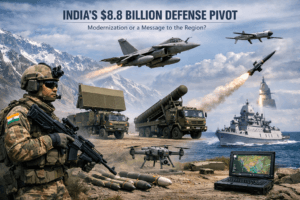
India’s $8.8 Billion Defense Pivot: Modernization or a Message to the Region?
In a move signaling both ambition and urgency, India’s Defense Acquisition Council (DAC) has greenlit a colossal spending package of 790 billion rupees (approximately $8.8 billion). Approved on a late December day, this decision is far more than a routine budgetary exercise. It is a strategic statement, a technical overhaul, and a reflection of the complex security calculus facing the world’s largest democracy. While headlines focus on the staggering figure, the real story lies in the “why” and the “what”—the geopolitical pressures driving this investment and the specific, often overlooked capabilities it seeks to bolster.
Beyond the Price Tag: Decoding the Strategic Imperatives
This approval is not an isolated event but a critical node in a long-term trajectory. To understand its significance, one must look past the dollar amount and examine the converging pressures that made it necessary.
- The Two-Front Reality:For decades, Indian defense planning has theoretically accounted for challenges from both Pakistan and China. Today, that theory is a stark, operational reality. The ongoing military stalemate with China along the Himalayan Ladakh border, now in its sixth year, has exposed critical infrastructure and capability gaps. It’s a theater demanding specialized mountain warfare equipment, all-weather surveillance, and robust logistics—needs that are both urgent and astronomically expensive. Simultaneously, the perennial threat from Pakistan, with its own evolving tactical and nuclear capabilities, necessitates constant readiness on the western front. This $8.8 billion is, in part, a direct response to the unsustainable strain of preparing for two simultaneous, geographically and tactically distinct, conflict scenarios.
- The Technology Gap Wake-Up Call:The 2020 Galwan clash was a watershed moment. It brutally highlighted that numerical superiority in troops means little without technological edge. Chinese advancements in areas like electronic warfare, cyber capabilities, and long-range artillery have forced India’s hand. Modern warfare is increasingly about networks, sensors, and data links, not just soldiers and tanks. The DAC’s clearance, therefore, heavily emphasizesforce multipliers—equipment that enhances the effectiveness of existing platforms and personnel. This is not about buying more of the old; it’s about buying smarter for the new age of combat.
- The “Atmanirbhar” Tightrope:A crucial, defining aspect of this spending spree is its alignment with India’s“Atmanirbhar Bharat” (Self-Reliant India) initiative. Notably, the defense ministry stated that a significant portion of these acquisitions will be sourced from domestic manufacturers. This represents a delicate balancing act. On one hand, there is an urgent operational need to plug capability gaps quickly, which often favors proven foreign systems. On the other, there is a long-term strategic imperative to build a resilient, indigenous defense industrial ecosystem. This investment, therefore, serves a dual purpose: addressing immediate threats while acting as a financial catalyst for Indian defense R&D and production, aiming to reduce a debilitating historical reliance on imports.
A Deep Dive into the “What”: Capabilities Over Commodities
The approved proposals are a diagnostic map of India’s perceived weaknesses. Let’s move beyond generic terms and explore what these systems actually do for the armed forces.
- Radars & Surveillance Systems: This isn’t just about “more radars.” In the context of the Himalayas, it likely refers to High-Altitude, Low-Observable (HALO) radars and advanced weather-penetrating systems. For the navy, it means maritime patrol radars to track surface and subsurface threats across the vast Indian Ocean Region, a critical need given China’s increasing naval presence. For the air force, it involves next-generation Active Electronically Scanned Array (AESA) radars that can track multiple stealthier targets at longer ranges, a direct counter to advanced fighter jets possessed by adversaries.
- Software-Defined Radios (SDRs): This is a silent game-changer. Modern armies run on secure, jam-resistant communication. Legacy radios are vulnerable to interception and electronic jamming. SDRs, with their encrypted, frequency-hopping capabilities, are the backbone of Network-Centric Warfare (NCW). They allow troops, artillery units, aircraft, and naval ships to share real-time data seamlessly, creating a unified, responsive battlespace. Investing in these is investing in the central nervous system of a modern military.
- Automatic Take-Off & Landing Recording Systems (ATOLRS): While seemingly niche, this reveals a focus on safety, training, and data analytics. These systems constantly record flight parameters during the most critical phases of flight. The data is used to analyze pilot performance, investigate incidents, and train pilots better. In an air force operating in diverse and challenging terrains—from Himalayan airstrips to carrier decks—enhancing safety and operational efficiency directly translates to more available aircraft and more proficient pilots.
- Other Equipment: The catch-all category likely includes critical but less-heralded items: precision-guided munitions for artillery, drone countermeasures (a vital lesson from global conflicts), advanced night-fighting gear for infantry, and upgraded sonar systems for the navy’s anti-submarine warfare fleet.
The Human and Strategic Impact: More Than Just Hardware
The ripple effects of this decision extend far beyond procurement contracts.
For the Indian Soldier, Sailor, and Airman: This translates to enhanced survivability and lethality. Better radars mean earlier warnings. Secure radios mean reliable commands. Modern systems reduce the “fog of war” and provide a tangible technological shield. It is a massive investment in their security and operational effectiveness.
For the Indian Defense Industry: This is a potential turning point. Large, guaranteed domestic orders provide the stability needed for companies like Bharat Electronics Limited (BEL), Larsen & Toubro, and private sector startups to invest in research, build infrastructure, and innovate. The goal is to create a virtuous cycle where the military’s needs fuel a capable industrial base, which in turn supplies world-class equipment.
For the Regional Power Dynamic: This approval sends an unambiguous message to both allies and adversaries. It signals India’s resolve to defend its interests and sovereignty, regardless of cost. It demonstrates a commitment to securing its strategic waterways and land borders. Crucially, it shows an understanding that in the geopolitics of the Indo-Pacific, credible military power remains a fundamental currency.
Navigating the Challenges Ahead
However, the path from DAC clearance to deployed capability is fraught with challenges.
- Bureaucratic & Procedural Hurdles: India’s defense procurement process has historically been slow, with deals often caught in red tape or controversy. The success of this initiative hinges on streamlined execution.
- Absorptive Capacity: Can the forces integrate this diverse, sophisticated technology quickly and effectively? It requires concurrent investment in training, maintenance ecosystems, and doctrinal adaptation.
- The China Benchmark: While this is a significant leap for India, it must be viewed against the scale and pace of China’s military modernization. This is a game of catch-up, not an overtaking maneuver.
Conclusion: A Necessary, But Not Sufficient, Step
India’s $8.8 billion defense approval is a powerful, necessary step toward securing its future in a volatile region. It is a pragmatic mix of addressing immediate tactical deficits and fostering long-term strategic independence. It moves the needle from simply adding mass to adding smart, connected intelligence across all military domains.
Yet, hardware alone does not make a military powerhouse. The true value of this investment will be determined by the speed of its deployment, the excellence of its integration, and the evolution of joint warfighting doctrines that leverage these new tools. If executed with vision and efficiency, this spending can transform India’s armed forces into a more agile, networked, and formidable deterrent. If mired in delays, it will remain just a headline figure. The December 29th clearance is the promise; the years ahead will reveal whether it becomes the reality.
You must be logged in to post a comment.