
India’s 7-Year Countdown: Can a Nation Build a Jet Engine from Scratch?
India is racing against a critical five-to-seven-year deadline to develop a sovereign jet engine, a challenge Defence Minister Rajnath Singh framed as the ultimate test of the nation’s self-reliance, following the decades-long struggle of the Kaveri project which, despite its initial failure, seeded essential knowledge now being applied to derivative engines for UCAVs like the Ghatak; this urgency is driven by the need to power the indigenous fifth-generation AMCA fighter through a strategic technology partnership with France’s Safran, while simultaneously laying the groundwork for a sixth-generation powerplant, all underpinned by the geopolitical imperative to break free from foreign supply chain vulnerabilities and achieve true technological sovereignty through domestic control over critical materials and intellectual property.
India’s 7-Year Countdown: Can a Nation Build a Jet Engine from Scratch?
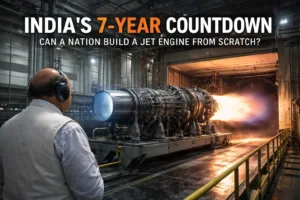
The photograph is striking: India’s Defence Minister, Rajnath Singh, standing in a protective bay at the Gas Turbine Research Establishment (GTRE) in Bengaluru, observing a plume of roaring, supersonic exhaust. The image, circulated by the DRNO in mid-February 2026, is a carefully curated piece of political theatre. It is meant to signal progress, to show the world that India’s quest for a homegrown fighter jet engine is finally leaving the lab and entering the realm of raw power.
But behind the photo op lies a story of immense technical struggle, geopolitical strategy, and a ticking clock. As Singh himself put it during his visit, the nation has, in his estimation, just “five to seven years” to achieve what only a handful of countries have ever done: build a modern, sovereign aircraft propulsion system from the ground up.
This is not just an engineering challenge. It is the final, formidable frontier of India’s Aatmanirbharta (self-reliance) in defence. It is a race against time, physics, and global competition, where the finish line isn’t a medal, but the very definition of India’s strategic independence in the 21st century.
The Weight of a Decade: The Kaveri’s Long, Arduous Journey
To understand the weight of Singh’s warning, one must look at the long shadow cast by the Kaveri engine project. Conceived in the 1980s to power the country’s first indigenous fighter, the Tejas Light Combat Aircraft (LCA), the Kaveri was meant to be India’s crowning achievement. It became, instead, a decades-long lesson in humility.
The problem was never a lack of ambition or scientific talent. The GTRE scientists understood the thermodynamics, the metallurgy, and the aerodynamics required on a theoretical level. The hurdle was the applied science. Building a high-performance gas turbine engine is arguably the most difficult engineering task a nation can undertake. It requires compressing air to extreme pressures, mixing it with fuel, and burning it at temperatures that can melt the very metal containing it—all while spinning turbines at tens of thousands of revolutions per minute, reliably, for thousands of hours.
The Kaveri, after years of development, simply could not deliver the thrust needed for a single-engine fighter like the Tejas without sacrificing its own lifespan. It was underpowered and overweight. By the early 2000s, the programme, for all intents and purposes, had failed in its primary objective. India was forced to turn to the United States for General Electric F404 engines to get its Tejas into the air.
For many, this was a national embarrassment. But for the engineers at GTRE, it was a brutal, necessary education. They didn’t just fail; they learned why they failed. They built a foundational knowledge of material science, coating technologies, and compressor design that cannot be taught in a textbook or bought off a shelf. This hard-won knowledge is now the bedrock upon which the new push is built.
As witnessed by the minister, that knowledge is now being applied to the “full afterburner engine test” of a Kaveri derivative. An afterburner—which injects raw fuel into the hot exhaust to create a massive, short-duration thrust boost—is the signature of a fighter engine. Seeing a Kaveri variant achieve this, even on a test stand, is a tangible proof point that the decades of quiet toil have yielded a critical mass of expertise.
The “Kaveri 2.0” and the Ghatak: A Stepping Stone, Not a Destination
The engine Singh observed is likely a crucial intermediary step. It’s not the mythical “Kaveri 2.0” that will power India’s next fighter, but a testbed for the afterburner module itself. The real programmatic focus, for now, is the Kaveri Derivative Engine (KDE), a “dry” (non-afterburning) engine in the 48-52kN thrust class.
While that thrust level is too low for a manned fighter, it is perfectly suited for the Ghatak, a stealthy, flying-wing Unmanned Combat Aerial Vehicle (UCAV) being developed by the DRDO. This is a masterstroke of pragmatic engineering. By targeting the KDE for the Ghatak, India accomplishes two critical goals.
First, it gives the engine program a viable, in-service platform, breaking the cycle of “technology demonstrators” with no clear home. The Ghatak provides a real-world requirement, forcing the GTRE and its production partners to solve the problems of manufacturing, reliability, and maintenance at scale.
Second, it allows the team to mature the core engine architecture—the heart of the machine—in a less demanding environment. A UCAV doesn’t need the same blistering throttle response or the extreme manoeuvre loads of a manned fighter. Flying the KDE on the Ghatak will generate thousands of hours of operational data, building confidence in the core design. That mature core can then be scaled up and an afterburner added to create the 80-85kN engine needed for a future fighter. The recent afterburner test is a sign that they are already working on that next step, even as the dry engine prepares for its flight career.
Why Five to Seven Years? The AMCA and the Sixth-Generation Shadow
So, why the urgency? Why does Singh feel the nation is on a short clock? The answer lies in the parallel development of the Advanced Medium Combat Aircraft (AMCA), India’s plan for a fifth-generation stealth fighter.
The AMCA is currently slated to fly in its initial Mk1 version with two American-sourced GE F414 engines. But the Mk2 version, the one that will truly embody fifth-generation capabilities, is supposed to be powered by a more powerful, indigenous 110kN engine. This engine, the heart of the AMCA Mk2, is what the GTRE must deliver in partnership with France’s Safran.
The technology transfer deal with Safran for the M88 engine—which powers the Rafale—is the pragmatic side of India’s strategy. While the rhetoric is about self-reliance, the reality is that India cannot, and should not, try to reinvent the wheel alone. The partnership with Safran is intended to give Indian engineers a masterclass in building a modern, combat-proven engine. They will gain access to intellectual property for critical single-crystal blade casting, advanced thermal barrier coatings, and digital engine control units (FADEC).
The five-to-seven-year timeline Singh speaks of is likely the window to translate that knowledge transfer into a tangible, testable prototype for the AMCA. If India misses this window, the AMCA Mk2 will be delayed indefinitely, forcing the air force to either fly a less-capable Mk1 for decades or buy more foreign jets, further eroding the self-reliance goal.
But Singh’s ambition didn’t stop at the fifth generation. He explicitly called for work to begin on a sixth-generation engine. This is not mere grandstanding. A sixth-generation fighter concept, which India is tentatively exploring, will not just be an aircraft. It will be a “flying sensor node,” a quarter-back in the sky directing swarms of drones, and a platform for directed-energy weapons. This requires an engine that is not just a source of thrust, but a powerful electrical generator.
Sixth-gen engines will need to manage heat far more effectively (to hide from infrared sensors) and generate vastly more electrical power for computers, lasers, and electronic warfare suites. This implies innovations like adaptive fan blades that can change their geometry for efficiency or high speed, and embedded electrical generators within the engine core. By pushing the scientific community to think about this now, Singh is trying to ensure that when the airframe designers sit down to draw the next-generation fighter, the powerplant to make it work isn’t a decade behind.
The Strategic Imperative: Titanium, Trust, and Tech Wars
The most profound reason for the urgency, however, is geopolitical. Singh’s warning was framed not as a technical milestone, but as a strategic necessity.
India’s reliance on foreign engines has been a critical vulnerability. The painful delays in Tejas Mk1A production were a direct result of global supply chain disruptions affecting GE’s F404 production line. When you buy an engine, you are buying into a supply chain over which you have no control. A political dispute between the US and a third country, a pandemic, or a factory fire thousands of miles away can ground your air force.
This dependency is compounded by the growing competition for critical minerals and advanced materials. Titanium, which makes up 20-30% of an engine’s weight, is the lifeblood of aerospace. The inauguration of a dedicated titanium and superalloy plant in Lucknow in late 2025 was a direct response to this. Singh’s message at the time was clear: you cannot have technological sovereignty without materials sovereignty.
This is the deep, human insight behind the headline. The quest for a jet engine is a quest for control. It’s about ensuring that an Indian pilot’s ability to defend Indian airspace does not hinge on a signature in a foreign capital or the stability of a foreign factory. It’s about breaking the psychological barrier of dependency, moving from being a “technology consumer” to a “technology creator,” as Singh put it.
The race is not just against a calendar, but against the advancements of others. The US flies the F-22 and F-35 with engines that are marvels of thermodynamic efficiency. China has operationalised the J-20 and J-35A with domestic powerplants. Russia has the Su-57. Turkey and South Korea are close behind. If India fails in this five-to-seven-year window, it risks falling into a second tier of defence industrial powers, permanently reliant on importing the most critical component of its combat aircraft.
The scene in Bengaluru—the roaring afterburner, the determined minister, the proud scientists—was a snapshot of a nation at a crossroads. It was a declaration that the long learning phase is over. The era of excuses has passed. The next five to seven years will determine whether the Kaveri’s long, painful journey was a prologue to failure or the foundation of a new, sovereign capability. The world, and India’s neighbours, will be watching the afterburner’s glow with intense interest.
You must be logged in to post a comment.