
India’s 2025 Economic Tightrope: Steady Growth Meets the Reality of Unsolved Challenges
India’s 2025 Economic Tightrope: Steady Growth Meets the Reality of Unsolved Challenges
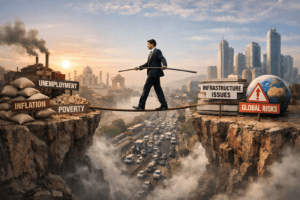
As 2025 draws to a close, India’s economic report card presents a classic paradox: a surface of resilient macro-indicators masking a foundation of persistent, and potentially deepening, vulnerabilities. The nation is ending the year with the enviable title of the world’s fastest-growing major economy, projected GDP growth above 7%, contained inflation, and a reformed financial sector. Yet, beneath this veneer of stability, the core engines of long-term prosperity—broad-based domestic consumption and private capital expenditure—are sputtering. The story of 2025 isn’t one of unqualified success, but of an economy expertly navigating immediate storms while the critical task of repairing its own engines remains unfinished for 2026.
The Art of Crisis Management: Reforms Forced by External Shocks
The year began under the long shadow of geopolitical uncertainty. The assumption that India would sidestep the worst of U.S. tariff wars and swiftly negotiate a deal proved optimistic. Instead, India found itself facing some of the highest effective tariffs into the American market, compounded by penalties linked to its geopolitical stance on energy imports. Simultaneously, tighter immigration policies threatened the vital services export corridor.
Faced with this twin assault, the government did what it has often done best: used the crisis as a catalyst for delayed, difficult reforms. The latter half of 2025 witnessed a policy blitz that belied post-election political caution:
- GST Rationalisation: Long-pending rate tweaks aimed at simplifying the tax structure and boosting demand in key sectors.
- Labour Code Movement: Breathing life into moribund labour law reforms, a crucial step for formalising employment and improving flexibility, though implementation remains key.
- Nuclear Sector Liberalisation: Amendments to attract private and foreign investment into a capital-intensive power sector, signalling a push for energy diversification even as renewable investments slow.
- Financial Sector Opening: Allowing 100% foreign ownership in insurance and new rules for pensions and banks, aimed at attracting stable, long-term capital to offset volatile portfolio outflows.
These moves were defensive yet strategic. A managed depreciation of the rupee, breaching 90 against the dollar, acted as a partial shock absorber against U.S. tariffs. Remarkably, goods exports to the U.S. showed resilience, buoyed by tariff-exempt pharmaceuticals and electronics, and genuine, albeit nascent, success in market diversification.
The Unsolved Core: The Consumption and Investment Conundrum
Despite these tactical wins, the structural weaknesses persist. The most significant challenge heading into 2026 is the stark divide in the domestic economy.
The Consumption Divide: Rural demand, supported by healthy agricultural output and robust rabi sowing, has shown surprising strength. Urban demand, however, tells a different story. The post-pandemic surge in high-end consumption and government-led capex, which have been the primary growth propellants, are now visibly ebbing. This creates a two-speed economy where broad-based, mass consumption—the true bedrock of sustainable growth—remains tepid. Without the Indian consumer spending confidently across income segments, the economic recovery lacks depth.
The Private Investment Stall: This consumption weakness feeds directly into the decade-long struggle with private investment. Corporate balance sheets are healthier than ever, and debt levels are low—conditions ripe for a capital expenditure boom. Yet, entrepreneurs consistently cite a lack of “demand visibility” as the primary hurdle. Why build new factories when existing ones are still operating at 75-77% capacity? The threshold for triggering greenfield investment is typically sustained capacity utilisation of around 80% for several quarters. We are not there yet.
This creates a vicious cycle: weak consumption discourages private investment, which in turn limits job creation and income growth, further dampening consumption. The government’s capital expenditure, while commendable, cannot fill this void indefinitely without risking fiscal imbalances.
External Winds: From Tariffs to AI and the Golden Hedge
The external environment in 2026 looks fraught with both familiar and novel risks.
- The Tariff Reality: The initial fear of an immediate export collapse has passed, but the uncertainty is now chronic. The tariffs are beginning to bite as U.S. inflation edges up, potentially dampening demand. More insidiously, the U.S.-China trade blockade risks redirecting a flood of Chinese exports into Asian and emerging markets, including India, threatening domestic manufacturers.
- The AI Double-Edged Sword: The global AI boom has serendipitously benefited India’s services exports, with Global Capability Centres expanding as remote work becomes entrenched. This has cushioned the blow from restrictive visa regimes. However, this poses a critical question for policymakers: Is India moving up the value chain in these centres, or is it providing cost-arbitrage labour that AI itself could soon substitute? The long-term challenge is transitioning from providing “bodies” to owning intellectual property and high-value decision-making processes.
- The Global Debt Spectre and Gold’s Warning: A less discussed but profound risk is the ballooning sovereign debt in developed nations. The global surge in gold prices is a telling indicator; investors are seeking a hedge against the rising possibility that central banks may eventually be forced to “inflate away” this debt through loose monetary policy. A wave of inflation in the West would have complex, potentially destabilising effects on global capital flows, currency stability, and import costs for India. It’s a slow-burn risk that makes managing the domestic fiscal deficit and attracting stable FDI even more critical.
The Path Forward in 2026: Beyond Crisis Management
For the Indian government, 2026 must transition from a year of adept crisis response to one of proactive, foundational building. The reform momentum of 2025 provides a platform, but the focus needs to sharpen.
- From Rural Strength to Rural-Urban Bridge: Policies must leverage the current robustness in rural demand to stimulate the broader economy. This means enhancing rural infrastructure and market access in ways that increase non-farm employment and income, creating a more seamless demand continuum with urban markets.
- Incentivising Demand-Led Investment: Fiscal policy could explore targeted incentives for industries that demonstrate a clear link between new investment and serving mass-market demand. The revival of labour-intensive sectors like textiles, freed from the burden of counterproductive Quality Control Orders, is a step in the right direction.
- Harnessing the Demographic Dividend in the AI Age: The new labour codes are a start, but the larger question looms: in an era where capital (like AI) is becoming exponentially more productive, how does policy ensure labour remains competitive? This requires a monumental focus on reskilling, education reform, and fostering innovation ecosystems that create high-value jobs, not just task-based gigs.
Conclusion: The Defining Challenge
India ends 2025 on solid ground, but it is ground that is still shifting. The economy has proven its resilience against external shocks, but its internal balance is delicate. The central task for 2026 is unambiguous: to engineer a virtuous cycle where policy stokes mass consumption, which in turn gives private entrepreneurs the confidence to invest, creating jobs and further fuelling demand.
This is more than an economic objective; it is the pathway to achieving the aspiration of high-income status by 2047. The World Bank notes the need for 7.8% average growth. Hitting that target requires moving beyond the comfortable 6-7% trend growth of the past three decades. That leap will not come from government spending or sporadic export wins alone. It will come from unlocking the immense, latent power of confident Indian consumers and audacious Indian investors. After a year of successfully fighting fires, 2026 must be the year India finally rebuilds the engine.
You must be logged in to post a comment.