
India’s $200 Billion AI Bet: Can the Land of Outsourcing Become the World’s AI Foundry?
India has announced an ambitious plan to attract over $200 billion in AI infrastructure investment by 2028, aiming to transform itself from a back-office services hub into a global “foundry” for artificial intelligence. Building on $70 billion in existing commitments from tech giants like Google and Microsoft, the strategy combines tax incentives, a $1.1 billion government-backed VC fund, and expanded public compute capacity (growing from 38,000 to 58,000 GPUs) to lure investment across the AI value chain—from data centers and chips to deep-tech applications. While the plan faces significant execution challenges around power and water resources for energy-intensive data centers, it represents a calculated geopolitical bet: positioning India as a reliable, third-way destination for global AI computing amid rising US-China tech tensions, while giving its massive technical workforce a stake in owning the AI revolution rather than being displaced by it.
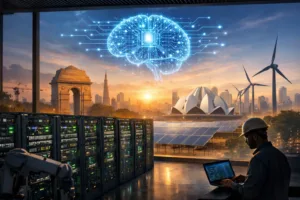
India’s $200 Billion AI Bet: Can the Land of Outsourcing Become the World’s AI Foundry?
On the surface, the numbers are staggering. At the AI Impact Summit in New Delhi this week, India’s IT Minister Ashwini Vaishnaw laid out a vision so ambitious it could reshape the global technology landscape: attract over $200 billion in artificial intelligence infrastructure investment by 2028.
This isn’t just another government press release touting economic growth. It is a calculated, high-stakes gambit to position India not merely as a consumer of AI or a source of talent, but as the global foundry for artificial intelligence—the place where the world’s compute happens.
While headlines will focus on the jaw-dropping figure, the real story lies in the tectonic shift it represents. For decades, India has been the world’s back office, the land of IT services and outsourcing. Now, with the rise of generative AI, it is staring down an existential threat to that very model—and fighting back with a plan to own the means of production.
The Perfect Storm: Why India’s Pitch Matters Now
To understand why this moment is critical, you have to look beyond New Delhi and into the data centers of Northern Virginia and the boardrooms of Silicon Valley.
The first wave of the AI revolution was defined by algorithms and models. The second wave, the one we are entering now, is defined by infrastructure—the physical stuff. We are talking about sprawling data centers consuming enough electricity to power small cities, filled with tens of thousands of NVIDIA H100 and Blackwell GPUs. These chips are the new oil, and right now, the spigot is tightly controlled and geographically concentrated.
The United States and China are in a bitter tech cold war over these assets. Europe is struggling with high energy costs and complex regulations. This creates a vacuum—and an opportunity.
India’s pitch is simple, yet powerful: We have the scale, the technical talent, a stable democratic government, and we are open for business. Minister Vaishnaw’s announcement isn’t just a wish list; it’s a formal declaration that India wants to be the “neutral” or “third pole” in the global AI arms race, a massive, reliable hub for compute capacity that serves the entire world.
Beyond the Billions: Decoding the $200 Billion
The $200 billion target is a composite number, and parsing it reveals the multi-layered strategy at play.
First, a significant portion—including the roughly $70 billion already pledged by Amazon, Google, and Microsoft—is aimed at “hyperscale” cloud and AI infrastructure. This is the foundation: the land, the buildings, the power grids, and the racks of servers. For the tech giants, India is a massive, growing market for their cloud services. But this new push asks them to see India as a global export hub for compute.
Second, and perhaps more indicative of a strategic shift, is the expected $17 billion in “deep-tech and AI applications.” This is where the “human insight” comes into play. The government isn’t just laying concrete; it’s trying to cultivate soil. By extending tax relief for export-oriented cloud services and launching a ₹100 billion ($1.1 billion) government-backed VC fund, New Delhi is signaling a move up the value chain. It wants Indian startups to build the next great AI application on top of this infrastructure, and it wants global AI companies to establish their core R&D centers in India, not just their sales offices.
The policy tweaks are subtle but profound. Extending the “startup” status eligibility for deep-tech companies to 20 years (from the usual 10) and raising the revenue threshold to ₹3 billion ($33 million) is a game-changer. In the startup world, the “10-year” clock creates immense pressure for a quick exit. By doubling that, the government is telling founders building hard-tech—like AI chips or foundational models—that they have the runway to do deep, patient R&D within a supportive regulatory framework.
The “IndiaAI Mission”: From 38,000 to 58,000 GPUs and Beyond
At the heart of this strategy is the “IndiaAI Mission,” a government-led initiative to democratize access to computing power. Currently, the mission offers a shared pool of 38,000 GPUs to researchers and startups. Vaishnaw’s announcement to add 20,000 more units in the coming weeks is a recognition of insatiable demand.
In the private sector, access to high-end GPUs is the ultimate gatekeeper. Only well-funded companies can afford to rent or buy them. An academic researcher in Mumbai or a bootstrapped founder in Bengaluru often finds themselves on a six-month waiting list for a US-based cloud provider.
By scaling up this shared capacity, the Indian government is effectively building a public utility for the age of AI. This isn’t socialism; it’s strategic capitalism. It’s about ensuring that the next big AI breakthrough—a model for crop yield prediction for Indian farmers, a diagnostic tool for rural clinics, a hyper-local language translator—can be built in India, by Indians, without needing a billionaire backer.
The Power Problem: Can India Keep the Lights On?
This is where the vision meets reality, and where the most critical human insight is required. You cannot build a $200 billion AI infrastructure empire without talking about watts and water.
Data centers are ravenous. A single large-scale AI training cluster can consume as much power as 50,000 homes. They also generate immense heat, requiring vast amounts of water for cooling. India, a country that knows the pain of water scarcity and power grid instability, is not immune to these challenges.
Minister Vaishnaw acknowledged this head-on, pointing to India’s energy mix—over 50% from clean sources—as a strategic advantage. This is a masterstroke in positioning. As ESG (Environmental, Social, and Governance) concerns become paramount for Western corporations, being able to power a data center with solar and wind energy is a massive competitive advantage.
However, the execution is everything. It requires a synchronized effort between the central government, state governments, and private power producers to build the dedicated transmission lines and renewable energy parks that can support these mega-campuses. States like Tamil Nadu, Karnataka, and Telangana, which already have a strong tech presence and significant renewable capacity, are likely to be the first battlegrounds for this investment. The promise of jobs and tax revenue is huge, but so is the strain on local resources.
What’s at Stake for the Indian Tech Worker?
For the millions of Indian software engineers, this plan is both a shield and a sword. For years, there has been a gnawing fear that generative AI would automate the very code they write, threatening the $250 billion IT services industry.
This $200 billion push represents a powerful reframing of that narrative. It says: Instead of fearing the AI that writes code, let’s own the AI that writes the code.
- For the services engineer: It’s a call to upskill. The demand will shift from writing routine code to architecting complex AI solutions, fine-tuning models, and managing the infrastructure itself.
- For the entrepreneur: It’s an unprecedented opportunity. Access to compute, government funding, and a massive domestic market creates a fertile ground for innovation.
- For the academic: It’s a chance to contribute to world-class research without having to leave the country.
The “brain drain” that has historically seen India’s best minds head to Silicon Valley could slow to a trickle if this vision succeeds. India is betting that the best place to build the future of AI is not just where the venture capital is, but where the infrastructure, the data, and the market are.
The Geopolitics of Neutral Compute
Finally, we must consider the global chessboard. As the US and China decouple their technology stacks, companies in Europe, Southeast Asia, Africa, and South America are looking for a reliable, third-way partner. They don’t want to be caught in the crossfire of export controls.
India, with its “strategic autonomy” in foreign policy, is perfectly positioned to be that partner. By building a massive, open-for-business AI infrastructure hub, India offers the world a choice. A French AI startup, a Japanese automotive giant, or a Brazilian fintech company can build their AI future in India, confident that their data and compute are safe from geopolitical whims.
This is the unspoken promise of Vaishnaw’s announcement. It’s not just about building data centers; it’s about building trust.
The Road Ahead: A Two-Year Sprint
The timeline—by 2028—is what makes this audacious. Compressing a decade’s worth of infrastructure development into two years is a sprint. It requires fast-tracked environmental clearances, rapid power grid upgrades, and a seamless partnership between the public and private sectors.
The challenges are real: land acquisition, water rights, power reliability, and the need for a skilled workforce to maintain this new digital infrastructure.
But the opportunity is historic. India is attempting to leapfrog from a service-based economy to a foundational player in the defining technology of the 21st century. The $200 billion figure is just the headline. The real story is about a nation trying to write itself into the very fabric of the world’s digital future. Whether it succeeds or fails, the attempt will reshape the tech industry for decades to come. The world will be watching to see if India can, indeed, keep the lights on.
You must be logged in to post a comment.