
Indian Railways 2025: Engineering Triumphs and the Quest for Sustainable Growth
In 2025, Indian Railways achieved historic milestones in national integration by connecting the Kashmir Valley and Mizoram’s capital Aizawl to the national network through extraordinary engineering feats like the world’s highest Chenab Bridge, while simultaneously advancing its modernization agenda with expanded Vande Bharat services, progress on dedicated freight corridors, and green initiatives like near-complete electrification.
However, this year of expansion was shadowed by persistent systemic challenges, including a tragic crowd-management failure at New Delhi station that exposed safety vulnerabilities, continued over-reliance on coal for freight revenue raising financial sustainability concerns, and the ongoing struggle to implement critical safety technology like Kavach across its vast network. This duality captures the institution’s current trajectory: successfully bridging India’s formidable geographic frontiers with world-class infrastructure, yet grappling with the immense operational and financial complexities of running a network that must equally serve as a public service, a commercial engine, and a sustainable pillar of the nation’s growth.
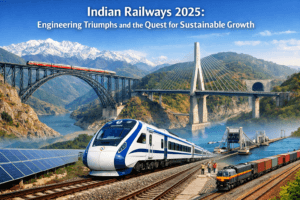
Indian Railways 2025: Engineering Triumphs and the Quest for Sustainable Growth
The year 2025 stands as a pivotal chapter in the 170-year story of Indian Railways. It was a year defined by historic breakthroughs in some of the world’s most challenging terrain, significant strides in modernization, and sobering reminders of the immense operational challenges that accompany a network of this scale. As the nation’s primary circulatory system, the railways’ evolution reflects India’s broader ambitions—connecting its final frontiers, boosting economic logistics, and navigating the complex balance between expansion, safety, and financial health.
This analysis delves beyond the headlines of inauguration ceremonies to explore the multifaceted narrative of Indian Railways in 2025: a story of steel and concrete conquering geography, of technology striving to keep pace with demand, and of an institution grappling with its dual identity as both a public service and a commercial enterprise.
Bridging the Final Frontiers: A Tale of Two Connections
The most symbolic achievements of 2025 were the rail links to two regions long isolated by geography and history.
The Kashmir Valley: A Century-Old Dream Realized In June 2025, Prime Minister Narendra Modi inaugurated the final section of the Udhampur-Srinagar-Baramulla Rail Link (USBRL), ending the Kashmir Valley’s century-long wait for a train connection to the Indian plains. More than just a transportation project, this 272-km line is an engineering marvel built at an estimated cost of ₹44,000 crore (approx. $5.3 billion). It traverses the seismically active and young Himalayan ranges, requiring solutions of extraordinary scale:
- The Chenab Bridge: Now the world’s highest railway arch bridge, soaring 359 meters above the riverbed—higher than the Eiffel Tower. Engineered to withstand extreme winds and seismic activity, it is built to last 120 years.
- The Anji Khad Bridge: India’s first cable-stayed railway bridge, showcasing advanced domestic engineering expertise.
- T-50 Tunnel: At 12.77 km, it became India’s longest operational transportation tunnel, piercing through the Pir Panjal range.
The strategic and economic implications are profound. The link provides all-weather connectivity, replacing a road journey prone to blockades, and halves travel time between Jammu and Srinagar to about three hours. It facilitates the movement of goods, tourists, and troops, strengthening integration with the rest of the country.
Mizoram: Overcoming the Eastern Wall Months later, in September, the Bairabi–Sairang line brought the capital city of Aizawl onto the national rail map for the first time. Mizoram’s rugged, mountainous terrain and landlocked location had made it perpetually dependent on road networks. This connection makes Aizawl the fourth northeastern capital with rail access, following Guwahati, Agartala, and Itanagar. It is a critical step in the larger project of economically and socially integrating the Northeast, where over 1,679 km of new tracks have been laid since 2014.
Key Infrastructure Milestones of 2025
| Project | Location | Significance | Key Feature |
| Udhampur-Srinagar-Baramulla Link (USBRL) | Jammu & Kashmir | First all-weather rail link to Kashmir Valley. | World’s highest rail arch bridge over Chenab (359m). |
| Bairabi–Sairang Line | Mizoram | First-ever rail connectivity to Aizawl. | Connects a remote northeastern capital, overcoming difficult terrain. |
| New Pamban Bridge | Tamil Nadu | Replaced a 110-year-old bridge. | India’s first vertical-lift railway sea bridge; enhances pilgrimage and tourism to Rameswaram. |
| Dedicated Freight Corridors (DFC) | Northern & Western India | High-capacity, freight-only network. | 2,843 km total length; 96.4% commissioned by year-end, running ~403 freight trains daily. |
| Mumbai-Ahmedabad High-Speed Rail | Gujarat-Maharashtra | India’s first bullet train project. | 55.6% physical progress; aims to revolutionize inter-city travel post-2029. |
The Dual Engine: Passenger Modernization and Freight Ambition
Alongside these geographic leaps, 2025 saw a concerted push to modernize the core passenger experience and turbocharge freight operations, the network’s financial backbone.
A Diverse Fleet for a Diverse Nation Indian Railways expanded its service portfolio to cater to different segments of its billion-plus users:
- Vande Bharat Express: The flagship semi-high-speed service network expanded to 164 trains by December 2025, with 15 new introductions during the year. The much-anticipated Vande Bharat Sleeper variant is set to transform overnight long-distance travel.
- Amrit Bharat Trains: Targeting affordability, 13 new non-AC Amrit Bharat trains were introduced, taking the total to 30. These trains focus on improved comfort for general passengers with features like better seats and toilets.
- Namo Bharat Rapid Rail: Two new regional services (Bhuj–Ahmedabad and Jaynagar–Patna) were launched, designed for high-frequency commutes on shorter, high-demand corridors.
The Freight Imperative Freight contributes nearly 65% of Indian Railways’ total earnings. The operationalization of the Eastern and Western Dedicated Freight Corridors (DFCs) is a game-changer. By diverting heavy goods traffic to these separate lines, congestion on the main passenger network eases, and freight efficiency soars. However, structural challenges persist. The system remains heavily reliant on bulk commodities like coal (nearly 50% of loading) and iron ore. The Standing Committee on Railways has warned that this lack of diversification into higher-value goods like automobiles, FMCG, and e-commerce exposes revenues to sectoral volatility. Despite being the world’s second-largest freight carrier, railways’ modal share in India’s total freight transport remains around 27%, significantly lower than road transport. Bridging this gap is essential for both revenue growth and environmental sustainability.
Persistent Challenges: Safety, Crowds, and Financial Tracks
For all its achievements, 2025 was also a year of stark reminders of the system’s vulnerabilities.
The Shadow of Tragedy The year began with a devastating stampede at New Delhi Railway Station on February 15, which resulted in 18 deaths and 15 injuries during a rush for Mahakumbh-bound trains. This tragedy triggered a nationwide introspection on crowd management. In response, Railways announced a project to create permanent holding areas at 60 high-passenger stations, starting with pilots in New Delhi, Anand Vihar, Varanasi, and others. These areas are designed to contain crowds outside the main station until trains arrive at platforms. The incident highlighted a critical gap: while stations have design manuals accounting for capacity, real-time management during festivals often falls short. Experts argue for better integration of disaster management plans with local District Disaster Management Authorities and the use of AI for real-time crowd monitoring.
The Safety-Technology Gap While the advanced anti-collision system Kavach 4.0 was deployed on an additional 738 route kilometers, its coverage remains limited to a few high-density corridors. The slow rollout of this critical safety technology, alongside occasional derailments and signaling issues, points to the monumental challenge of retrofitting safety across a 68,000 km network.
The Financial Balancing Act Ambitious expansion and modernization come at a high cost. While exact figures for 2025 are not detailed in the search results, the Standing Committee has historically flagged concerns about high revenue expenditure and low earnings per route kilometer, affecting long-term financial health. The railways must finance its future while keeping passenger fares politically sensitive—a tightrope walk that necessitates maximizing freight efficiency and exploring new revenue streams.
The Green Advantage and the Road to 2030
Amidst these challenges, Indian Railways holds a powerful card: its green advantage. It is one of India’s most environmentally friendly transport modes, accounting for only about 1% of transport emissions while moving millions. This position is strengthened by a near-100% electrified broad-gauge network (surpassing China, Russia, and the UK), over 2,626 solar-powered stations, and trials of hydrogen-powered trains.
Looking ahead, the targets are staggering: 3 billion tonnes of annual freight loading and 10 billion passengers by 2030, up from 1.6 billion tonnes and nearly 7 billion passengers in FY25. Achieving these goals will depend on the successful execution of corridor-based development, complete integration of DFCs, and a sustained focus on safety and passenger experience.
Recommendations for a Sustainable Trajectory
- Accelerate Safety Tech Deployment: Prioritize and fast-track the nationwide rollout of the Kavach system, potentially through public-private partnerships, to build an irreversible safety culture.
- Diversify the Freight Basket: Actively develop policies and infrastructure (like specialized wagons and handling facilities) to attract automobiles, perishables, and retail logistics, reducing over-dependence on coal.
- Institutionalize Crowd Science: Move beyond temporary measures. Integrate permanent crowd management infrastructure, predictive analytics, and specialized training for staff at all major hubs, learning from global best practices in managing mass gatherings.
- Monetize the Green Leadership: Leverage the near-complete electrification and solar capacity to brand Indian Railways as the backbone of India’s low-carbon logistics, attracting environmentally conscious partners and premium freight.
Conclusion
The narrative of Indian Railways in 2025 is not a simple one of triumph or shortfall. It is the story of an organization attempting a multidimensional transformation at a breathtaking pace. It is building monuments of engineering for national integration while racing to install basic safety systems on old networks. It is championing green mobility while figuring out how to pay for it all.
The completion of the lines to Kashmir and Mizoram proves that the railways can conquer the hardest physical frontiers. The true test of the coming years will be whether it can conquer its internal frontiers of operational efficiency, financial sustainability, and unwavering safety to truly become the future-ready network that a modern India requires. The tracks to the future are laid; the journey ahead will be defined by how smoothly the train runs on them.
You must be logged in to post a comment.