
Indian Army Pioneers 3D Glaucoma Surgery: A New Dawn in the Fight Against Irreversible Blindness
In a major leap forward for ophthalmic care in India, the Indian Army’s medical corps has successfully performed the country’s first 3D Flex Aqueous Angiography with iStent implantation at the Army Hospital (Research & Referral) in Delhi Cantt. This pioneering glaucoma procedure, led by Brigadier Dr. Sanjay Mishra, combines advanced real-time 3D imaging to map the eye’s fluid drainage pathways with the precise placement of a microscopic iStent to improve outflow and reduce pressure. The technology enables a highly targeted, minimally invasive intervention for glaucoma—a leading cause of irreversible blindness often diagnosed too late. Following this success, the Armed Forces Medical Services will deploy the same system at Command Hospital Lucknow, significantly expanding access to this precise treatment for military personnel, veterans, and civilians across northern India and Nepal, marking a transformative step in preserving vision through precision surgery.
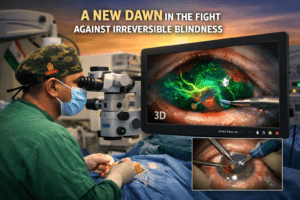
Indian Army Pioneers 3D Glaucoma Surgery: A New Dawn in the Fight Against Irreversible Blindness
In a landmark achievement that bridges cutting-edge medical technology with compassionate patient care, the Indian Army has etched its name in the annals of India’s medical history. At the Army Hospital (Research & Referral) in Delhi Cantt, a team of military ophthalmologists has successfully performed the nation’s first 3D Flex Aqueous Angiography with iStent implantation, a revolutionary procedure for glaucoma. This isn’t just another medical milestone; it’s a transformative leap in diagnosing and treating a disease that silently steals sight from millions of Indians. By marrying real-time, three-dimensional imaging with a microscopic stent, the Army Medical Corps has redefined precision in ophthalmic surgery, offering a beacon of hope in the relentless battle against one of the leading causes of irreversible blindness.
Understanding the Silent Thief: Why Glaucoma is a National Health Priority
To grasp the magnitude of this breakthrough, one must first understand the adversary. Glaucoma is often termed the “silent thief of sight.” It is a group of eye conditions that damage the optic nerve, typically due to a buildup of intraocular pressure (IOP) from the eye’s natural fluid—the aqueous humour—not draining properly. The insidious nature of glaucoma lies in its symptomless progression in early stages; peripheral vision fades gradually, often going unnoticed until significant, irreversible damage has occurred. By the time symptoms appear, the vision loss is permanent.
In India, the burden is staggering. The disease is a primary cause of irreversible blindness, affecting an estimated 12 million people, with a worrying number diagnosed at advanced stages. The conventional management paradigm has long been one of containment—using pressure-lowering eye drops, laser therapies, or traditional surgeries like Trabeculectomy. These methods, while valuable, often come with limitations: lifelong medication adherence, variable success rates, and potential complications. The Army’s new procedure addresses the very root of the problem with unprecedented precision.
Deconstructing the Breakthrough: 3D Angiography Meets Micro-Stent Technology
The pioneering surgery, led by Brigadier Dr. Sanjay Mishra, Head of Ophthalmology, represents a paradigm shift from guesswork to guided precision. The procedure is a two-part innovation:
- 3D Flex Aqueous Angiography: The Real-Time Map This is the diagnostic cornerstone. Traditionally, assessing the eye’s drainage channels (the trabecular meshwork) was somewhat indirect. The newly introduced movable Spectralis imaging system, paired with a 3D operating microscope, changes the game. During surgery, a safe fluorescent dye is introduced into the eye. The advanced system then provides surgeons with a high-definition, zoomed-in, real-time 3D video map of how the aqueous humour flows (or fails to flow) through these microscopic channels. It’s like getting a live, colour-coded GPS of the eye’s internal plumbing, vividly highlighting areas of blockage or resistance.
- The iStent: Microscopic Engineering for Macro Impact Once the precise location of the blockage is identified, the second component comes into play: the iStent. This device is among the smallest medical implants ever used in humans, smaller than the tip of a pen. It is a titanium, snorkel-like stent that is surgically placed into the main drainage canal (Schlemm’s canal) under the guidance of the 3D map. By creating a permanent bypass, it restores the eye’s natural fluid outflow, thereby reducing intraocular pressure at its source.
The synergy of these technologies is what makes it revolutionary. Surgeons are no longer operating on a standard model of the eye; they are operating on a specific, visually mapped eye of that individual patient. This allows for highly targeted, minimally invasive intervention, optimizing the stent’s placement for maximum efficacy.
The Human and Strategic Impact: Beyond the Operating Theatre
The implications of this success extend far beyond a single surgery.
For the Patient: The benefits are profound. The minimally invasive nature of the procedure promises faster recovery, less postoperative discomfort, and a significant reduction in the dependence on glaucoma eye drops. Most importantly, by enabling earlier, more precise intervention, it aims to halt disease progression decisively, preserving a patient’s vision and quality of life for decades. For glaucoma patients in the armed forces, whose roles demand optimal visual performance, this is particularly crucial.
For Indian Healthcare: The Indian Army has often been a vanguard in adopting specialized medical tech for its personnel, which eventually percolates to civilian practice. By mastering this procedure, the Army Hospital (R&R) has established a gold-standard protocol for advanced glaucoma care in the country. It sets a new benchmark for precision ophthalmology, pushing the entire medical community towards more targeted and effective treatments.
Strategic Expansion: Recognizing its potential, the Armed Forces Medical Services (AFMS) has already announced the procurement of the same advanced system for the Command Hospital in Lucknow. This is a strategic move with massive reach. Catering to nearly 3.5 lakh patients across six states and Nepal, this expansion will democratize access to this world-class treatment for a vast population of serving personnel, veterans, and their families in Northern India. It establishes a dual-node centre of excellence for glaucoma management within the military health system.
Important Insights for Aspirants and Readers
For students and competitive exam aspirants, this news is a rich repository of converging themes: Science & Technology, Defence, and Healthcare.
- First in India: The procedure underscores India’s growing capability in adopting and mastering niche medical technologies.
- Role of Indian Army: It highlights the often-overlooked role of the Armed Forces Medical Services in pioneering civilian-applicable medical advancements, showcasing a dimension of the Army beyond defence.
- Tech-Me-Medicine: The integration of 3D imaging, angiography, and micro-device implantation is a classic case of interdisciplinary innovation driving healthcare outcomes.
- Public Health: It addresses a critical non-communicable disease (NCD) burden, aligning with national health goals to reduce preventable blindness.
The Road Ahead: Challenges and Cautious Optimism
While this is a moment for celebration, the journey ahead involves challenges. The high cost of such advanced technology and the need for specialized surgical training are barriers to widespread, pan-India adoption in the immediate future. The procedure may initially be accessible only at tertiary care centres. However, the Army’s successful implementation serves as a powerful proof-of-concept. It provides the necessary data and clinical experience that can guide policy, encourage further research, and potentially lead to indigenous innovations that make such technology more affordable.
In conclusion, the Indian Army’s successful execution of India’s first 3D Flex Aqueous Angiography with iStent is more than a surgical feat. It is a testament to the relentless pursuit of excellence that defines our armed forces. It represents a shift from reactive treatment to proactive, precision-based management of glaucoma. As this technology flows from Delhi Cantt to Lucknow and hopefully to more centres in the future, it carries with it the promise of preserving the gift of sight for countless individuals, ensuring that the “silent thief” is met not with resignation, but with a formidable, technologically empowered defence. This is not just an advancement in ophthalmic care; it is a reaffirmation of the commitment to safeguarding vision, and with it, the independence and dignity of every patient.
You must be logged in to post a comment.