
India Weather Update: North India Feels the Early Summer Heat as Rains Lash the South on 23 February 2026
On February 23, 2026, India is experiencing a sharp meteorological divide, with the northern plains—including Delhi, Punjab, and Rajasthan—baking in an unseasonal early summer heat as temperatures soar 3 to 5 degrees above normal due to clear skies and the subtropical jet stream blocking cold air, while the southern and eastern states like Odisha and Kerala face thunderstorms and rainfall from a low-pressure system over the Bay of Bengal. Simultaneously, the Himalayan regions of Himachal Pradesh and Uttarakhand are bracing for isolated snowfall, highlighting a day of extreme contrasts that has prompted the IMD to issue advisories ranging from heat preparedness in the north to thunderstorm warnings in the south.
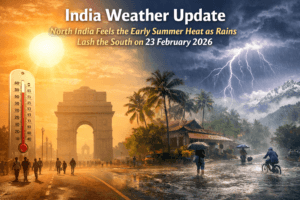
India Weather Update: North India Feels the Early Summer Heat as Rains Lash the South on 23 February 2026
As February 2026 draws to a close, the Indian subcontinent is presenting a classic case of meteorological contrasts. While the northern plains are experiencing an unseasonal and intense warm-up, skipping the gentle transition of spring, the southern peninsula and eastern states remain under the influence of active weather systems bringing rain and thunderstorms. According to the latest bulletin from the India Meteorological Department (IMD), February 23 is shaping up to be a day of two halves: a hot, dry north and a wet, stormy south and east .
This detailed report breaks down the forecast for major cities, explains the science behind the early heat, and offers practical advice for residents navigating these fluctuating conditions.
The Big Picture: A Tale of Two Indias
The primary weather story on February 23 is the sharp divide between the northern and southern regions.
- North India’s “Early Summer”: The northern plains, including Punjab, Haryana, Delhi-NCR, Rajasthan, and Uttar Pradesh, are under the grip of a rising temperature trend. With clear skies, arid ground conditions, and the influence of the subtropical westerly jet stream preventing the intrusion of cold northern winds, maximum temperatures are soaring 3 to 5 degrees Celsius above normal . This has led to what experts are calling a “missing spring,” with daytime conditions feeling like mid-April rather than late February . For residents, this means swapping woollens for light cottons much earlier than usual.
- Rain and Snow in Specific Zones: In contrast, a well-marked low-pressure area persisting over the Southwest Bay of Bengal is pulling in moisture, leading to significant weather activity in the south and east . Scattered rainfall, accompanied by thunderstorms and gusty winds, is forecast for Kerala, Coastal Andhra Pradesh, and parts of Odisha. Meanwhile, the higher reaches of the Western Himalayas, particularly in Himachal Pradesh and Uttarakhand, are likely to receive isolated snowfall due to a feeble trough affecting the region .
City-Wise Forecast for 23 February 2026
Here is a detailed breakdown of what to expect in major metropolitan areas and key states today, based on IMD data .
| City/Region | Min / Max Temp | Forecast & Conditions | Sunrise & Sunset |
| Delhi-NCR | 15°C / 31°C | Mainly clear sky with morning mist. Northwest winds around 10 kmph will make the afternoon sun feel sharp. A clear sign of early summer heat . | Sunrise: 06:36 AM Sunset: 06:03 PM |
| Mumbai | 25°C / 28°C | Stable and mild weather with partly cloudy skies. Gentle winds around 7 kmph. Coastal areas may feel slightly humid but comfortable . | Sunrise: 07:02 AM Sunset: 06:41 PM |
| Chennai | 22°C / 34°C | Warm and humid with partly cloudy skies. Afternoon sea breezes may offer some relief from the heat . | Sunrise: 06:01 AM Sunset: 06:09 PM |
| Bengaluru | 20°C / 31°C | Dry and clear skies. Temperatures are slightly above normal for this time of year, signaling the end of the pleasant winter weather . | Sunrise: 06:16 AM Sunset: 06:27 PM |
| Kolkata | 19°C / 31°C | Partly cloudy sky. The city remains on the fringe of the eastern disturbance, but conditions are expected to remain dry. | Data not specified |
| Ahmedabad | 22°C / 34°C | Hot and sunny day. Afternoon wind speeds may reach up to 7 kmph, providing minimal respite from the bright sunshine . | Sunrise: 07:06 AM Sunset: 06:39 PM |
| Jaipur | 16°C / 29°C | Clear skies and rising daytime temperatures. Conditions are warm and dry, typical of the early heat wave building in Rajasthan . | Sunrise: 06:57 AM Sunset: 06:23 PM |
| Lucknow (UP) | 15°C / 29°C | Dry skies with rising temperatures. Isolated pockets, especially near rivers, may experience morning fog . | Sunrise: 06:36 AM Sunset: 06:03 PM |
| Srinagar (J&K) | -20°C / -4°C | Frigid but slowly warming. Light snow or isolated rainfall is possible in the higher altitudes. Mornings remain bitterly cold . | Sunrise: 07:02 AM Sunset: 06:15 PM |
Regional Weather Breakdown
- The Hot North: Delhi, Punjab, Rajasthan, and UP
The story in North India is one of a steady and significant temperature climb. The IMD has noted that the lack of active western disturbances affecting the plains has allowed the sun to heat the ground directly. In Delhi, the maximum temperature is expected to settle at 31°C, a value more typical of early April . Similar conditions prevail in Punjab’s Ludhiana and Amritsar, where the maximum will hover around 30°C.
Key Takeaway for Northerners: The morning mist might briefly disguise the day’s character, but by noon, the heat will be unmistakable. It is advisable to stay hydrated and limit direct sun exposure during peak afternoon hours .
- The Wet South and East: Odisha, Kerala, and Bengal
The low-pressure system over the Bay of Bengal is the main driver of weather in these regions. On February 23, its influence will be felt strongly.
- Odisha: The IMD has issued a yellow warning for several districts, including Malkangiri, Koraput, and Balasore. Isolated places are very likely to experience thunderstorms accompanied by lightning and gusty winds reaching speeds of 30-40 kmph .
- Kerala & Mahe: Scattered to fairly widespread light or moderate rainfall is on the cards, continuing the wet spell brought on by the southerly flow from the Bay system .
- The Snowy Mountains: Himachal Pradesh and Uttarakhand
While the plains bake, the mountains will see a dusting of fresh snow. An upper air cyclonic circulation over Uttarakhand and a trough running from Kashmir to Ladakh will cause isolated rainfall and snowfall in the higher reaches . This is crucial for maintaining glacier health and water reserves, even as the plains below swelter.
Why is it so Hot? The Science Behind the “Missing Spring”
The warmth being felt across North India isn’t just a casual fluctuation; it’s a pattern observed with increasing frequency. Here’s why February 23 feels more like a summer day :
- Clear Skies and Arid Land: With no rain or clouds to block solar radiation, the sun’s energy is directly heating the ground. The dry land heats up quickly and transfers that warmth to the lower atmosphere.
- The Jet Stream Factor: The position of the subtropical westerly jet stream is currently preventing cold air masses from descending from the Himalayas into the plains. This acts like a lid, trapping the heat and keeping night-time temperatures (minimums) also above normal .
- Climate Trend: This early heat is consistent with the broader trend of rising global temperatures. Experts note that 2025 was one of the hottest years on record, and the first half of February 2026 has shown temperatures 3-5°C above normal in many cities, raising concerns that 2026 could be even hotter .
Practical Advice: Navigating February 23
Given the extreme variations in weather, here is some state-specific advice for residents and travelers:
- For Delhi/NCR, Rajasthan, and Gujarat:
- Health: Carry water bottles when stepping out. Avoid strenuous activity between 12 PM and 3 PM.
- Travel: Morning commutes might be slightly hazy, but roads will be clear by mid-morning.
- For Odisha and Kerala:
- Safety: The IMD’s yellow warning should be heeded . Seek shelter during thunderstorms and avoid being under open skies or tall trees due to the risk of lightning and gusty winds.
- Travel: Check for flight and local train delays, as sudden squalls can disrupt schedules.
- For Jammu & Kashmir, Himachal Pradesh:
- Travel: If heading to higher altitudes, be prepared for slippery roads and snow closures. Check local highway authority updates before traveling .
- For Punjab and Uttar Pradesh:
- Commute: Be cautious while driving in the early morning. Dense fog in isolated pockets can reduce visibility drastically .
Conclusion
The weather on February 23, 2026, serves as a powerful reminder of India’s diverse climatic personality. From the snow-dusted peaks of the north to the rain-lashed coasts of the south and the summer-like heat of the western plains, the country is experiencing a dynamic day of weather.
As the IMD forecasts suggest, this trend is likely to continue, with northern and central India expected to see a gradual rise in temperatures over the coming week, while southern India remains on alert for thunderstorms . Whether it’s preparing for an early summer or bracing for a thunderstorm, staying informed through official IMD channels is the best way to navigate the conditions.
You must be logged in to post a comment.