
India Weather Today (25 March 2026): Summer Intensifies Across Plains While Kashmir Freezes at -7°C – A State-by-State Breakdown
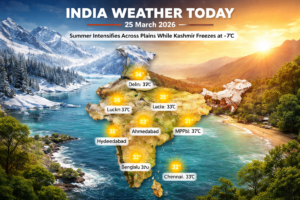
On March 25, 2026, India experiences a stark meteorological divide: while the Himalayan regions, especially Srinagar, remain locked in winter with a bone-chilling -7°C to 4°C range and frost conditions, the northern plains and central India witness an early summer surge, with Ahmedabad touching 37°C, Hyderabad reaching 36°C, and Uttar Pradesh bracing for 40°C later in the week. Delhi-NCR sees warm conditions (21°C to 34°C) with temperatures set to climb further, while Mumbai and Chennai contend with humid, stable coastal weather. Bengaluru offers a pleasant respite with its mild 19°C–32°C range. The day’s broader trend signals an accelerated seasonal shift—summer is arriving early across much of the country, urging residents to adopt heat-safety measures, while Kashmir awaits a gradual thaw in the coming days.
India Weather Today (25 March 2026): Summer Intensifies Across Plains While Kashmir Freezes at -7°C – A State-by-State Breakdown
If you stepped outside in Delhi this morning expecting the gentle warmth of early spring, the heat that greeted you likely told a different story. March 25, 2026, marks a distinct turning point in India’s weather narrative—the season of transition is rapidly giving way to the first real whispers of summer, and in some parts of the country, those whispers are already sounding like full-throated declarations.
Across the subcontinent today, a fascinating meteorological divide is playing out. While the northern plains begin to swelter under temperatures pushing past 35°C, the Himalayan regions remain locked in winter’s embrace, with Srinagar recording a bone-chilling -7°C at dawn. This 42-degree temperature gap between the Kashmir Valley and the heat-building plains of central India tells the story of a country caught between seasons—and for residents from Ahmedabad to Amritsar, it signals that the time to prepare for the long, harsh summer is now.
The Big Picture: A Country Divided by Temperature
What makes March 25 particularly noteworthy is not just the individual city forecasts but the broader pattern emerging across the meteorological data. After a relatively mild February that offered extended winter comfort across much of North India, the final week of March is accelerating the seasonal shift with notable intensity.
Temperatures in Hyderabad are projected to touch 36°C today, with forecasts suggesting a climb to 39°C within days. Ahmedabad is already baking at 37°C. Delhi, while registering a relatively moderate 34°C today, is expected to cross the 36°C threshold shortly. For residents of Uttar Pradesh, the warning signs are even more pronounced—the state is staring at the possibility of 40°C temperatures before this week concludes.
This early heat build-up is significant for several reasons. First, it compresses the traditional spring window, giving farmers, outdoor workers, and city planners less time to adjust. Second, it raises immediate concerns about water availability, power grid strain, and heat-related health risks—particularly for vulnerable populations like the elderly, young children, and those working in unshaded environments.
Delhi-NCR: The Summer Threshold Arrives
Temperature Range: 21°C to 34°C
For the roughly 30 million residents of the National Capital Region, today feels like the first genuine summer day of the season. The morning started with a relatively comfortable 21°C—cool enough for a pleasant walk or morning chai—but by midday, the mercury is expected to climb steadily to 34°C.
What makes today’s forecast particularly telling is what it represents: a preview. Meteorological models indicate that Delhi’s temperatures will continue their upward trajectory, potentially reaching 36°C within the next 72 hours. This is roughly 2-3 degrees above the typical range for late March, suggesting that this year’s summer may arrive earlier and with more intensity than the seasonal average.
Wind speeds around 5.57 km/h will provide occasional relief, but residents should not mistake these breezes for cooling trends. The wind pattern today is more about air movement than temperature moderation, doing little to offset the building heat.
For Delhiites, practical considerations come into focus: midday outdoor activities should be minimized, hydration needs to become intentional rather than reactive, and those with respiratory conditions should note that while temperatures rise, air quality concerns remain a parallel challenge in the capital.
Mumbai and Coastal Regions: Humidity Takes Center Stage
Mumbai: 28°C to 31°C
Mumbai’s weather today presents a study in coastal consistency. With a minimum of 28°C and a maximum of 31°C, the temperature spread is narrow—just three degrees separate the city’s coolest and warmest moments. This is the signature of maritime influence: the Arabian Sea acts as a thermal regulator, absorbing heat during the day and releasing it slowly at night.
What the temperature numbers don’t fully capture is the humidity factor. Mumbai residents know that 31°C with coastal humidity feels substantially more oppressive than 35°C in a dry climate like Delhi’s. Today’s humidity levels are expected to intensify during afternoon hours, creating that characteristic “heavy air” feeling that defines Mumbai summers.
Moderate winds at 8.67 km/h—the strongest among major metros today—will offer some circulation, but they won’t eliminate the sticky discomfort that accompanies coastal weather. For those commuting or working outdoors, the practical advice remains consistent: light cotton clothing, regular hydration, and awareness that even moderate temperatures can be deceptive when humidity is factored in.
Chennai: 26°C to 33°C
Further down the eastern coast, Chennai mirrors Mumbai’s maritime pattern but with its own regional character. The city’s temperature range of 26°C to 33°C reflects the Bay of Bengal’s moderating influence, but the humidity story here is equally significant.
Chennai’s weather today carries the distinct signature of coastal Tamil Nadu—warm mornings that transition into humid afternoons, with the sun setting early (6:18 PM) given the city’s geographical position. For residents, the key concern will be the afternoon discomfort window, typically between 1 PM and 4 PM, when humidity peaks and perceived temperatures often exceed actual readings by several degrees.
The Heat Builders: Hyderabad and Ahmedabad
Hyderabad: 25°C to 36°C
If there’s a city that exemplifies the early summer intensification today, it’s Hyderabad. With a projected maximum of 36°C and forecasts suggesting a climb to 39°C in the coming days, the city is entering serious summer territory earlier than many residents might expect.
The 11-degree gap between minimum and maximum temperatures (25°C to 36°C) tells an important story: dry conditions and clear skies allow for significant daytime heating followed by substantial nighttime cooling. This diurnal temperature variation is characteristic of Hyderabad’s semi-arid climate, but the absolute values—particularly the upper end—are notable for March.
For Hyderabad residents, this means mornings remain pleasant enough for outdoor activities, but by noon, the conditions shift decisively toward summer heat management mode. The city’s famous biryani spots might see adjusted lunchtime crowds as people seek air-conditioned comfort during peak heat hours.
Ahmedabad: 25°C to 37°C
Ahmedabad’s weather today delivers an unambiguous message: summer has arrived in Gujarat. At 37°C, the city ties with the hottest spots in the country today, and dry winds during afternoon hours will add to the heat stress rather than alleviating it.
What makes Ahmedabad’s situation noteworthy is the combination of high temperatures and the urban heat island effect. As a rapidly growing metropolis with extensive paved surfaces and dense construction, the city’s core areas often register temperatures several degrees higher than the official readings. Residents in central Ahmedabad should anticipate conditions that feel substantially warmer than the forecast suggests.
The sunset timing of 6:51 PM—among the latest today—means that evening relief will come later than in many other cities, extending the period of heat exposure for outdoor workers and evening commuters.
The Himalayan Cold Pocket: Kashmir’s Winter Grip
Srinagar: -7°C to 4°C
While the rest of India discusses summer preparedness, the Kashmir Valley remains firmly in winter’s grasp. Srinagar’s minimum temperature of -7°C today represents not just cold but extreme cold—the kind that transforms morning routines, dictates clothing choices, and shapes daily life in fundamental ways.
The maximum temperature of 4°C means that even at the warmest point of the day, Srinagar is colder than the minimum temperatures in most Indian cities. This 11-degree gap between the valley’s highest and the national capital’s lowest highlights the remarkable climatic diversity within India’s borders.
Snowfall chances remain low today, but frost conditions are virtually guaranteed during early morning hours. For residents, this means cars need de-icing, pipes require insulation precautions, and the simple act of stepping outside demands multiple layers.
The forecast offers a glimmer of gradual change: over the next seven days, temperatures may slowly rise toward 10°C, suggesting the eventual transition toward spring. But for now, Kashmir remains in a climatic world apart from the rest of the country.
North Indian Plains: The Warm-Up Accelerates
Punjab: 17°C to 30°C
Punjab’s weather today occupies an interesting middle ground—pleasant by summer standards but unmistakably warming. The 17°C minimum offers cool, comfortable mornings that farmers and early risers have long appreciated, while the 30°C maximum signals that the state is on the cusp of transition.
The forecast suggests temperatures may rise to 34°C soon, which has significant implications for Punjab’s agricultural economy. Wheat harvest timelines, irrigation schedules, and labor planning all respond to temperature patterns, and an early heat build-up can accelerate crop maturation in ways that require careful management.
Uttar Pradesh: 21°C to 35°C
Uttar Pradesh presents a more advanced warming pattern, with temperatures already reaching 35°C and projections indicating a possible 40°C later this week. The state’s vast geographical spread—from the Himalayan foothills to the Gangetic plains—means conditions vary considerably, but the overall trend is unmistakably toward summer intensification.
For Lucknow and other major UP cities, today’s weather offers a preview of the heat management strategies that will define the coming months. Early morning remains the optimal window for outdoor activities, and the relatively early sunset (6:19 PM) provides some evening relief.
Karnataka and the South: The Pleasant Exception
Bengaluru: 19°C to 32°C
Among all major urban centers, Bengaluru stands out as the pleasant exception today. With a minimum of 19°C and a maximum of 32°C, the city offers what many would consider ideal March weather—cool mornings, warm afternoons, and comfortable evenings.
This is Bengaluru’s famous climate advantage in action. The city’s elevation (approximately 900 meters above sea level) moderates temperatures in ways that coastal cities and inland plains cannot match. While afternoon heat increases, evenings remain comfortable enough for outdoor dining, evening walks, and the city’s famed pub culture to continue without the oppressive heat that characterizes other metros.
The Karnataka forecast reflects this pleasant middle ground across much of the state, though coastal areas like Mangaluru will experience higher humidity and a different comfort profile.
Sunrise and Sunset: Understanding the Daylight Factor
Today’s sunrise and sunset timings across major cities offer more than just poetic markers of the day’s rhythm—they have practical implications for everything from energy consumption to outdoor activity planning.
The shortest daylight period today belongs to Chennai (6:10 AM to 6:18 PM, roughly 12 hours 8 minutes), while Mumbai enjoys the longest day (6:39 AM to 6:50 PM, approximately 12 hours 11 minutes). This slight variation reflects India’s geographical spread and has implications for solar energy generation, outdoor work schedules, and even traffic patterns during evening commutes.
For residents in western cities like Ahmedabad and Mumbai, the later sunset times (6:51 PM and 6:50 PM respectively) mean that the hottest part of the day extends further into the evening, while eastern cities like Lucknow and Chennai see earlier sunsets that provide quicker evening relief.
Air Quality: The Unspoken Concern
While temperature dominates today’s weather narrative, the article’s mention of “air quality concerns persisting in major metros” deserves elaboration. For residents of Delhi-NCR, Mumbai, and other urban centers, the weather experience isn’t just about temperature—it’s about the air they breathe.
Delhi’s air quality in late March typically hovers between moderate and poor categories, with dust becoming an increasing concern as construction activity picks up and soil dries out. For vulnerable populations—children, the elderly, and those with respiratory conditions—this adds another layer of consideration to daily outdoor activities.
Mumbai’s coastal location offers some natural ventilation advantage, but localized air quality issues persist, particularly in areas with heavy traffic or industrial activity.
Looking Ahead: What the Next Week Brings
The forecast for the coming week suggests several important trends:
- Continued warming across northern and central India, with multiple cities likely crossing 40°C before March concludes
- Gradual improvement in Kashmir, with temperatures potentially reaching 10°C within a week
- Persistent humidity along both coasts, creating uncomfortable conditions even when absolute temperatures remain moderate
- Increasing dust activity in western and northern regions as soil moisture declines and winds pick up
For residents across India, the message is clear: the transition season is ending, and summer preparedness should begin now. Hydration, sun protection, and heat-aware scheduling will become increasingly important in the weeks ahead.
Practical Takeaways for Residents
For Delhi-NCR residents: Midday outdoor activities should be minimized. Consider shifting exercise and errands to morning or evening hours. Stay hydrated with water and electrolytes.
For Mumbai and Chennai residents: Focus on managing humidity. Light cotton clothing, frequent hydration, and awareness of heat stress symptoms are essential.
For Hyderabad and Ahmedabad residents: Prepare for rapidly intensifying heat. If your home lacks air conditioning, ensure proper cross-ventilation and consider cooling strategies like wet curtains or reflective window coverings.
For Srinagar residents: Continue winter precautions. Frost conditions require vehicle care, pipe insulation, and appropriate clothing. The thaw will come, but not yet.
For Bengaluru residents: Enjoy your climate advantage, but remain aware that afternoon heat still requires basic precautions. Don’t let the pleasant reputation lead to complacency about sun exposure and hydration.
Conclusion: A Nation in Seasonal Transition
March 25, 2026, captures India in a moment of meteorological transition—a country where some regions are already deep in summer’s embrace while others still shiver through winter mornings. From Srinagar’s -7°C to Ahmedabad’s 37°C, the 44-degree temperature spread across the country tells the story of India’s extraordinary climatic diversity.
For those in the warming regions, today serves as an early warning: this summer is arriving with intensity, and preparation should begin now. For those in the cold pockets, patience remains the watchword—the warmth will eventually arrive, but not before several more cold mornings.
As the sun sets today across the subcontinent—at 6:51 PM in Ahmedabad, 6:40 PM in Srinagar, 6:34 PM in Delhi—each city will have experienced its own version of March 25. But regardless of location, the underlying pattern is the same: India is moving, inexorably and noticeably, toward the summer that will define the coming months. How we prepare for that transition will determine how well we navigate the heat that lies ahead.
You must be logged in to post a comment.