
India Navigates Regional Turmoil and Strategic Partnerships: A Deep Dive into This Week’s Diplomatic Moves
India’s foreign policy this week demonstrates a calculated, multi-track approach to navigating complex global pressures: it prioritizes citizen safety in a volatile Iran through advisories while strategically engaging the U.S. to preserve its connectivity interests in the Chabahar port project under a conditional sanctions waiver. Simultaneously, it deepens future-oriented partnerships with Japan on AI and critical minerals, actively pursues trade negotiations with the U.S., and maintains pragmatic engagement with regional actors like Afghanistan and Bangladesh. Across all fronts, India’s actions reflect a consistent principle of strategic autonomy—balancing immediate threats, long-term investments, and geopolitical diplomacy without aligning exclusively with any single power bloc.
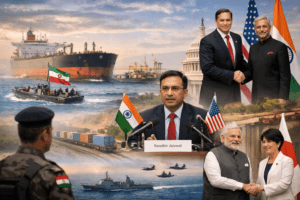
India Navigates Regional Turmoil and Strategic Partnerships: A Deep Dive into This Week’s Diplomatic Moves
In a week marked by escalating tensions in West Asia and crucial strategic dialogues, India’s External Affairs Ministry outlined a careful, multifaceted foreign policy approach, balancing citizen safety, geopolitical partnerships, and long-term strategic investments. The official weekly briefing, led by Spokesperson Shri Randhir Jaiswal, provided critical insights into India’s stance on Iran, its evolving partnerships with Japan and the United States, and its navigation of complex regional dynamics.
The Iranian Tightrope: Citizen Safety and Strategic Patience
The situation in Iran remains a primary concern, with approximately 9,000 Indian nationals—primarily students, seafarers, pilgrims, and professionals—currently in the country. In response to recent instability, India has issued advisories urging its citizens to avoid travel to Iran and for those already there to consider departing via commercial flights, which remain operational. This calibrated response indicates a policy of proactive caution rather than immediate large-scale evacuation.
“We are closely watching the unfolding situation,” stated Jaiswal, emphasizing that the government is “fully committed” to taking all necessary steps for citizen welfare should the need arise. This posture reflects a nuanced understanding: while the threat perception is serious enough to warrant advisories, the existence of functional commercial avenues allows for a measured, individual-driven response, reserving government-led evacuation for a more acute crisis.
A poignant sub-plot is the case of the 16 Indian crew members of the tanker ‘Valiant Roar’, seized by Iranian Revolutionary Guards in December 2025. The government confirmed it is actively seeking consular access and is in continuous contact with Iranian authorities regarding the crew’s welfare. This incident underscores the tangible risks to Indian citizens in the region, extending beyond general political instability to the frontline of regional conflicts.
The Chabahar Conundrum: Between Geopolitics and Connectivity
Perhaps the most significant clarification came regarding the strategic Chabahar port project in Iran. Recent reports of an Indian exit were addressed head-on. Jaiswal clarified that India is operating under a conditional sanctions waiver granted by the U.S. Treasury Department on October 28, 2025, valid until April 26, 2026.
“We remain engaged with the U.S. side in working out this arrangement,” he stated, neither confirming nor denying reports of an eventual wind-down. This reveals a delicate diplomatic dance. Chabahar is India’s key infrastructure gateway to Afghanistan and Central Asia, bypassing Pakistan. However, escalating U.S. sanctions pressure on Iran, including a new 25% tariff on business with Iran announced by the Trump administration, creates immense complexity.
The context is stark: India-Iran bilateral trade has dwindled to about $1.6 billion annually, a mere 0.15% of India’s global trade. This diminishing economic cushion makes the strategic and political cost of maintaining the project under U.S. scrutiny even more pronounced. India’s statement is a holding pattern, affirming engagement while the ultimate fate of its involvement hangs in the balance of U.S.-Iran relations and Washington’s willingness to grant a permanent waiver.
The Japan Partnership: Elevating Tech and Security Ties
In contrast, the India-Japan relationship showcased forward momentum with the 18th Strategic Dialogue. The visit of Japanese Foreign Minister Yoko Kamikawa highlighted a partnership moving beyond traditional areas into defining future technologies.
A key outcome was the formal launch of an Artificial Intelligence (AI) Dialogue, an initiative born from the 2025 Annual Summit. This positions AI not just as a tech collaboration but as a pillar of strategic cooperation. Furthermore, both sides decided to convene a joint working group on critical minerals under their economic security initiative, targeting supply chain resilience for rare earths and minerals essential for everything from electronics to defense.
Defense cooperation was explicitly acknowledged as a discussed and “important element,” with several projects under consideration. While specifics on awaited deals like the export of US-2 amphibious aircraft were not detailed, the public emphasis signals intent to deepen military interoperability. The upcoming 75th anniversary of diplomatic relations in 2027 offers a timeline for concretizing these ambitions.
U.S. Engagements: Trade Talks and High-Level Contact
On the Washington front, the first conversation between External Affairs Minister S. Jaishankar and new U.S. Secretary of State Marco Rubio on January 13th set a broad agenda. Talks covered trade, critical minerals, defense, civil nuclear cooperation, and energy. The readout suggests a continuity of engagement despite the U.S. administration change.
Trade remains a central, complex pillar. Jaiswal noted that trade teams are “engaged with the objective of arriving at a mutually beneficial bilateral trade agreement.” This comes amid a significant 50% increase in India’s purchases of American crude oil last fiscal year—a leverage point that may feature in ongoing negotiations for tariff relief and a broader deal. The Ambassador in Washington’s frequent meetings with U.S. lawmakers, as highlighted in the briefing, underscore a sustained lobbying and diplomatic effort to steer this crucial relationship.
Regional Diplomacy: Afghanistan, Bangladesh, and Non-Aligned Exercises
Other updates painted a picture of India’s active regional calibration:
- Afghanistan: The diplomatic exchange has been formalized with the new Afghan Charge d’Affaires (CDA) taking charge in New Delhi on January 9th. Discussions continue on establishing a dedicated freight corridor to boost trade in pharmaceuticals, fruits, and essential commodities, indicating a pragmatic, needs-based engagement with the Taliban administration.
- Bangladesh: Responding to queries about contact with the Jamaat-e-Islami, the Spokesperson framed it within the routine engagement with various Bangladeshi interlocutors, stating interactions should be viewed in that “context.” This careful phrasing maintains diplomatic neutrality regarding Bangladesh’s internal politics.
- BRICS Exercise: India’s notable absence from a BRICS naval exercise hosted by South Africa in the Indian Ocean was acknowledged. While reasons weren’t specified, it hints at India’s selective participation in multilateral military drills, possibly due to the involvement of actors like China and Iran amid ongoing bilateral tensions or strategic calculations.
The Unspoken Calculus: Sovereign Choices in a Multipolar World
The briefing, in totality, revealed India’s foreign policy operating on multiple tracks simultaneously. It is:
- Reactive & Protective: Prioritizing citizen safety in conflict zones like Iran through advisories and consular activism.
- Strategically Patient: Holding its position on Chabahar while negotiating with a powerful ally (the U.S.), unwilling to unilaterally abandon a long-term regional connectivity asset.
- Ambitiously Collaborative: Deepening a technology and security-centric partnership with Japan to build future-ready capabilities.
- Pragmatically Engaged: Maintaining working relations with challenging regimes (Afghanistan) and complex neighbors (Bangladesh) based on immediate practical and economic interests.
The through-line is a steadfast commitment to strategic autonomy, now expressed as the ability to manage conflicting pressures without compromising core interests. From the simmering crisis in Iran to the AI labs with Japan and the trade talks with the U.S., India is demonstrating a foreign policy that is both nimble and principled, constantly calculating its path in an increasingly multipolar and turbulent world. The coming weeks will test this balance, especially as the deadlines on Iran waivers approach and regional tensions continue to evolve.
You must be logged in to post a comment.