
India Joins US-Led Pax Silica Alliance to Break China’s Rare Earth Grip
India formally joined the US-led Pax Silica strategic alliance on February 20, 2026, a move designed to secure resilient supply chains for critical minerals and artificial intelligence while reducing its heavy reliance on China, which currently dominates rare earth processing. The declaration, signed at the India AI Impact Summit in New Delhi, positions India as a crucial node in the coalition due to its engineering talent, untapped mineral reserves, and growing semiconductor ecosystem, with Minister Ashwini Vaishnaw emphasizing that the partnership will benefit India’s electronics industry and youth. The initiative aims to create a trusted alternative to the current China-dominated supply chain for the entire technology lifecycle—from mineral extraction to AI development—and comes as India and the US finalize an interim trade deal, signaling a deepening of bilateral ties built on strategic trust and shared technological ambitions.
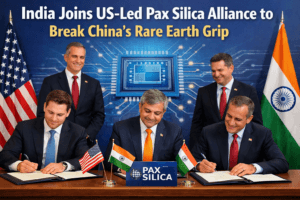
India Joins US-Led Pax Silica Alliance to Break China’s Rare Earth Grip
On February 20, 2026, on the margins of the India AI Impact Summit in New Delhi, a compact was signed that signals a significant realignment of the global technology landscape. India formally joined the Pax Silica declaration, a US-led strategic coalition, marking its entry into an exclusive group of nations committed to securing the future of artificial intelligence and semiconductors . The event, attended by Union Minister Ashwini Vaishnaw, US Ambassador Eric Garcetti, and US Under Secretary of State Jacob Helberg, was more than a diplomatic formality; it was a declaration of intent in an era where economic security is increasingly indistinguishable from national security .
For the casual observer, the term “Pax Silica” might sound like a relic of a bygone empire, but its modern implications are profound. As the world pivots from an economy powered by oil and steel to one driven by silicon and bits, this alliance represents a collective bid to shape the rules, supply chains, and standards of the 21st century. This article delves into the nuances of the declaration, exploring why India’s participation is deemed “strategic and essential,” and what it truly means for the future of technology, geopolitics, and the global balance of power.
Deconstructing Pax Silica: More Than Just a Treaty
To understand the weight of the declaration, one must first dissect its nomenclature. “Pax,” the Latin word for peace, evokes historical periods of stability enforced by a dominant power, such as the Pax Romana or Pax Britannica. “Silica” points to the foundational material of the digital age—silicon, the lifeblood of computer chips . Launched in December 2025, Pax Silica is envisioned as a strategic coalition of trusted nations dedicated to securing the “silicon stack” . This stack represents the entire vertical chain of the technology lifecycle: from the mining and processing of critical minerals, through semiconductor fabrication, to the development of software platforms and frontier AI models .
The core philosophy of the alliance is a rejection of “weaponised dependency.” In his address at the signing ceremony, Jacob Helberg drew a powerful historical parallel, invoking Alexander the Great’s encounter with India. “It was in India that he finally met his match and turned back… Both our nations were forged by that very word. Both claimed their freedom by learning to say no… So today, as we sign the Pax Silica Declaration, we say no to weaponised dependency, and we say no to blackmail” .
This rhetoric underscores the alliance’s primary objective: to create a trusted, resilient alternative to the current global ecosystem, which is heavily dominated by a single player—China. By securing the supply chain from the ground up, Pax Silica aims to prevent the kind of disruptions that have plagued industries from automobiles to electronics in recent years, ensuring that the transformative power of AI is developed and governed by open, democratic societies .
Why India? The “Strategic and Essential” Partner
India’s inclusion in this coalition was not a matter of diplomatic courtesy; it was a calculated move based on tangible assets. US Ambassador Eric Garcetti described India’s participation as both “strategic and essential,” citing the nation’s deep engineering talent pool, its expanding capacity in mineral processing, and the “trust factor” that underpins the US-India partnership .
- The Demographic and Talent Dividend:While much of the Western world faces aging populations and skill shortages, India remains a “young nation,” as Minister Vaishnaw repeatedly stressed. He projected that India’s growth period would extend well beyond 2047, providing decades of “compounding” benefits . This demographic dividend translates into a massive, adaptable workforce for the tech industry. Vaishnaw highlighted that the global semiconductor industry will require about one million additional skilled people, asserting, “Where will that talent come from? This will come from here” . Furthermore, Indian engineers are already designing the most advanced 2-nanometer chips, demonstrating a high level of sophistication in chip design that goes beyond mere assembly .
- The Mineral Imperative:Beyond human capital, India possesses a geological advantage. The country holds the third-largest reserves of rare earth elements (REEs) and other critical minerals in the world . These minerals—including lanthanum, neodymium, and dysprosium—are essential for everything from electric vehicle motors and wind turbines to advanced defense systems and the semiconductors that power AI .
However, possessing reserves is not the same as possessing capability. Currently, India faces a critical dependency: it imports a significant portion of its rare earth requirements, with China accounting for over 45% of these imports and dominating nearly 92% of the world’s refining capacity . This dependency was starkly highlighted in late 2025 when reports emerged that India had to assure China it would not re-export Chinese rare earth magnets to the US, underscoring the leverage Beijing holds over the supply chain . Pax Silica offers a pathway to break this cycle by facilitating partnerships with other technologically advanced nations like Japan and the US to build indigenous processing and manufacturing capabilities, aligning perfectly with India’s National Critical Mineral Mission .
The China Factor: Diversification and Strategic Autonomy
While the Pax Silica declaration does not explicitly name any nation, the “China factor” is the invisible ink in which the entire document is written. China’s stranglehold on the rare earth market is not just an economic statistic; it is a strategic vulnerability for the West and its allies. As The Hindu reported, China leverages its mining industry as a “strategic bargaining chip” in global tariff wars .
For India, this dependency is particularly acute. The country’s ambitious push into electronics manufacturing, renewable energy, and defense production is entirely contingent on a stable supply of these critical inputs. By joining Pax Silica, India is effectively hedging its bets. It is signaling a move away from an over-reliance on a single source and towards a diversified, “friend-shored” supply chain involving the US, Australia, Japan, and other partner nations .
This move also aligns with a broader US strategy to contain China’s technological ascent. The US Department of State has even announced a “concierge service” to help Pax Silica nations acquire advanced American AI semiconductors more efficiently, effectively creating a preferential lane for allies and bypassing the bureaucratic hurdles of standard exports . This transforms diplomats into business development officers for American tech, ensuring that the most advanced chips power the ecosystems of trusted partners.
The Delhi AI Summit: A Confluence of Vision and Policy
The signing of the Pax Silica declaration was the highlight of the week-long India AI Impact Summit 2026, which was themed around “People, Progress, and Planet” . Hosted in New Delhi, the summit was the first in the series to be held in the Global South, signaling India’s intent to be a voice for developing nations in the AI discourse .
The summit was a who’s who of global tech and politics, featuring leaders like France’s Emmanuel Macron, Brazil’s Lula da Silva, and tech CEOs including Google’s Sundar Pichai and OpenAI’s Sam Altman . Pichai emphasized the critical nature of the US-India partnership, stating, “We must work together to ensure the benefits of AI are available to everyone and everywhere” .
In parallel with Pax Silica, the summit also saw the announcement of the “Delhi Declaration,” a non-binding pledge signed by 75 countries outlining goals for inclusive and shared AI development . This dual-track approach—joining a focused strategic alliance like Pax Silica while championing a broader, inclusive global declaration—showcases India’s nuanced foreign policy. It seeks to deepen ties with the Quad-adjacent partners while maintaining its leadership role in the Global South.
The Economic Stakes: From Potato Chips to Computer Chips
One of the most memorable moments from the press interaction was Minister Vaishnaw’s quip: “When we say chips, some people think of potato chips. Forget it, they will keep crying… The country has a direction, a clear goal, and we have to take global leadership in the semiconductor industry and the electronics industry” . This was a pointed rebuttal to domestic critics who have long lamented India’s missed opportunities in manufacturing.
The stakes are monumental. India already has ten semiconductor plants in various stages of establishment, with the first one expected to begin commercial production soon . Joining Pax Silica is expected to accelerate this ecosystem. It provides a framework for collaboration that de-risks investment. When the CEO of Micron, Sanjay Mehrotra, endorses the initiative, stating it will “bring the technology collaboration closer between the US and India,” it signals confidence to global investors that India is a stable, reliable destination for high-tech manufacturing .
This is about capturing value at every level of the stack. For decades, India participated in the tech boom only at the services and software level. Pax Silica offers a seat at the table where the hardware—the actual physical infrastructure of the AI revolution—is being built. From refining minerals to fabricating wafers and designing algorithms, India is positioning itself to capture a slice of the “historic opportunity and demand” that the AI age promises .
A Partnership Cemented by Trust
The signing of the Pax Silica declaration occurs against the backdrop of a reset in India-US relations. Following a period of strain, the two nations are on the cusp of finalizing a trade deal. Ambassador Garcetti confirmed that while the interim deal is essentially done, “a few tweaking points” remain, with the signing expected “sooner than later” .
This economic rapprochement is built on a foundation of strategic trust. The US views India as an indispensable partner in maintaining a free and open Indo-Pacific. India views the US as a critical enabler of its technological ambitions and its vision of becoming a developed nation (Viksit Bharat) by 2047. The “Transforming the Relationship Utilizing Strategic Technology” (TRUST) initiative, envisioned by the leadership of both nations, finds its most concrete expression in partnerships like Pax Silica .
Conclusion: Shaping the Future, One Wafer at a Time
India’s entry into Pax Silica is far more than a headline; it is a generational pivot. It represents a conscious choice to integrate its economic destiny with a bloc of nations committed to openness, innovation, and mutual resilience. For the Indian youth, it promises a future where they are not just consumers of technology or back-office innovators, but primary architects of the world’s most advanced systems.
The path ahead is fraught with challenges. Building a semiconductor ecosystem from scratch is a capital-intensive, long-gestation endeavor. Breaking China’s decades-long head start in rare earth processing will require immense investment in research and infrastructure. Furthermore, India must navigate its historical non-alignment and its deep economic ties with all global powers without getting ensnared in great-power rivalries.
However, the message from New Delhi is one of confidence. As Minister Vaishnaw put it, “We are not just holding a summit here; we are building the future” . By joining Pax Silica, India has laid a cornerstone for that future—one where the silicon that powers the world is sourced, processed, and assembled in a network of trust, with India serving as a critical node. The declaration of “no” to weaponised dependency is, ultimately, a declaration of “yes” to a future of strategic autonomy and technological leadership.
You must be logged in to post a comment.