
India Considers Social Media Ban for Children Under 16, Following Australia’s Lead
Indian states like Goa and Andhra Pradesh are studying Australia’s model to potentially ban social media for children under 16, driven by concerns over online safety and mental health. However, this state-level push faces significant legal and practical hurdles, as internet governance falls under federal authority, requiring central government support for a cohesive national policy. The move contrasts with India’s existing Digital Personal Data Protection Act, which focuses on regulating data processing with parental consent rather than imposing blanket access bans. Enforcement poses a major challenge, mirroring Australia’s struggles with age verification and the risk of pushing youth to unregulated platforms, while global tech companies resist, arguing such bans could undermine safety features and parental autonomy in a critical growth market.
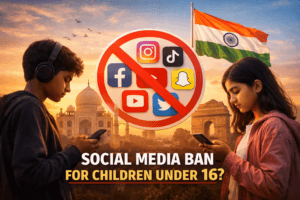
India Considers Social Media Ban for Children Under 16, Following Australia’s Lead
India, with its billion-plus internet users and a deeply youthful demographic, is poised to become the world’s next major battleground over children’s digital lives. Following in the footsteps of Australia’s pioneering law, the Indian states of Goa and Andhra Pradesh are actively exploring legislation to ban social media access for children under the age of 16. This move, sparked by growing global anxiety over online safety and youth mental health, could reshape digital experiences for millions of young Indians and force a reckoning for global tech giants in one of their most critical growth markets.
A State-Level Push for a National Debate
The regulatory momentum is building not from India’s federal capital, but from its states. In early 2026, Goa’s Information Technology Minister, Rohan Khaunte, announced that his department was studying Australia’s legislative “papers” to potentially “implement a similar ban”. This sentiment was echoed by Nara Lokesh, the IT and Education Minister for Andhra Pradesh, who stated the need for a “strong legal enactment” and has convened a panel of ministers to study the legal and practical feasibility of such restrictions.
This state-level activism has been bolstered by India’s judiciary. In December 2025, the Madras High Court urged the federal government to consider Australia-style curbs, highlighting that concerns over children’s online safety are driving debate across all branches of government.
However, experts caution that states may have limited authority to act unilaterally. Kazim Rizvi of the think tank The Dialogue notes that internet governance in India falls under federal law, meaning states cannot amend key national statutes like the Information Technology Act. Aprajita Rana, a partner at AZB & Partners, warns that a patchwork of state laws could push children toward unmonitored online spaces, potentially undermining the safety goals of such a policy. The likely path forward for states like Andhra Pradesh is to seek support from the central government—an outcome that remains uncertain.
The Australian Blueprint: A “Delay,” Not a Ban
The model inspiring Indian lawmakers is Australia’s Online Safety Amendment (Social Media Minimum Age) Act 2024, which took effect in December 2025. Officially framed as a “delay” to having accounts, the law requires social media platforms to take “reasonable steps” to prevent Australians under 16 from creating or maintaining accounts.
The law carries hefty penalties for non-compliant companies—fines of up to A$49.5 million—but imposes no penalties on children or their parents for attempting to access platforms. The initial list of “age-restricted” platforms includes Facebook, Instagram, Snapchat, TikTok, X (formerly Twitter), YouTube, and others, though the list is designed to be updated as services evolve.
The rollout has already exposed significant enforcement challenges. In late 2025, Meta began notifying Australian teenagers that their accounts would be shut down, a process that has led to the removal of over half a million accounts it believed belonged to under-16s. This highlights the core difficulty: accurately determining a user’s age when they may not be truthful at sign-up.
India’s Existing Framework: The DPDP Act vs. a Proposed Ban
India is not starting from a regulatory blank slate. The Digital Personal Data Protection Act (DPDP Act) 2023 already establishes specific, robust protections for children’s data. This creates a fascinating policy contrast: the proposed social media ban represents a blunt, access-based restriction, while the DPDP Act takes a more nuanced, rights-based approach to data processing.
The table below outlines the key differences between the existing law and the proposed ban:
| Aspect | India’s Digital Personal Data Protection Act (2023) | Proposed Australia-Style Social Media Ban |
| Core Philosophy | Regulates how children’s data is processed, emphasizing consent and limiting harm. | Restricts access to entire platforms based solely on age. |
| Primary Tool | Verifiable Parental Consent required before processing a child’s data. | Age-Gating & Account Removal to prevent under-16s from having accounts. |
| Key Obligations | Prohibits tracking, behavioral monitoring, and targeted advertising directed at children. | Places obligation on platforms to take “reasonable steps” to exclude underage users. |
| Flexibility | Considers child’s maturity and “best interests”; allows for exempted services like educational platforms. | Blanket restriction for all children under 16 on designated platforms. |
| Enforcement Focus | On data fiduciaries (companies) for improper processing of data. | On platforms for failing to prevent underage access. |
A critical point of tension is age verification. The DPDP Act’s draft rules detail mechanisms for obtaining “verifiable parental consent,” which can involve checking existing reliable details or using government-issued digital tokens. This is the same technological and privacy challenge at the heart of enforcing an Australian-style ban: how to verify age or parental authority without collecting excessive sensitive data or creating new surveillance risks.
The Global Ripple Effect and Industry Resistance
India’s consideration is part of a global regulatory wave. Governments in Denmark, France, Spain, Indonesia, and Malaysia are all studying similar age-based restrictions, closely watching Australia’s experiment. An Indian ban, however, would be unprecedented in scale, affecting the user and advertising strategies of companies like Meta, Google, and X in a market of over one billion internet users.
The industry’s response has been one of cautious resistance. A Meta spokesperson stated that while the company shares the goal of safe online experiences, it believes parents—not governments—should decide which apps their teenagers use. Meta warns that blunt bans could push teens toward “less safe, unregulated sites” that bypass the protective features built into platforms like Instagram’s Teen Accounts. At the same time, Meta is complying with the Australian law, integrating third-party age verification technology and removing hundreds of thousands of accounts.
Looking Ahead: A Complex Road to Implementation
The path to any social media ban in India is fraught with complexity:
- Constitutional and Federal Hurdles: The most immediate barrier is legal. Experts agree that a coherent national approach would require federal action. States may spark the debate, but central legislation would be needed for uniform implementation.
- The Enforcement Quagmire: Australia’s experience shows that enforcement is messy. Can platforms develop accurate, privacy-preserving age assurance? Will bans simply encourage the use of VPNs or migration to non-listed platforms?
- Balancing Protection and Rights: A key criticism is that outright bans are a draconian measure that may overlook the internet’s positive role in education, social connection, and self-expression for teens. It also raises questions about children’s evolving capacities and rights in the digital world.
- The Alternative Path: Rather than a ban, India could choose to strengthen and fully implement the DPDP Act’s child protections—enhancing parental consent tools, strictly enforcing prohibitions on tracking and targeting, and promoting digital literacy—to create a safer online environment without outright denial of access.
India stands at a digital crossroads. The drive to protect children from online harms is powerful and justified, evidenced by the tragic stories that have fueled reforms in Australia and elsewhere. However, translating this protective impulse into effective, rights-respecting law in the world’s most populous democracy is a challenge of unparalleled scale. The decisions made in the halls of Indian state capitals and in New Delhi will not only determine the online lives of a generation of Indian youth but also set a pivotal precedent for the global internet.
You must be logged in to post a comment.