
India at the Crossroads in West Asia: Why the Iran War Demands More Than Just Tactical Shifts
The article argues that the large-scale US-Israeli preemptive war on Iran represents a fundamental geopolitical shift that forces India to move beyond its standard, cautious diplomatic responses and undertake a deep recalibration of its foreign policy. It contends that India’s vital strategic interests—including energy security, the Chabahar Port project, access to Central Asia, and the safety of its diaspora—are inextricably linked to the stability and sovereignty of Iran, a nation that has historically supported India. By offering only a “vapid” statement calling for restraint instead of unequivocally upholding the principles of sovereignty and justice, India risks tacitly endorsing a “might is right” world order that ultimately threatens its own interests. The piece concludes that a meaningful recalibration requires active, principled diplomacy that champions de-escalation and humanitarian access, recognizing that defending core values like sovereignty is not a contradiction to national interest, but the very foundation of long-term strategic wisdom.
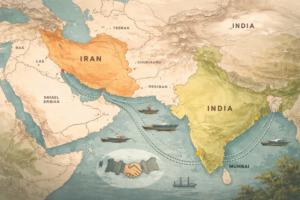
India at the Crossroads in West Asia: Why the Iran War Demands More Than Just Tactical Shifts
The drums of war in West Asia have a different timbre this time. They are not merely the sound of another skirmish in a region marred by perennial conflict. As the world grapples with the reality of a large-scale, preemptive war on Iran—dubbed Operation Epic Fury by the US and Roaring Lion by Israel—the reverberations are tectonic. The reported assassination of Supreme Leader Ayatollah Ali Khamenei and the bombing of 131 Iranian cities signal a paradigm shift, not just for the region, but for the very architecture of global power.
For India, a nation with millennia-old civilizational links to the Persian Gulf and immense contemporary stakes in its stability, this is not a distant spectacle. It is a direct hit on its strategic underbelly. The Indian Express article by Salman Khurshid and Pushparaj Deshpande rightly calls for a “recalibration” of Indian foreign policy. But the call for recalibration goes deeper than a mere tactical adjustment. It demands a philosophical reckoning: can a nation’s national interest be truly secure when it is divorced from its core values of sovereignty, justice, and peaceful coexistence?
The Geopolitical Earthquake and India’s Shifting Sand
To understand India’s predicament, one must first grasp the sheer scale of the rupture. The conflict is framed by its architects as a necessary strike to remove “existential threats” and redraw the regional balance of power. As the original piece highlights, the roots lie in strategic documents like Project 2025, which envision a world where American dominance is unchallenged. By crippling Iran, the axis aims to free up bandwidth for the Indo-Pacific, disrupt China’s energy calculus, and reinforce the petro-dollar’s waning hegemony.
This is where the world’s tectonic plates grind against India’s foundational foreign policy principles.
For decades, India has mastered the art of strategic autonomy, or what practitioners call “multi-alignment.” It has painstakingly cultivated relationships with all actors in West Asia: Israel, Iran, Saudi Arabia, the UAE, and Turkey. This wasn’t duplicity; it was a survival strategy for an energy-hungry, diaspora-dependent economy. We built pipelines with Iran while co-developing missiles and sharing intelligence with Israel. We welcomed Israeli investment and Iranian support in international forums with equal pragmatism.
The current war has shattered the delicate vessel of this policy. The “but” that once connected these relationships has been replaced by a “versus.” India is being forced, implicitly, to choose a side in a conflict where its partners are on opposite ends of the gun.
The High Cost of Abstention
In the aftermath of the initial strikes, India’s diplomatic response, as characterized by External Affairs Minister S. Jaishankar’s parliamentary statement, was notably cautious—some would say vapid. It called for restraint and dialogue, a standard template for crises. But a standard template is insufficient for an extraordinary crisis.
The problem with vapid diplomacy in a moment of historical rupture is that it is read not as neutrality, but as acquiescence to the fait accompli created by military action. When massive sovereign violence is unleashed, and a major power’s statement fails to name the transgressor or uphold the principle of sovereignty unequivocally, it signals a preference for the emerging order over the principles of the old one.
India’s silence on the assassination of a foreign head of state, or the bombing of a sovereign capital during Ramzan, risks being interpreted as a tacit endorsement of the “might is right” doctrine. This is a dangerous slope for a nation whose own rise is predicated on a rules-based international order.
The Iran Factor: A Legacy of Trust Undermined
One of the most poignant arguments made by Khurshid and Deshpande is that while India’s strategic partnership with Israel enjoys bipartisan support, the nation must also “recognise that Iran consistently supported India.”
This is not mere sentimentality; it is a ledger of strategic debt. Iran was one of the few countries that openly supported India’s position on Kashmir at the Organization of Islamic Cooperation (OIC) when many others were hostile. During the 1999 Kargil War, Iran leaned in India’s favour. More than that, Iran provides India something no other nation in West Asia can: unhindered, overland access to Central Asia and Afghanistan, circumventing our rival, Pakistan. The Chabahar Port is not just a commercial venture; it is India’s strategic lifeline to the “Stans,” providing connectivity for trade and security.
If Iran descends into chaos or is broken up by internal strife following the decapitation of its leadership, India doesn’t just lose an energy supplier. It loses a strategic partner that helped it balance Pakistan’s influence. Chabahar becomes a ghost port. The International North-South Transport Corridor (INSTC) loses a critical node. The strategic bandwidth that India hoped to free up for the Indo-Pacific will instead be consumed by a fire burning on its western flank.
The Values vs. Interest Fallacy
The core of the recalibration argument rests on a simple, often misunderstood premise: national interest is not at odds with core values.
For decades, realism has dominated foreign policy circles, positing that states act only in their material self-interest, and values like human rights, sovereignty, and justice are luxuries for the powerful to impose on the weak. But the war on Iran exposes the bankruptcy of this narrow view.
If India abandons its core value of advocating for the sovereignty of nations, what moral authority does it have when its own sovereignty is questioned? If it remains silent on the injustice of a “preemptive war” that kills over 1,200 people, including schoolchildren during a holy month, how does it credibly ask for justice for its own citizens in multilateral forums? Values are not a veneer; they are the girders of the international order. When those girders buckle, the building collapses on everyone, including the tenants on the top floor.
Supporting the rules-based order isn’t just “being nice”; it’s self-preservation. A world where preemptive strikes become normalized is a world where India’s own neighborhood—fraught with cross-border terrorism and revisionist powers—becomes exponentially more dangerous.
Recalibrating the Compass: A Blueprint for India
So, what does a meaningful recalibration look like? It moves beyond a sterile parliamentary statement to active, principled diplomacy.
First, public advocacy for a ceasefire and humanitarian access must be relentless. India cannot afford to have its voice muffled by bilateral trade concerns. It must use its G20 presidency legacy and its voice in the UN to demand an immediate halt to hostilities and the protection of civilians. The image of Indian nurses and engineers stranded in an active war zone is a stark reminder that our diaspora’s safety is directly tied to the region’s stability.
Second, India must engage with all parties, including the “resistance” axis. Diplomacy cannot be reserved only for victors. India must maintain open channels with whatever leadership emerges in Iran, as well as with Iraq and the Gulf states navigating this storm. We must decouple our strategic assessment from the American lens. Washington’s “terrorist” is often a key interlocutor in a region where India has vital interests.
Third, prepare for economic contingencies. The price of crude oil will inevitably spike, impacting India’s current account deficit and inflation. The government must be ready to tap into strategic petroleum reserves and diversify import sources, even as it protects the remittance economy of the 9 million Indians working in the Gulf.
Finally, reassert the principle of dialogue. India should offer its own experience as a model—the idea that massive, diverse civilizations can manage differences through conversation rather than conflict. It can quietly propose itself as a facilitator for de-escalation, not as a mediator, but as a trusted voice for the Global South that is bearing the brunt of this war’s economic fallout.
Conclusion
The war on Iran is a watershed moment. It signals the end of the post-Cold War unipolar moment and the beginning of a more brutal, transactional era of great power competition. For India, the path forward cannot be paved with ambiguity alone.
Prime Minister Modi’s government has often spoken of Vasudhaiva Kutumbakam (the world is one family) and India’s role as a Vishwa Mitra (Friend of the World). This crisis tests whether those phrases have operational weight. A true friend does not merely watch a family member’s house burn down; they rush in with water and call for help.
Recalibrating foreign policy means recognizing that in the long arc of history, nations are remembered not just for the wars they won, but for the principles they upheld. For India, standing up for the sovereignty of a nation that stood by it, and for the human rights of ordinary people caught in a geopolitical inferno, is not a choice between values and interests. It is the very definition of strategic wisdom.
You must be logged in to post a comment.